Case study:
SEO and
AI search

B2B service company · Technical SEO · Content SEO · GEO

Oct 2024 – Oct 2026 · B2B/B2C service company · specialist services

Technical SEOTopic clustersContent SEOSchema.orgGEOAnswerlyzer
6–7×
Estimated organic traffic (Ahrefs, 2 years)
422K
Google impressions in 12 months (GSC)
12% → 38.5%
Share of AI answers with the brand (YoY)

> Starting point and goal

A specialist services company working mostly with businesses and partly with consumers. At the start it had little visibility in Google and barely appeared in AI answers. The goal was not to push a few keywords but to grow the visibility of the whole domain: more valuable queries, broader topic coverage and stronger key pages. On that foundation I built the brand’s presence in ChatGPT, Gemini, Claude and AI Overviews.

  • →Steady growth of visibility in Google’s organic results.
  • →More organic traffic from queries that match the offer.
  • →Visibility growth across the whole domain, not single keywords.
  • →A stable base for the brand’s presence in AI-generated answers.

Before and after

MetricBeforeAfter
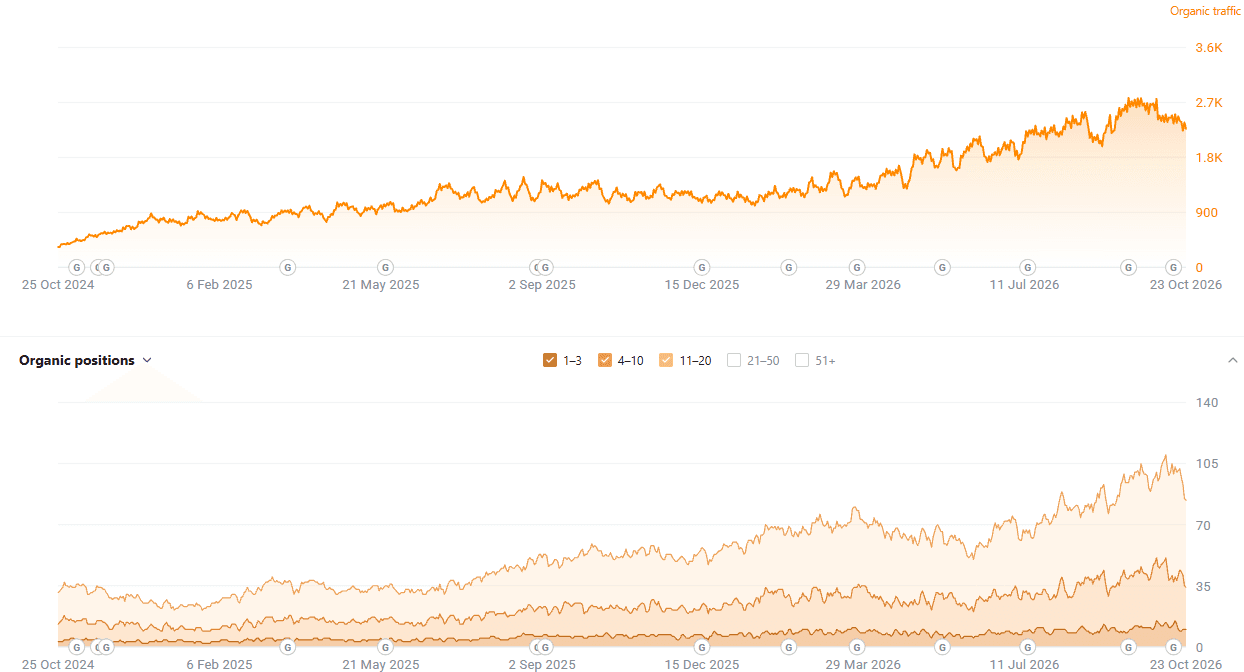
Estimated organic traffic / month (Ahrefs)approx. 300–400approx. 2,200–2,400
Keywords in TOP 3, TOP 10 and TOP 20 (Ahrefs)a few keyword groupssteady growth in every range
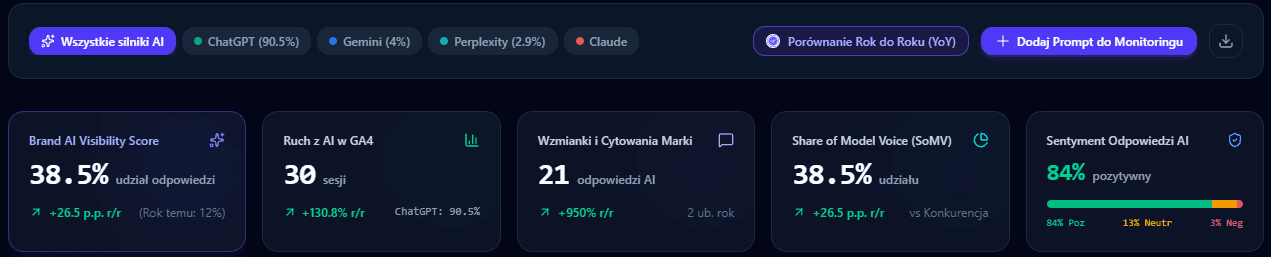
Share of AI answers with the brand (Answerlyzer)12%38.5%
AI answers with a mention or citation221
Sessions from AI tools in GA4 (YoY)–30 (+130.8%)

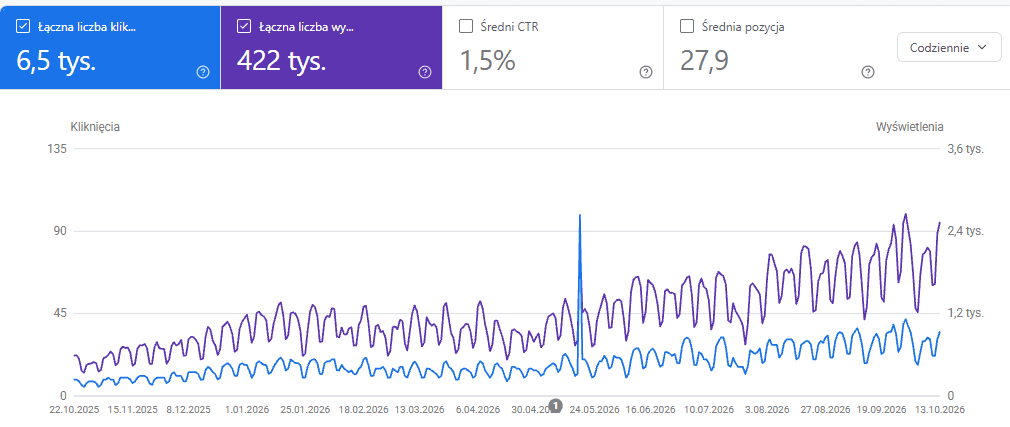
Ahrefs shows an estimate of traffic, not visits. Actual Google Search Console data for 22 Oct 2025 – 13 Oct 2026 is 6.5K clicks and 422K impressions (average CTR 1.5%, average position 27.9). Both sources point the same way: steady growth.

Project data

Google Search Console: 6.5K clicks and 422K impressions between 22 Oct 2025 and 13 Oct 2026, rising trend
Google Search Console, 22 Oct 2025 – 13 Oct 2026
Ahrefs: estimated organic traffic rising from about 350 to about 2,300 a month, plus keywords in TOP 3, TOP 10 and TOP 20, 25 Oct 2024 – 23 Oct 2026
Ahrefs: estimated traffic and positions, 25 Oct 2024 – 23 Oct 2026
Answerlyzer: 38.5% share of AI answers with the brand, 30 AI sessions in GA4, 21 answers with a mention, 84% positive sentiment
Answerlyzer: brand visibility in AI, year over year

What I did

Technical SEO

First I made sure Google could see and index what matters. Without that, new content would not pay off.

  • →Indexing and crawlability analysis.
  • →Review of URL structure, redirects and canonicals.
  • →Fixing technical errors and indexing problems.
  • →Cleaning up information architecture and page hierarchy.
  • →Internal linking analysis and rebuild.
  • →Site speed review.

Keyword strategy and site structure

Instead of a keyword list I built a topic map where each query group has one page responsible for it.

  • →Keyword potential and search intent analysis.
  • →Grouping keywords into topic clusters.
  • →Assigning topics to existing and new pages.
  • →Finding topic gaps against competitors.
  • →Expanding the service structure and supporting content.

Content SEO

I aligned content with what clients actually look for before contacting a service company.

  • →Optimising existing content for user intent.
  • →New pieces answering specific queries.
  • →Expanding expert content.
  • →Improving headings, titles and meta descriptions.
  • →Topical links between pages.
  • →Fitting content to search result features.

GEO: content and data for AI systems

Once SEO gave a stable base, I extended the strategy to the brand’s presence in AI-generated answers.

  • →Clear answers to specific user questions.
  • →Expanded expert sections, definitions and explanations.
  • →Connections between entities: the company, its services and topics.
  • →Showing sources and strengthening content credibility.
  • →Content accessibility for search and AI crawlers.
  • →Schema.org structured data: organisation, authors and services.

Measurement and growth

Every next step came from data, not from a publishing calendar.

  • →Regular visibility and ranking analysis in Search Console and SEO tools.
  • →Evaluating how each topic group performs.
  • →Brand monitoring in ChatGPT, Gemini, Claude and Google AI Overviews with my tool, Answerlyzer.
  • →Comparing AI visibility with competitors and analysing pages cited in answers.
  • →Updating the strategy based on data.

Results

6–7×
Estimated traffic (Ahrefs)

From about 300–400 to about 2,200–2,400 a month between October 2024 and October 2026.

6.5K
Clicks in 12 months (GSC)

With 422K impressions between 22 Oct 2025 and 13 Oct 2026, and a clearly rising trend in daily clicks and impressions.

38.5%
Share of AI answers with the brand

A year earlier: 12%. In a fixed set of prompts the brand now appears in more than one in three AI answers.

84%
Positive sentiment in AI

84% positive, 13% neutral and 3% negative answers. Over 90% of AI sessions in GA4 come from ChatGPT.

Takeaways

#01

Growth came from the whole domain, not a few keywords. Topic clusters and internal linking brought more queries than work on single terms.

#02

Good SEO is a precondition for GEO. AI systems with search use pages that index well and answer questions clearly.

#03

Tool estimates need checking against Search Console. I show both sources because they measure different things.

#04

AI visibility can be measured: a fixed prompt set, the same tools and a year-over-year comparison show whether the work pays off.

FAQ

How long before SEO for a service company shows results?

In this project growth was gradual: the first period built the foundation, and the biggest rise in estimated traffic came in the second year, from spring 2026. Technical fixes and indexing usually show sooner than ranking gains.

How is SEO different from GEO?

SEO grows visibility in Google’s results. GEO raises the chance that ChatGPT, Gemini, Claude or AI Overviews use your content and brand information in their answers. In practice GEO builds on SEO: without well-indexed, clear content, AI systems have nothing to draw on.

How do you measure brand visibility in AI?

With a fixed set of prompts asked regularly in the same AI tools. I track the share of answers that mention or cite the brand, sentiment and cited pages, and check AI traffic in GA4. In this project I use my own tool, Answerlyzer.

Why is Ahrefs’ estimated traffic higher than Search Console clicks?

Ahrefs estimates traffic from rankings and approximate search volumes, so it is a model, not a measurement. Search Console shows actual clicks from Google. Both help with trends, but I base business results on Search Console and GA4 data.

/// SERVICES_USED

Services behind the build

The engineering capabilities applied in this case study are available as standalone services.

/// MORE_WORK

Other case studies

/// KNOWLEDGE_BASE

Related reading

Want Google and AI to find your company?

Terminate
Silence

Initiate protocol. Establish connection. Let's build something loud.

> WAITING_FOR_INPUT...