RETURN_TO_BASE

GEO – AI Search Optimization

Generative Engine Optimization (GEO) gets your brand into AI answers — ChatGPT, Google AI Overviews and AI Mode, Gemini, Perplexity and Copilot. I make AI know your company, cite your site and recommend you.

Author: Paweł Wiszniewski · Updated:

Key takeaways

Generative Engine Optimization (GEO) gets your brand into AI answers — ChatGPT, Google AI Overviews and AI Mode, Gemini, Perplexity and Copilot. I make AI know your company, cite your site and recommend you.

  • ›AI Visibility Audit
  • ›ChatGPT SEO
  • ›Google AI Overviews & AI Mode
  • ›Entity SEO & Knowledge Graph

GEO – AI Search Optimization – how it works

GEO (Generative Engine Optimization) is optimizing your website and brand for generative search engines — systems that give a ready answer with a handful of cited sources instead of ten blue links. 2026 studies by Ahrefs and Seer Interactive show the top organic result losing roughly half or more of its clicks when an AI Overview appears, so what matters is not just ranking but being the source of the answer. GEO extends SEO rather than replacing it: I start with an AI visibility audit (how ChatGPT, Gemini and Perplexity describe your brand and who they recommend instead), then build your brand entity in the knowledge graph, restructure content into self-contained, citable passages with data and sources, optimize for AI Overviews and AI Mode, and earn mentions where models learn from. Progress is measured by AI share of voice and by traffic from ChatGPT, Perplexity and AI Mode in GA4.

› CORE_CAPABILITIES:

  • AI Visibility Audit
  • ChatGPT SEO
  • Google AI Overviews & AI Mode
  • Entity SEO & Knowledge Graph
  • Perplexity, Copilot & ChatGPT Search
  • Voice Search & AI Assistants
const geo_strategy = new AI_Optimizer();

// Injecting brand authority into LLM...
› Connecting to Gemini... OK
› Connecting to ChatGPT... OK
› Optimizing Knowledge Graph... PROCESSING

Paweł Wiszniewski · why me

What I do differently

I measure GEO rather than guess. I built AnswerLyzer, a tool that checks how ChatGPT, Gemini and Perplexity describe and recommend brands using an LLM-as-a-judge. I also have my own Content Intelligence tool for comparing content with competitors, and I'm preparing original research on Polish brands' AI visibility. That means recommendations are based on data from your category and results are shown in numbers, not generalities.

Case study: AnswerLyzer AI Analytics

Who this service is for

  • Brands whose customers ask ChatGPT, Gemini or Perplexity for recommendations.
  • Companies losing clicks to Google AI Overviews.
  • Brands that AI describes briefly, vaguely or incorrectly.
  • B2B companies, SaaS products and experts building authority in their category.
/// SYSTEM_MODULES

What's included: GEO – AI Search Optimization

/// GUIDE

GEO and AI Search Optimization – The Complete 2026 Guide

This guide pulls together what I know about GEO from working on code, content and AI answer measurement. It explains where ChatGPT, Perplexity, Copilot and Google AI Overviews get their sources, what actually improves your odds of being cited, how to measure AI visibility without fooling yourself, and what it costs. Every number comes with its publisher and year, and where the industry repeats myths, I say so plainly.

What GEO (Generative Engine Optimization) is and what it covers

GEO (Generative Engine Optimization) is the work of making answer-generating systems such as ChatGPT, Perplexity, Gemini, Copilot and Google AI Overviews and AI Mode know your brand, use your content as a source and mention you in recommendations. In practice it combines technical SEO, content written to be cited, brand entity building and presence in third-party sources.

The term was popularised by a paper from researchers at Princeton and IIT Delhi presented at KDD 2024 (Aggarwal et al.). They built GEO-bench, a set of 10,000 queries, and tested how content changes affect whether a generative engine uses a given page in its answer. The right methods raised visibility by up to around 40%. I come back to the details in the content section, because it is one of the few hard pieces of evidence in the whole field.

The same thing goes by many names: AI SEO, LLM SEO, ChatGPT SEO, AEO (Answer Engine Optimization), LLMO, AI search optimization. The naming differences are mostly marketing. The distinction that matters, and that people often blur, is this one:

  • A citation – your URL appears as a source under the answer or in a footnote. It is measurable and depends mainly on whether the system retrieved and selected your content.
  • A brand mention – the model names your company in the answer, for example in a list of recommended vendors, even without a link. That depends on what the model learned in training and found in third-party sources, not only on your site.

A good GEO plan works on both layers. On-site optimization earns citations for informational questions, but recommendation prompts like ‘which company should I hire for…’ also need signals from beyond your website.

GEO vs SEO – what stays the same and what changes

GEO is not a separate discipline cut off from SEO. Google states in its 2026 guide to optimizing for generative AI features that, from Google Search's perspective, optimizing for generative AI search is still SEO. What changes is the unit of optimization, the way you measure and the weight of third-party sources.

The foundation is identical: the site must be crawlable, indexed, fast, with content visible without JavaScript and a credible author. If you have indexing problems, no ‘AI hack’ will help, because the retrieval system simply won't find your content.

AreaClassic SEOGEO / AI search optimization
GoalA ranking position and a clickBeing the source of the answer or a brand named in the recommendation
Unit of optimizationA whole page for a keywordA passage that answers a question on its own
Query scopeHead term and variantsFull questions, conversations and sub-queries (query fan-out)
Signal sourcesContent, links, technical healthThe same plus brand mentions, entity, forums, video, rankings
Search enginesMostly GoogleGoogle's index, Bing's index, Perplexity's own index and others
MeasurementRankings, clicks, conversionsShare of answers, citations, sentiment, AI referral traffic
StabilityRelatively stable rankingsAnswers change on almost every run

The biggest practical difference is measurement. In SEO you check a ranking and know where you stand. In GEO the same prompt run twice gives different answers, so a single test proves nothing. This is a field for statistics, not screenshots.

How AI models choose the sources for their answers

An AI assistant answers in one of two ways: from knowledge stored in the model during training, or from search results retrieved at the moment the question is asked (retrieval, or RAG). For questions about current facts, prices and recommendations the second mode is increasingly common, which means you can influence the answer far faster than through training data.

Training knowledge

A model learns from a huge corpus of web text, and its knowledge stops at the training cutoff. Whether the model ‘knows’ your brand without searching depends on how often, and in what context, your brand was written about in sources that made it into training. You can't change this layer in a few weeks. You build it with mentions, a clear entity and content that others cite.

Live retrieval

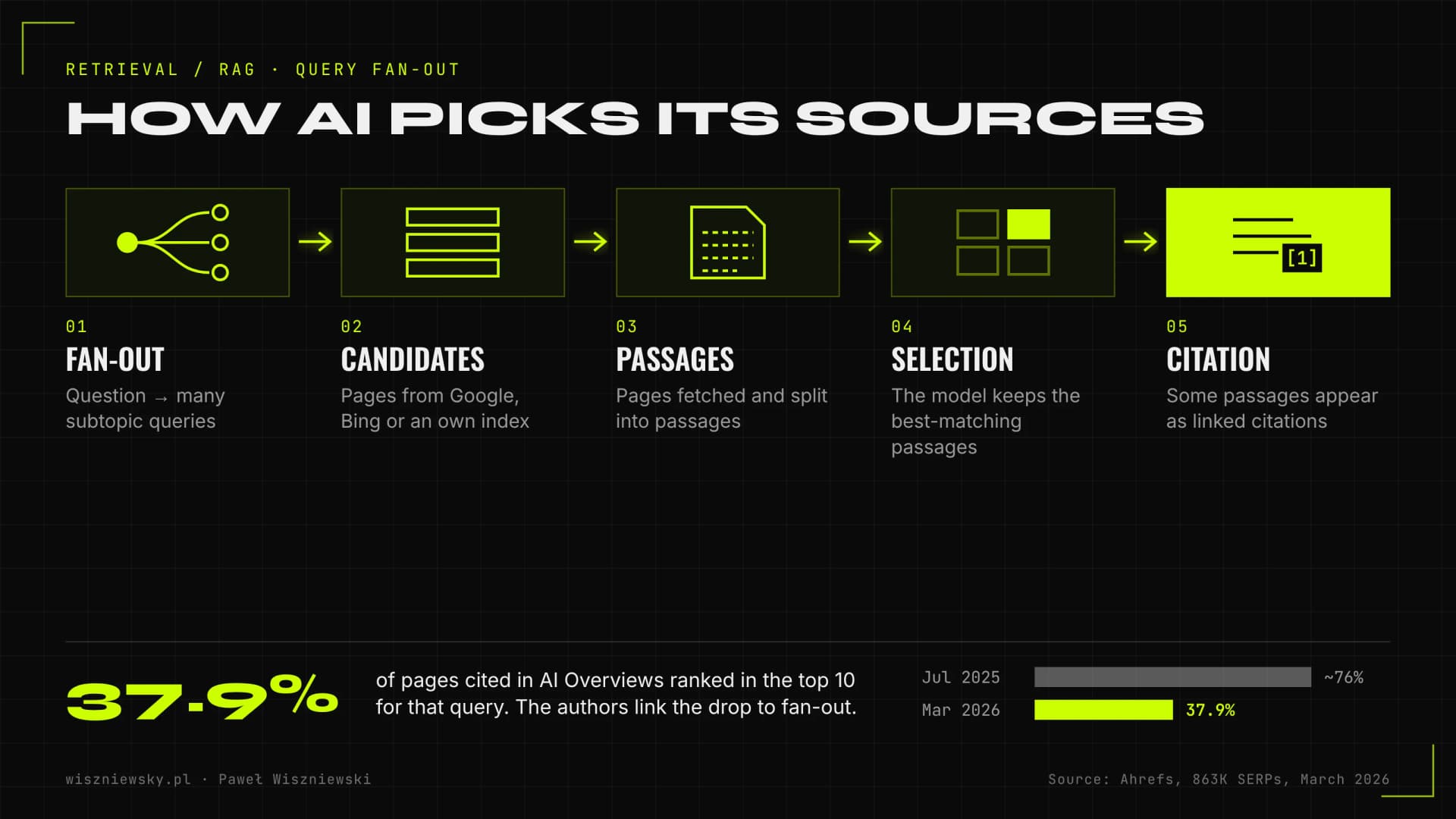
When an assistant uses search, the process looks roughly like this:

  1. The model rewrites the user's question into one or more search queries. Google calls this query fan-out: the system issues many related queries about subtopics in parallel.
  2. A search engine returns candidates from its index (Google, Bing or the company's own index).
  3. The system fetches the selected pages, or uses cached versions, and splits them into passages.
  4. The model picks the passages that best match the question and writes the answer from them.
  5. Some of the passages used are shown as linked citations.
Five stages of how AI picks sources: fan-out, index candidates, passages, selection and citation; the top-10 share of cited pages fell from ~76% to 37.9%.
From question to citation in five steps; top-10 data from the Ahrefs analysis of March 2026.

A few practical conclusions follow. First, to be cited you have to get into the candidate pool, which means being indexed by the right search engine and reachable by its crawler. Second, passages win, not pages, so a paragraph must make sense when lifted out of context. Third, fan-out means coverage of sub-questions matters, not just the head term. I explain how to find those sub-questions in my post on keyword research for query fan-out.

This isn't theory. An Ahrefs analysis from March 2026 across 863,000 keyword SERPs found that only 37.9% of pages cited in AI Overviews ranked in the organic top 10 for that query, down from roughly 76% in their July 2025 study. The authors attribute the drop to fan-out: Google cites pages that answer the sub-queries, not only the query the user typed.

ChatGPT, Perplexity and Copilot – where their results come from

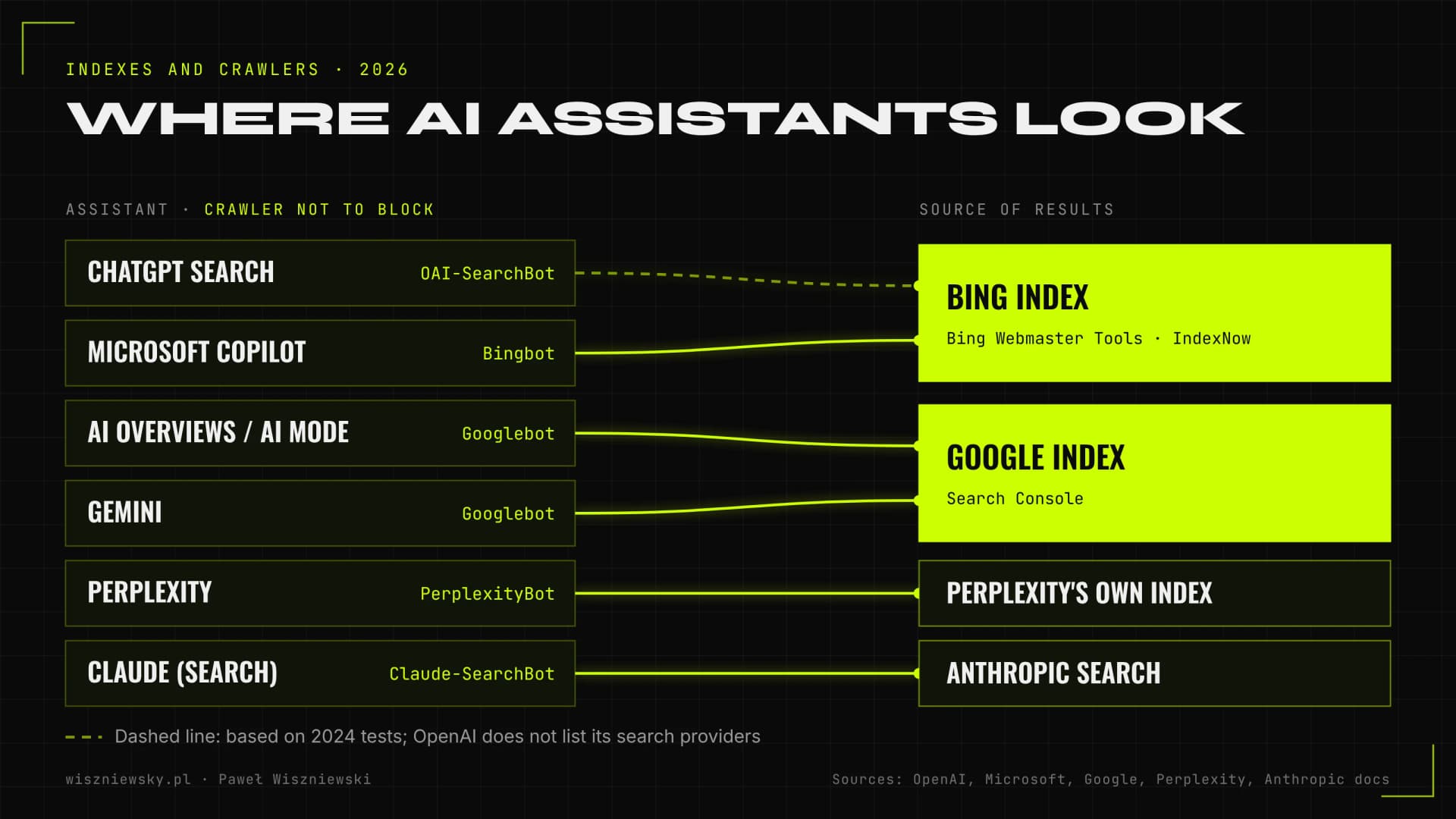
Each assistant uses a different index and different crawlers, so a site that does well in Google may be invisible to ChatGPT or Copilot. The first step in ChatGPT SEO is checking whether the search engine behind the assistant knows your site at all.

Map of AI assistant sources: ChatGPT Search and Copilot use Bing, AI Overviews and Gemini use Google, Perplexity and Claude their own search, with crawlers.
Which assistant draws on which index and which crawler not to block; the ChatGPT-Bing link comes from 2024 tests.

ChatGPT and ChatGPT Search

OpenAI's publisher FAQ says any public website can appear in ChatGPT search as long as it doesn't block the OAI-SearchBot crawler. OpenAI acknowledges using third-party search providers without naming them. Tests run after ChatGPT Search launched in 2024 (reported by Notebookcheck, among others) pointed to heavy reliance on Bing's index. That is why verifying the site in Bing Webmaster Tools and submitting changes through IndexNow is a mandatory part of my ChatGPT visibility work.

Microsoft Copilot

Copilot runs on Bing. In February 2026 Microsoft released an AI Performance report in Bing Webmaster Tools (as a public preview) showing how often pages from your domain were cited in Copilot answers, AI-generated summaries in Bing and select partner integrations, along with the grounding queries that led to those citations. It is one of the first tools in which an AI provider reports citations itself.

Perplexity

Perplexity runs its own crawler, PerplexityBot, which according to its documentation is used to surface and link websites in Perplexity results and not to train models. A separate agent, Perplexity-User, visits pages when a user asks a question and, per the documentation, generally ignores robots.txt because a person initiated the request.

Gemini, Claude and others

Gemini uses Google Search. Anthropic documents three separate bots: ClaudeBot (collecting training data), Claude-SearchBot (search result quality) and Claude-User (fetching pages at a user's request). Separating training crawlers from search crawlers is now the norm, and it directly shapes how you should configure robots.txt, as covered below.

AssistantMain source of resultsCrawler not to blockWhere to check results
ChatGPT (search)Third-party providers, Bing in testsOAI-SearchBotGA4: utm_source=chatgpt.com, prompt monitoring
Microsoft CopilotBingBingbotBing Webmaster Tools, AI Performance report
PerplexityOwn indexPerplexityBotGA4: perplexity.ai referrals, prompt monitoring
Google AI Overviews and AI ModeGoogle's indexGooglebotSearch Console (blended with web results), citation monitoring
GeminiGoogle SearchGooglebotPrompt monitoring
Claude (search)Anthropic's searchClaude-SearchBotPrompt monitoring, server logs

Preparing a site for these engines in detail, from Bing Webmaster Tools to crawler access at the firewall, is the scope of my Perplexity, Copilot and ChatGPT Search optimization service.

Google AI Overviews and AI Mode – how to get into Google's answers

AI Overviews and AI Mode draw on pages that are indexed and eligible to be shown in Google with a snippet. Google's documentation on AI features stresses that there are no additional technical requirements and no special files or markup that ‘switch on’ citation.

That is good news and bad news. Good, because you don't need to implement anything exotic. Bad, because there is no shortcut: whether your passage is picked depends on how well it fits the question and the sub-questions Google generates behind the scenes. In the March 2025 AI Mode announcement, Google described query fan-out as issuing multiple related searches concurrently across subtopics and multiple data sources.

What this means for traffic

Pew Research Center analysed 68,879 searches by 900 US adults from March 2025. An AI summary appeared in about 18% of searches, rising to 53% for queries of ten words or more. The longer and more conversational the question, the more likely the user gets an AI answer instead of a list of links. That's another reason to write for full questions, not just short keywords.

Controls and measurement

  • Limiting snippets – nosnippet, data-nosnippet and max-snippet also apply to AI features, but they limit your regular search snippets too. I rarely recommend it.
  • Google-Extended – according to Google, this token controls use of your content for training Gemini models and for grounding in some other systems; it does not affect inclusion in Google Search and is not a ranking signal. It does not opt you out of AI Overviews.
  • Search Console – traffic from AI features is counted in the Performance report together with other ‘Web’ results, with no separate filter. Citations therefore need separate monitoring.

Page-level work for AI Overviews and AI Mode, including a map of queries that trigger AI summaries and rebuilding key sections, is covered by my Google AI Overviews and AI Mode optimization service.

Brand entity and the knowledge graph – so AI knows who you are

An entity is an unambiguously identifiable thing, such as a company, person or product, with facts and relationships attached. If Google and language models can't connect your name to your industry, location and people, they describe your brand vaguely or confuse it with a similarly named company.

Entity building happens both on and off your site. On the site it means a consistent About page, Organization and Person structured data with sameAs, and consistent naming. Off the site it means a Wikidata item (where independent sources justify one), up-to-date profiles in industry databases and registries, and the same name, address and business description everywhere the brand appears.

The entity checklist I use

  • One fixed brand name and a one-sentence business description used on the site, in profiles and in bios.
  • An About page with specifics: founding year, people, location, specialisation, registration details.
  • A single entity identifier in structured data (for example a URL ending in #organization), referenced by @id rather than redefined on every page.
  • sameAs links only to profiles that exist, are current and belong to the brand.
  • A check of what the Knowledge Graph Search API returns for the brand and what AI assistants say when asked about the company directly.
  • A list of sources with wrong data to fix, prioritised by how often they show up in citations.

I did the same work for my own site, which has one author entity linked to Wikidata, LinkedIn and GitHub, and for the fashion brand described in the entity architecture case study. The full scope is described under knowledge graph engineering.

Brand mentions and third-party sources in GEO

For ‘which company do you recommend’ prompts, models lean heavily on what others say about a brand: media, rankings, comparisons, forums, reviews and video. Your own website rarely suffices, because the model looks for independent confirmation.

The data backs this up, with the caveat that these are correlations, not proof of causation. In a May 2025 study of 75,000 brands, Ahrefs measured which factors correlate most strongly with brand visibility in AI Overviews:

FactorCorrelation with AI Overview brand visibility (Ahrefs, 2025)
Branded web mentions0.664
Branded anchors0.527
Branded search volume0.392
Domain Rating0.326
Number of referring domains0.295
Number of backlinks0.218

An earlier Seer Interactive study from January 2025 (10,000 finance and SaaS queries run through GPT-4o) pointed the same way: brands ranking on Google's first page showed a strong correlation with LLM mentions (around 0.65), while the impact of backlinks alone was weak or neutral. The takeaway for a GEO plan: mentions in places that people and crawlers actually read matter more than raw link counts.

Where to earn mentions

  • Industry and local media: expert commentary, data from your own research, interviews.
  • Rankings, roundups and comparisons in your category, which models reach for when asked for recommendations.
  • Communities: forums, groups and threads where customers ask for solutions, with real people from your company, not sock puppets.
  • Video and podcasts with transcripts where your brand is named in the context of the topic.
  • Directory and review profiles with current details.

What about links?

Link packages from random sites are a weak investment in both SEO and GEO. Carefully chosen placements on topical sites with real traffic can make sense, but Google requires paid links to be marked with rel="sponsored", and I tell clients that upfront. I treat such a placement as a mention in front of the right audience, not a way to sneak in authority. My approach to buying links is described under link building strategy, and earning mentions in my post on digital PR and brand mentions.

Content AI cites – patterns backed by research

AI systems prefer passages that contain something concrete: a sourced number, an expert quote, a clear definition or a comparison. Padding, keyword stuffing and vague generalities don't help and often hurt, because the model has nothing to quote.

What the GEO paper (KDD 2024) found

In the paper by Aggarwal and co-authors, three methods performed best: adding quotations from credible people (about 41% relative improvement in visibility), adding statistics (about 40%) and citing sources. Fluency improvements gave 15–30%. Keyword stuffing offered little to no improvement. The most interesting result concerned lower-ranked pages: for a site in fifth position, citing sources raised visibility by 115.1%, while the top-ranked site's visibility dropped by 30.3% on average. The authors also note that effectiveness varies by domain.

The study used a controlled generative engine, not production ChatGPT or Google, so I treat it as direction rather than a guarantee. The direction does match what you see in real answers: specifics beat volume.

Patterns I apply in content

  • A direct answer at the top of each section – one or two sentences that answer the heading's question on their own.
  • Self-contained paragraphs – each paragraph makes sense out of context, with no ‘as mentioned above’ and no pronouns pointing back to an earlier section.
  • Numbers with publisher and year in the sentence – ‘according to Ahrefs (2026)’, not ‘studies show’.
  • Comparison tables – for ‘X vs Y’ questions, prices, specs and selection criteria.
  • Sub-questions as H2 and H3 headings – covering fan-out queries.
  • A first-hand element – your own test, measurement, implementation or data that nobody else has.
  • Author and last-updated date – visible on the page and consistent with structured data.

I also avoid overcorrecting. Google's 2026 guide says there is no requirement to break content into tiny pieces for AI to understand it. The aim is clear, specific content for people, not a page chopped into loose sentences. More before-and-after examples are in my post on how to write content AI cites.

Structured data in GEO – what it does and doesn't do

Structured data is not a ticket into AI answers. Google's 2026 guide says it isn't required for generative AI search and there is no special schema.org markup to add. I still implement it in every GEO project, because it plays a different and important role.

Schema.org organises facts about the brand, authors and content in a form machines can read without guessing. It helps tie a site to its entity (Organization, Person, sameAs), describe products, prices and reviews, and state the author and publication date. For systems that build knowledge graphs it is a consistent source of facts, and in Google it is also a prerequisite for some rich results.

Rules I stick to

  • Structured data must match the content visible on the page. Markup with information users can't see is a risk, not an optimization.
  • One definition of the organization and author entities across the site, referenced by @id on other pages.
  • Types that fit the content: Article with author and date, Product with price and availability, LocalBusiness for local firms, FAQPage only where the page genuinely has a Q&A section.
  • Validation after every deployment and monitoring in Search Console.

I implement markup directly in the code, as described in my Schema.org implementation service.

AI crawlers and robots.txt – who to let in and who to block

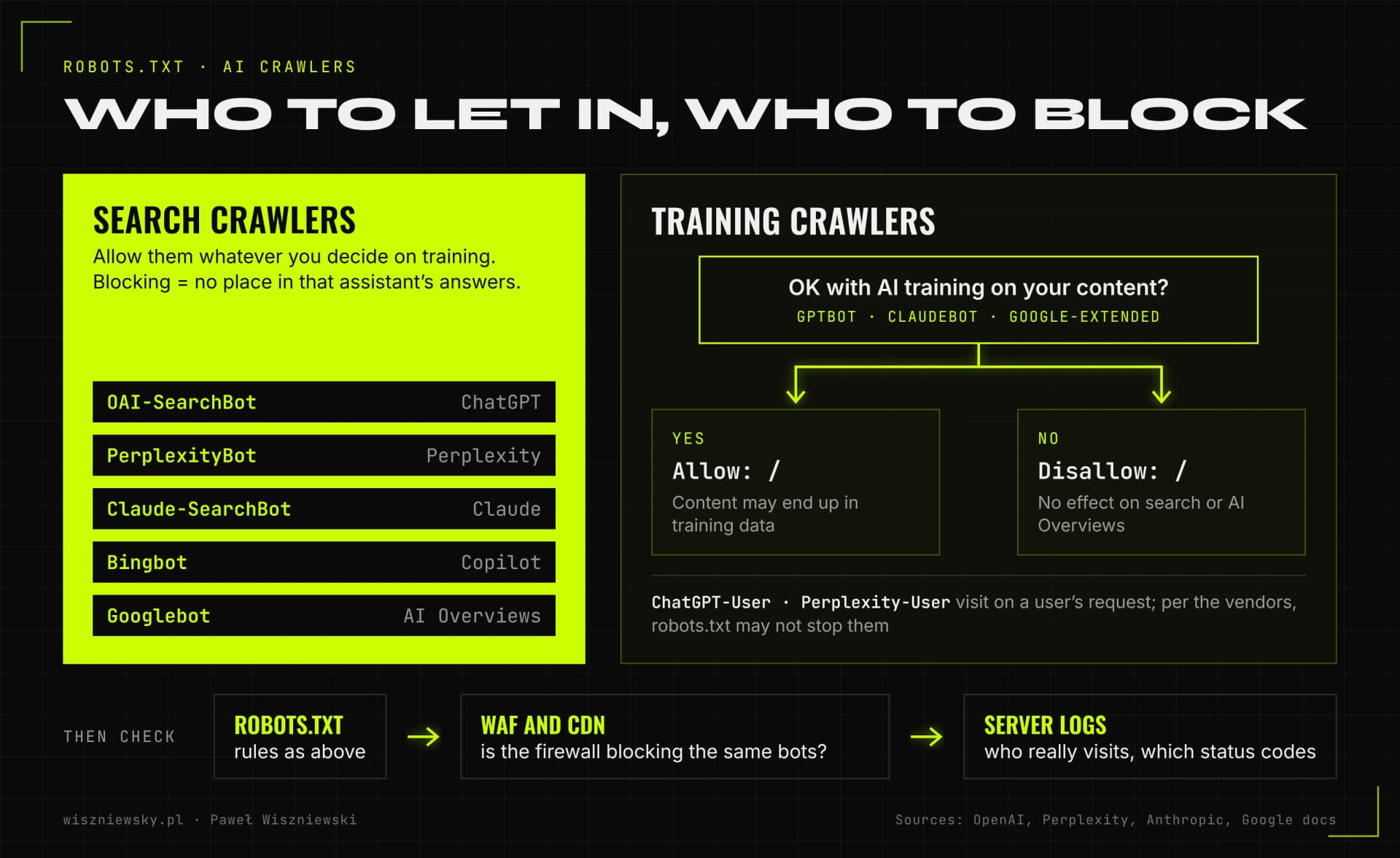
The key rule: training crawlers and search crawlers are separate. You can block model training on your content and still be cited by AI search engines. Many companies do the opposite and block every AI bot with a single CDN switch.

User agentCompanyPurpose (per official docs)Effect of blocking
OAI-SearchBotOpenAISurfacing sites in ChatGPT search resultsSite won't be shown in ChatGPT search answers (navigational links at most)
GPTBotOpenAICollecting content to train modelsContent excluded from training; per OpenAI, search is unaffected
ChatGPT-UserOpenAIVisits initiated by users, e.g. during a chatPer OpenAI, robots.txt rules may not apply
PerplexityBotPerplexitySurfacing and linking sites in Perplexity resultsSite missing from Perplexity's index
Perplexity-UserPerplexityFetching pages when a user asksPer Perplexity, generally ignores robots.txt
ClaudeBot / Claude-SearchBotAnthropicTraining / search result qualityExcluded from training / from search respectively
Google-ExtendedGoogleToken controlling Gemini training and grounding in some systemsPer Google, no effect on Search inclusion or AI Overviews

There is also a layer beyond robots.txt. On 1 July 2025 Cloudflare announced that new domains on its network block known AI crawlers by default, and launched a pay-per-crawl programme for publishers. A site can therefore have a correct robots.txt and still turn AI search crawlers away at the firewall. That's why I check CDN settings and server logs, not just the file.

How I approach the configuration

  1. Agree with the owner whether model training on the content is acceptable. That's a business decision, not a technical one.
  2. Allow search crawlers (OAI-SearchBot, PerplexityBot, Claude-SearchBot, Bingbot, Googlebot) regardless of that decision, unless the client deliberately gives up visibility in a given assistant.
  3. Set training crawlers (GPTBot, ClaudeBot, Google-Extended) according to the decision in step 1.
  4. Check WAF and CDN rules to make sure they don't block the same bots robots.txt allows.
  5. Verify in server logs which bots actually visit and which status codes they get.
robots.txt decision tree: AI search crawlers always allowed, GPTBot, ClaudeBot and Google-Extended set by the owner’s choice, then WAF, CDN and log checks.
Search crawlers and training crawlers are two separate decisions, and robots.txt is only the first of three checkpoints.

The full list of bots, example configurations and the pay-per-crawl question are covered in my post on AI crawlers and robots.txt access control.

llms.txt – is it worth adding?

llms.txt is a proposed Markdown file listing a site's most important content for language models. Short answer: in 2026 it is not a signal that improves visibility in Google, ChatGPT or Perplexity, and I tell every client that honestly.

The format was proposed by Jeremy Howard of Answer.AI in September 2024. The idea is sensible, but adoption by AI providers remains negligible. Google's 2026 guide to optimizing for generative AI search says you don't need to create new machine-readable files, AI text files or Markdown versions, and that doing so will neither help nor harm your visibility. OpenAI controls its crawlers through robots.txt and its crawler documentation doesn't mention llms.txt.

The hard data: in May 2026 Ahrefs analysed 137,210 domains. In that sample 28% of domains had an llms.txt file, yet 97% of the files received zero requests over the period studied, and of the requests that did arrive only 19.5% came from AI-related bots. SEO audit tools generated more requests than any single category of AI bot.

The one place llms.txt has proven value is technical documentation read by coding agents. If you sell an API or SDK or run a documentation portal, add it. Otherwise it's fifteen minutes of work with no effect on results, so I don't treat it as part of a strategy. Details and data from other studies are in my post llms.txt – does it actually help AI visibility?

Measuring AI visibility without fooling yourself

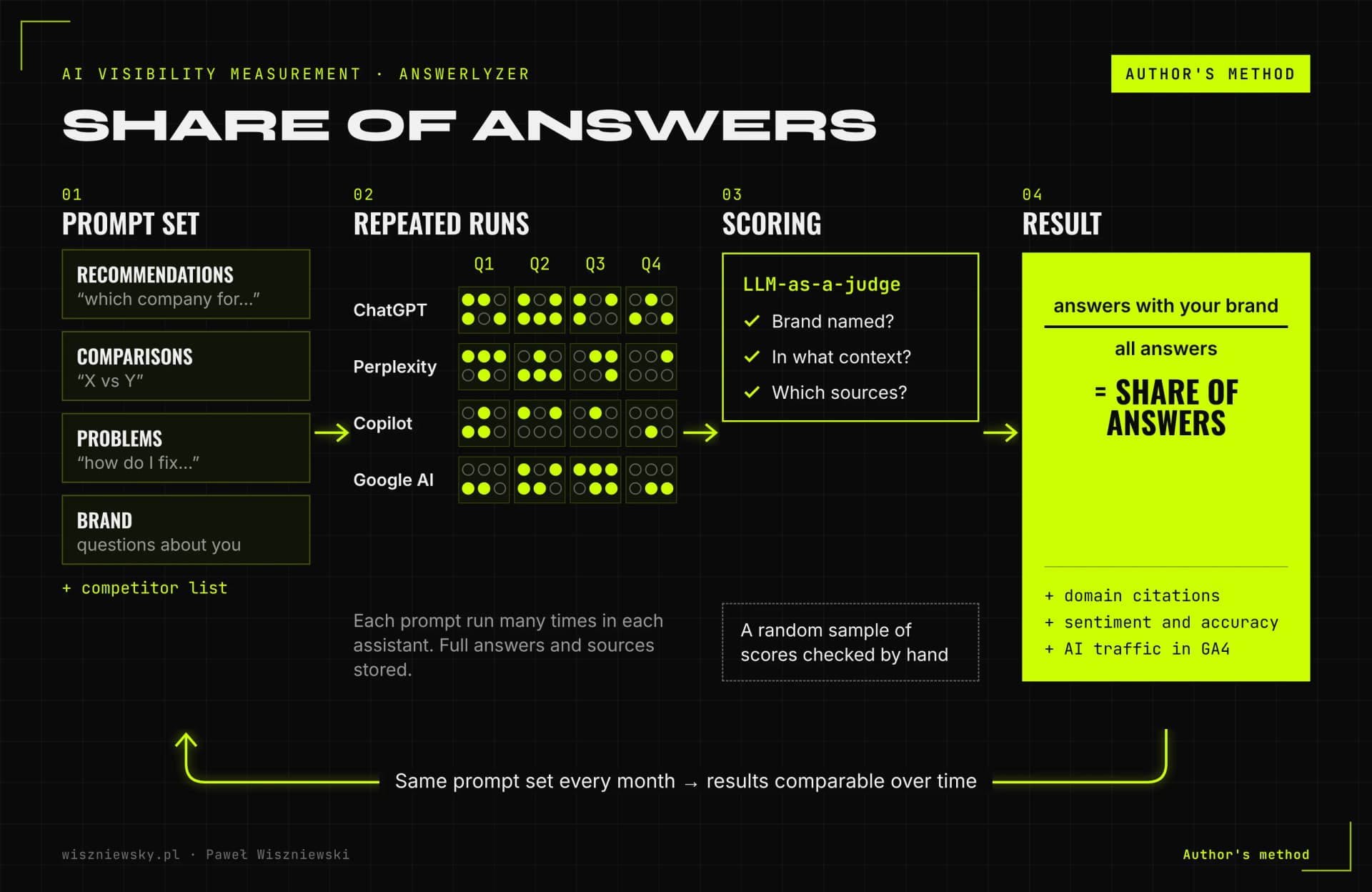
AI visibility is measured as your brand's share of answers across a fixed set of customer questions, run many times in several assistants, combined with AI referral traffic data. One ChatGPT screenshot is not a measurement.

Why a single test means nothing

SparkToro and Gumshoe.ai ran 12 brand recommendation prompts (chef's knives, headphones, marketing consultants and more) 60–100 times per platform across ChatGPT, Claude and Google AI Overviews or AI Mode, 2,961 runs in total. The results, reported by Search Engine Land and Search Engine Journal in January 2026, showed less than a 1-in-100 chance of getting the same list of brands twice, and less than 1-in-1,000 of getting the same list in the same order. So ‘my ChatGPT ranking’ as a single number is misleading. The meaningful metric is the percentage of answers in which your brand appears.

How I build the prompt set

  1. Collect questions from sales calls, customer support, Search Console and forums, not only from keyword tools.
  2. Group them by intent: recommendations (‘which company should I choose for…’), comparisons (‘X vs Y’), problems (‘how do I fix…’) and brand questions.
  3. Agree on a competitor list whose presence is tracked too.
  4. Run each prompt many times in each assistant and store full answers and cited sources.
  5. Keep the set fixed between measurements so results are comparable month to month.
Author’s AI visibility method: a fixed prompt set, repeated runs in ChatGPT, Perplexity, Copilot and Google, LLM-as-a-judge scoring and share of answers.
My measurement process in AnswerLyzer: the output is the share of answers naming the brand, not a single “ranking”.

Metrics I report

MetricWhat it showsData source
AI share of voiceShare of answers that name your brand, versus competitorsRepeated prompt monitoring
Domain citationsHow often your URLs are used as sourcesPrompt monitoring, Bing Webmaster Tools AI Performance report
Most-cited domains in the categoryWhere mentions are worth earningPrompt monitoring
Sentiment and accuracyWhether AI describes the brand correctlyAnswer scoring (manual and LLM-as-a-judge)
AI assistant trafficVisits and conversions from ChatGPT, Perplexity, CopilotGA4: referral sources, utm_source=chatgpt.com
Google trafficClicks from results, including AI Overviews and AI ModeSearch Console (no separate AI feature breakdown)

OpenAI's publisher FAQ states that ChatGPT automatically adds utm_source=chatgpt.com to referral URLs from search, which makes segmentation in GA4 straightforward. I cover setting up an AI channel in GA4 and log analysis in my post on measuring traffic from ChatGPT, Perplexity and AI Mode.

AI search optimization step by step – my process

I run AI visibility work in stages: baseline measurement, accessibility, entity, content, third-party sources, then ongoing monitoring. The order matters, because each stage depends on the one before.

  1. Baseline measurement. A customer prompt set, repeated measurement across several assistants, a competitor list and the domains cited in the category. Without it you don't know what to fix or whether anything improved. This is the scope of the AI visibility audit.
  2. Accessibility for AI search engines. Indexing in Google and Bing, IndexNow, robots.txt, CDN and firewall rules, content visible without JavaScript, speed. This is often where the quickest win hides.
  3. Brand entity. About page, structured data, sameAs, Wikidata where justified, fixing wrong data in third-party sources.
  4. Content. Reworking the pages with the most potential: direct answers, sourced data, tables, sub-questions. New content where the category lacks a solid answer or comparison.
  5. Third-party sources. Digital PR, rankings, communities, video, selected placements labelled according to Google's rules.
  6. Monitoring and iteration. The same prompt set every month, a report on share of answers, citations and AI traffic, and plan adjustments based on results.

Stages 4–6 as an ongoing engagement are covered by ChatGPT SEO and AI citation strategy.

What GEO costs and how long it takes to see results

The cost of AI search optimization depends on whether you need a one-off diagnosis, implementation on key pages, or ongoing work on citations and mentions. My prices start at €500 for an audit, and an ongoing citation strategy starts at €800 per month.

ServicePrice fromWhen it makes sense
AI visibility audit€500As a starting point: you want to know how AI sees your brand and who it recommends instead
Voice search and AI assistants€600Local businesses and sites answering practical questions
AI citation strategy€800 / moOngoing work on share of answers and mentions
Knowledge graph engineering€1,000AI describes your brand vaguely, wrongly or confuses it
Perplexity, Copilot and ChatGPT Search€1,200Visible in Google but absent from AI search engines
AI Overviews and AI Mode€1,200You're losing clicks because AI summaries appear above your results

What drives the price

  • The number of prompts, assistants and competitors measured.
  • The site's technical state and whether I or the client's team implement changes.
  • The number of pages to rework and the need for new content.
  • How competitive the category is and the scope of off-site work such as digital PR.
  • The number of languages and markets.

Realistic timelines

Systems with live retrieval, meaning AI Overviews, AI Mode, Perplexity, Copilot and ChatGPT Search, react to on-site changes after re-indexing, usually within weeks. Changing what a model knows about your brand without searching takes months of consistent mention and entity building, because it depends on future training cycles. Anyone promising ‘number one in ChatGPT in 14 days’ is promising something nobody controls.

How to choose a GEO specialist or agency

You can spot a good GEO provider because they talk about repeated measurement, site access for specific crawlers and third-party sources, not magic files and ranking guarantees. The market is young, so the questions you ask before signing matter more than in classic SEO.

Questions worth asking

  • How do you measure AI visibility? How many times do you run each prompt, and in which assistants?
  • Where does the prompt set come from, and does it stay fixed between reports?
  • How do you check that the site is reachable by OAI-SearchBot, PerplexityBot and Bingbot, including at the CDN level?
  • What will you do beyond my website, and how will any paid placements be labelled?
  • Who implements technical changes, and how long does that take?
  • Which metrics will I see in reports, and how will you tie them to traffic and conversions?

Warning signs

  • A guaranteed position or ‘top spot’ in ChatGPT.
  • Reports built on one-off screenshots.
  • llms.txt or ‘special AI schema’ as the core of the offer.
  • Packages of hundreds of links or mass-produced, unedited articles.
  • No discussion of technical SEO or Bing indexing.
  • No explanation of which actions moved the results and which didn't.

Common myths about AI search optimization

GEO has collected plenty of myths, because the field is new and AI products change quickly. Here are the ones I hear most, with what the sources actually say.

  • ‘GEO will replace SEO.’ Google says outright that optimizing for generative AI search is still SEO, and AI Overviews use Google's index. Without search visibility there is nothing to cite.
  • ‘Just add llms.txt.’ Google says such a file neither helps nor harms, and according to Ahrefs (2026) 97% of llms.txt files were never requested.
  • ‘Special schema will make AI cite me.’ According to Google, no markup is required to appear in AI features. Structured data helps organise facts and entities, but it isn't a switch.
  • ‘Blocking GPTBot removes me from ChatGPT.’ GPTBot is for training. Search is handled by OAI-SearchBot, and OpenAI describes these as independent settings.
  • ‘My ChatGPT ranking is third place.’ The SparkToro and Gumshoe.ai study found the same brand list repeats less than once in 100 runs. A position in a single answer is noise.
  • ‘Longer content gets cited more.’ AI cites passages. Long text without specifics gives the model nothing to use.
  • ‘Links don't matter any more.’ Links still help SEO, which is the foundation of GEO. In the 2025 Ahrefs study, however, brand mentions correlated with AI Overview visibility more strongly than backlink counts.
  • ‘You can opt out of AI Overviews at no cost.’ Directives like nosnippet also limit your regular snippets, and Google-Extended does not remove you from AI Overviews.

If you want to know how AI assistants see your brand today, start by measuring. Data from your own category usually shows quickly which of the topics above matter for you and which you can skip.

/// KNOWLEDGE_BASE

Read more

Articles that dive deeper into this service.

/// FAQ

Frequently Asked Questions

What is GEO (Generative Engine Optimization)?

GEO is optimizing your website and brand so that generative search engines — ChatGPT, Google AI Overviews and AI Mode, Gemini, Perplexity and Copilot — cite your content and recommend your company. It combines extractable content, structured data, brand entity building and mentions on third-party sources.

How is GEO different from SEO?

SEO competes for a position in the results list; GEO competes for a place inside the AI answer. The foundation is shared — an indexable site, authority and great content. GEO adds self-contained citable passages, coverage of follow-up questions (query fan-out), a consistent brand entity and presence where models get their knowledge: media, forums, YouTube and Wikidata.

How can I check whether ChatGPT recommends my company?

That's what the AI visibility audit does: I run dozens to hundreds of prompts your customers actually ask and measure how often your brand appears, in what context and which sources get cited. You get your AI share of voice versus competitors and a prioritized action list.

How long does GEO take to work?

Engines with live retrieval (AI Overviews, AI Mode, Perplexity, ChatGPT Search) react to on-site changes within weeks of recrawling. Changing what a model “knows” about your brand from training data takes longer — usually several months of consistent mention and entity building.

How much does GEO cost?

An AI visibility audit starts from €500, Perplexity and AI search optimization from €1,200, and an ongoing AI citation strategy from €800 per month. Scope depends on your industry, competition and the current state of your site.

Does GEO replace SEO?

No. GEO extends SEO: AI Overviews use Google's index, and AI assistants prefer to cite pages that are visible, fast and credible. Combining both works best.

Where should I start with AI search optimization?

With an AI visibility audit. It shows how assistants describe your brand, who they recommend instead and which sources drive that. We then pick the highest-impact actions.

Got a project?

Terminate
Silence

Initiate protocol. Establish connection. Let's build something loud.

> WAITING_FOR_INPUT...