AI assistant that answers questions using only your internal documents—contracts, policies, manuals. Every answer cited, zero hallucinations.
I build Retrieval-Augmented Generation (RAG) systems that give your team an AI assistant grounded exclusively in your proprietary documents. Upload contracts, policies, product manuals, or internal wikis—the system retrieves the most relevant passages and feeds them to the LLM, producing precise answers with exact source citations. No general knowledge hallucinations, and no data leaving your infrastructure if self-hosted.
Answers grounded exclusively in your documents—the AI cannot fabricate information that isn't present in your actual knowledge base.
Source citation for every answer—users see exactly which document and paragraph the answer came from, enabling fast verification.
Handles diverse document formats natively: PDF, DOCX, Notion, Confluence, Google Docs, and plain text out of the box.
Access control layer—different user roles query only the documents they're authorized to see, enforced at the vector search level.
Self-hostable architecture—your documents and queries never leave your servers; compliant with GDPR, HIPAA, and enterprise data governance requirements.
I inventory your documents and choose the optimal chunking strategy—by section, by paragraph, or by semantic block—for your specific content type and query patterns.
I configure the vector database (Pinecone, Weaviate, or pgvector), define metadata schemas for filtering, and index all documents with quality embeddings.
I build the query pipeline: embed user question → vector search → rerank results → inject context into LLM prompt → return answer with source citations.
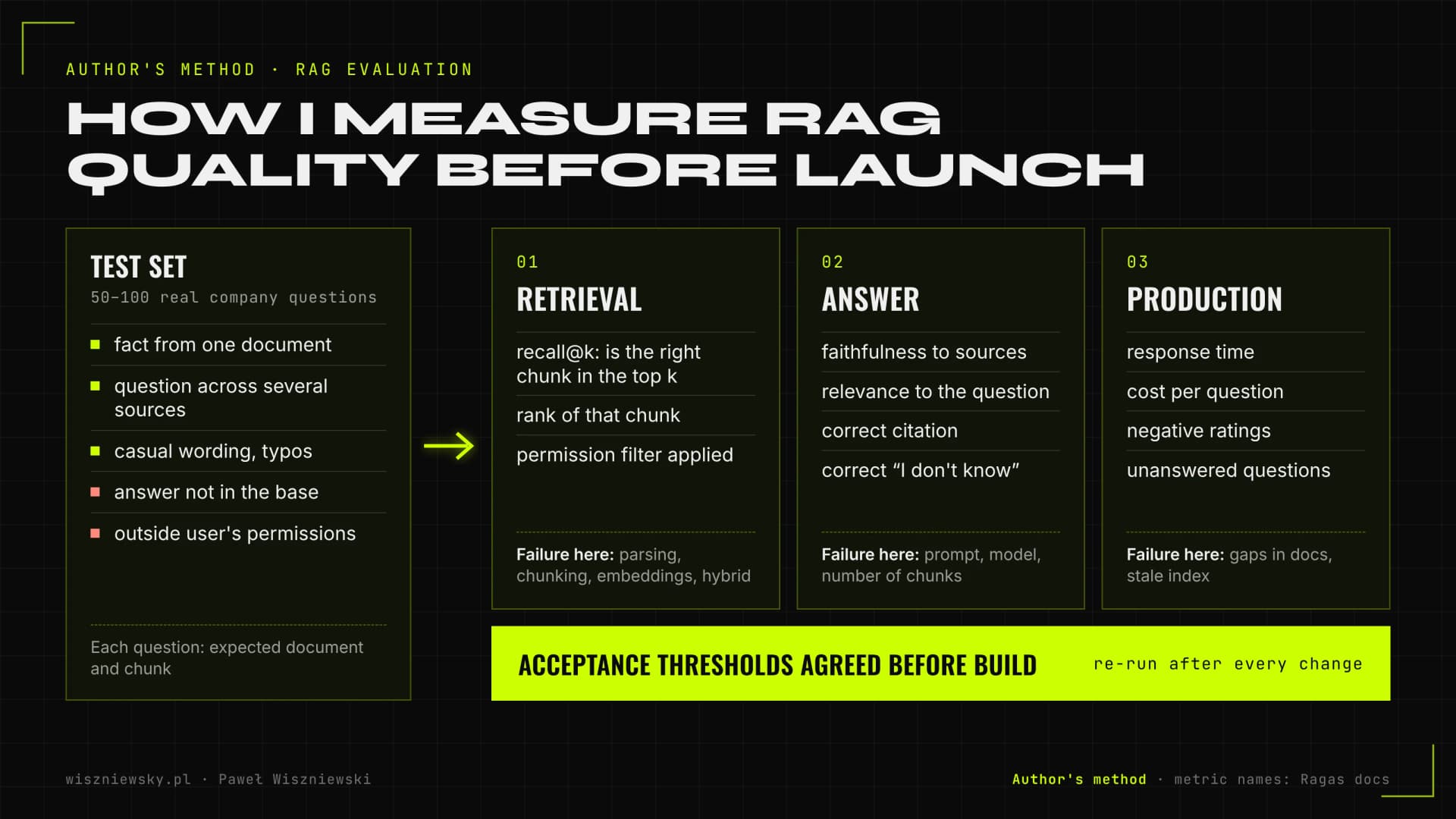
I build or integrate the chat interface, implement authentication and document-level access control, test accuracy on 100+ representative questions, and deploy.
On domain-specific questions, RAG accuracy is dramatically higher because the LLM sees your exact documents instead of relying on general training data. Accuracy typically improves from 40–60% to 85–95% for internal knowledge queries.
Yes. Vector databases like Weaviate and Pinecone scale to hundreds of millions of vectors. Search latency stays under 100ms even at that scale with proper index configuration.
I build an incremental indexing pipeline. Updated or new documents trigger a re-embedding job that updates only the changed vectors, keeping the knowledge base current without a full re-index.
Initiate protocol. Establish connection. Let's build something loud.