BACK TO Content Marketing & SEO

Content Marketing Strategy

I build a 12-month content strategy based on SERP analysis, topical authority mapping, and customer journey. Every article targets a specific keyword with measurable KPIs.

Author: Paweł Wiszniewski · Updated:

Key takeaways

I build a 12-month content strategy based on SERP analysis, topical authority mapping, and customer journey. Every article targets a specific keyword with measurable KPIs.

  • ›50+ specific article briefs with target keywords, H1-H3 outline structure, and search intent
  • ›12-month topical authority map using a hub-and-spoke cluster model
  • ›Content gap analysis against your top 3 competitors in Ahrefs

Price: from €1,500

SERVICE DETAILS

I develop a comprehensive content marketing strategy: from auditing your existing content, through topical authority mapping, to an editorial calendar with 50+ articles per year. I select every topic based on Ahrefs/SEMrush keyword research, search intent, and content gap analysis against your competitors. You receive a ready-to-implement strategy document — not vague recommendations, but specific article briefs with target keywords, outline structure, and success metrics.

› INVESTMENT:

from €1,500
const module = new ExecutionProtocol();

// Initializing content-marketing-strategy...
› Loading dependencies... OK
› Establishing connection... OK
› Ready for deployment... AWAITING_COMMAND

Paweł Wiszniewski · my approach

What I do differently

I plan content strategy on two axes at once: Google keywords and the questions customers ask AI assistants. The latter often don't appear in keyword tools at all, yet they decide whether a brand makes it into answers. I test this on myself — this blog has over 100 articles in two languages organized into topic clusters with a plan for the coming quarters. For a fashion brand I built a topical authority hub across 14 clusters, described in the case study.

Case study: Fashion Brand SEO/GEO

My take and a real-world example

My take

In my view the era of “writing for keywords” is over. Big publishers with huge domain authority will beat you on every generic keyword, so strategy has to rest on what they don't have: experience, data and a narrow specialization.

From the market

HouseFresh, an independent site testing air purifiers, lost around 91% of its Google traffic after updates — falling from about 4,000 to 200 visits a day while large publishers took its keywords. The story shows text quality alone isn't enough: authority, brand recognition and diversified traffic sources matter too.

Sources: Search Engine Land: HouseFresh lost 91% of Google traffic

Who this is for

  • Companies that publish content “now and then” with no plan or measurable results.
  • Brands entering a new category that need to build topical authority.
  • Marketing teams that need a plan, briefs and priorities for the whole year.
  • Companies whose blog traffic is dropping after Google updates or because of AI Overviews.

What you get

  • Demand analysis: keywords, questions people ask AI assistants and gaps versus competitors.
  • A topic cluster map with pillar and supporting articles.
  • A 12-month publishing schedule with priorities and business goals.
  • Article briefs: keyword, intent, structure, sources and internal links.
  • A plan for refreshing existing content and a KPI set.

How results are measured

  • Organic traffic and visibility for cluster keywords.
  • Leads and conversions attributed to content.
  • Citations of your content in AI answers.
  • Share of content still attracting traffic a year later.

Key Benefits

50+ specific article briefs with target keywords, H1-H3 outline structure, and search intent — ready to write from day one, no creative guesswork needed.

12-month topical authority map using a hub-and-spoke cluster model — builds topical authority faster than publishing isolated, unconnected articles.

Content gap analysis against your top 3 competitors in Ahrefs — I identify every topic your competitors rank for that you're missing.

Prioritized by business impact: high-purchase-intent articles first, brand awareness content as a supplement — you see ROI faster.

Measurable KPIs per article: target position, estimated monthly traffic, time-to-rank — accountable goals, not vague promises.

The Process

1

Existing content audit

I analyze your current articles in Google Search Console and Ahrefs — identifying what already ranks, what needs updating, and what's cannibalizing your keywords and should be merged or removed.

2

Keyword research and competitor analysis

I build a database of 200+ keywords with search volume, keyword difficulty, and search intent. I analyze the SERP for each topic and identify the content gap I can exploit.

3

Topical authority architecture

I design cluster structures (hub-and-spoke): one pillar page (its length follows the scope of the topic) and 5-8 supporting articles per cluster, with a full internal linking plan connecting every piece.

4

Editorial calendar and article briefs

I deliver a 12-month publishing schedule with priority order, plus detailed briefs for each article: structure, target keywords, internal links, competitor references, and success metrics.

Common mistakes

  • A content plan built only from a keyword tool, without customer and sales team questions.
  • Articles unrelated to your offer that attract traffic but not customers.
  • Publishing new posts without refreshing old ones that are losing rankings.
  • No internal links between articles and service pages.

When this service is not worth it

  • Nobody on your side can approve and publish content — the strategy will sit in a drawer.
  • You need results within weeks — content marketing works over months.
  • Your market is so narrow you know customers by name — direct outreach will work better.
/// GUIDE

Content marketing strategy – how I build it and what it actually contains

This guide shows the workshop behind a content strategy: what data I collect, how I group queries, which criteria set the order of topics, how I lay out the calendar and how, after a quarter, I decide whether to grow a cluster or stop it. The general principles of SEO content marketing, search intent, cluster structure and the content brief are covered in my content marketing guide. Here I focus on what happens inside a strategy project.

Anatomy of a strategy document: parts, contents and readers

A strategy is a set of working documents used by whoever writes, whoever approves and whoever is accountable for results: a topic map with priorities, a calendar, briefs, an update plan and KPI definitions. A slide deck of general recommendations isn't a strategy, because nobody knows what to write on Monday.

PartWhat it containsWho uses it
Summary and goalsBusiness goals, the offer content should support, audiences, a 12-month horizonLeadership, marketing
Content inventoryEvery existing URL with traffic, impressions, conversions, cluster assignment and a decisionEditorial, SEO
Topic databaseQueries and questions grouped into topics, with intent, demand, format and target URLSEO, writers
Cluster mapPillar pages, supporting articles, service or category pages, linking planSEO, writers, developer
Priority scoringA score for every topic and the reasoning behind the orderMarketing, budget owner
CalendarTopics for 12 months with dates, owners and slots for updatesEditorial
BriefsA full brief for every first-quarter topic; scope and query for later onesWriters, experts
Working rulesRoles, approval path, rules for using AI, sources, styleWhole team
KPIs and reportingMetrics per cluster, data sources, review rhythmMarketing, leadership

I rarely write briefs for the whole year upfront. After the first quarter, Search Console data and changes in the results almost always reshape part of the plan, so detailed briefs cover the current and next quarter, while later topics have a scope and a target query. What goes into a brief is described in the content marketing guide.

Inputs: what I collect before choosing the first topic

The best topics come from data your competitors can't see: your Search Console, your CRM and your customers' questions. Keyword tools complete the picture but don't replace it.

  • Search Console: queries and pages from the last 16 months (the history the Performance report keeps), to see seasonality and trend. I also use the branded and non-branded query filter Google introduced in November 2025, and Query groups in Search Console Insights, which bundle variants of the same question (available for properties with high query volume).
  • GA4 and CRM: which landing pages lead to key events and leads, and which draw traffic with no further action.
  • Sales and support: questions from emails, calls and tickets from recent months. I ask for the raw messages, not a summary, because the customer's own words are better material than a salesperson's interpretation.
  • SEO tools: demand, difficulty and gaps against competitors (Ahrefs, Semrush; Senuto for the Polish market).
  • Questions put to AI assistants: test conversations with ChatGPT, Gemini and Perplexity on topics from the offer, plus Google's People also ask. They show questions with context that tools don't capture.
  • The company's expert assets: who can give an interview, what data the company collects, which implementations or tests can be described. Without these there's no first-hand element, and without one a piece won't stand out in the results.

Inventorying existing content and spotting cannibalization

Before planning new pieces, I map every existing URL to a topic and check whether several pages compete for the same queries. For companies with a blog that's a few years old, the first quarters of a strategy are often more about updating and merging than publishing.

Columns in the inventory sheet

  • URL, title, publication date and date of the last significant update.
  • Clicks, impressions and average position over 16 months, plus year-over-year change.
  • Key events and leads from GA4 or CRM attributed to the landing page.
  • Main query and topic from the topic database.
  • Incoming internal links, and whether the page links to the offer.
  • Decision: keep, update, merge, redirect, remove. My criteria are in Content Decay – When to Update, Merge, or Delete Content.

How I spot cannibalization

  1. I export query–page pairs from Search Console and look for queries where more than one URL from the site gets impressions.
  2. I discard natural cases: a service page and a guide can both show for the same query if they serve different intents.
  3. What's left are pairs where two similar articles swap positions over time, or neither climbs. Those are merge candidates: I keep the stronger URL, move the valuable content from the other one into it and set a 301 redirect.
  4. I check every new topic in the database the same way before it reaches the calendar. The cheapest cannibalization is the one never published.

Grouping queries into topics: by search results, not word similarity

Two queries belong in one piece when Google shows largely the same pages for both. Word similarity can mislead: "content marketing strategy" and "content marketing examples" sound close but may need completely different formats.

For every query in the database I pull the top ten results and compare them in pairs. My working rule as a starting point: if several of the same URLs appear in both result sets (usually 3–4 out of 10), one page serves both queries. With less overlap I check the results by hand, because the nuances decide: does Google show guides, product pages, forums or video? I automate the grouping with a script, and on large databases part of the work is done by a language model whose output I always verify on a sample. I describe that process in SEO Automation with AI Agents.

What I get from grouping

  • A list of topics, each with a main query, variants and side questions.
  • Intent and the format that wins in the results (guide, comparison, service page, category).
  • Whether the query triggers an AI Overview, video, forum results or a local pack.
  • A target URL: an existing page to expand or a new piece.

Questions from AI conversations go into topics as side questions, even with no volume in tools. According to Google's documentation, AI features in Search may break a question into many related searches (query fan-out), so a piece that answers them has more chances to be cited. More in Keyword Research in the AI Era.

How I prioritize topics: scoring on four criteria

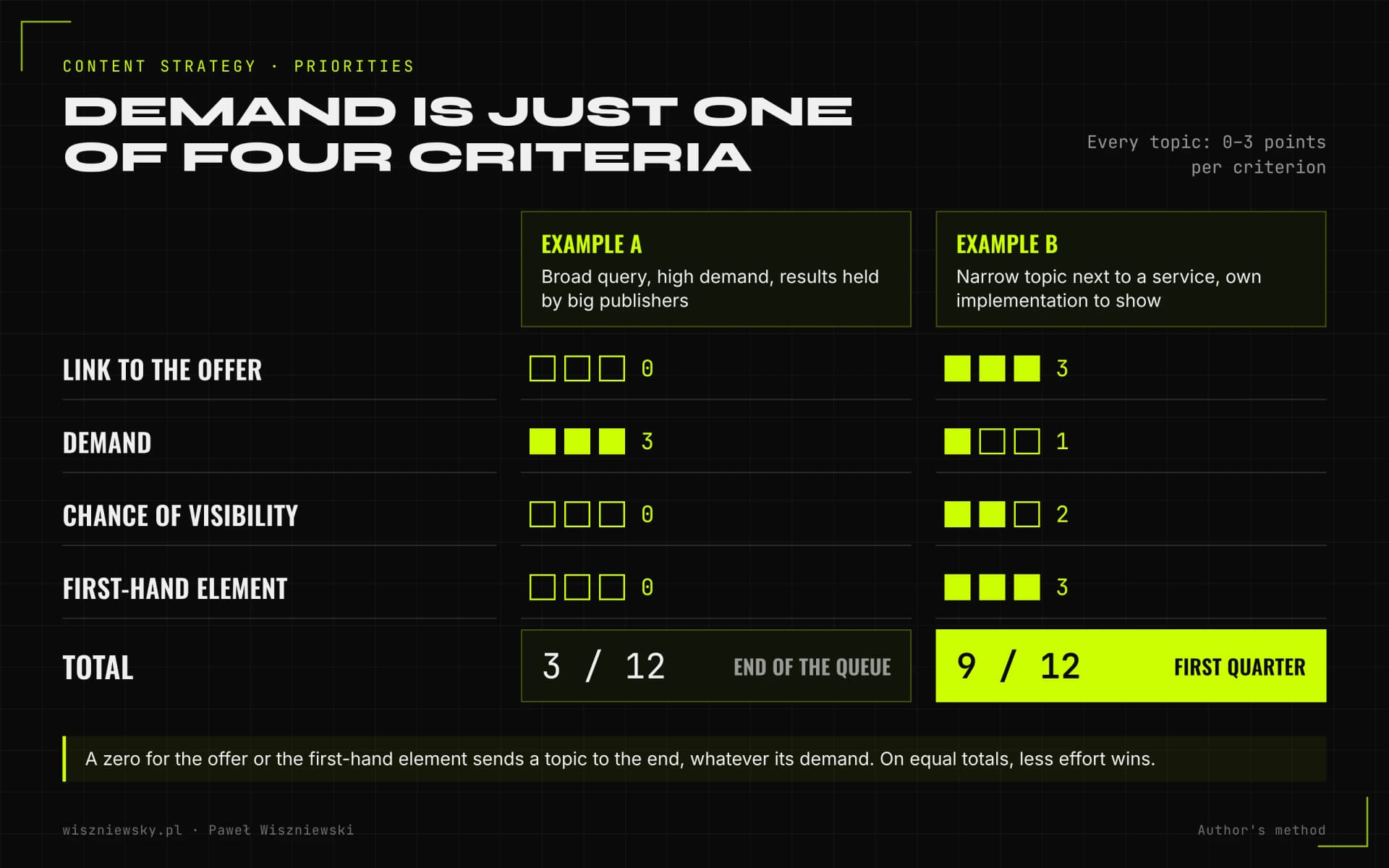
I set the order of topics with a score in which demand is only one of four criteria. The others are the link to the offer, a realistic chance of visibility, and whether the company has something of its own to say. That way the start of the calendar holds pieces that can bring enquiries, not just traffic.

Topic scoring card: link to the offer, demand, chance of visibility and first-hand element each rated 0 to 3, with the total weighed against effort; a topic with a zero for the offer or the first-hand element goes to the end of the queue.
Every topic in the database gets points on four criteria. The total sets the order, and a zero for the offer or the first-hand element moves a topic to the end, whatever its demand.
Criterion0 points3 pointsWhere the rating comes from
Link to the offerThe topic leads to no service or productThe reader is one step from an enquiry or purchaseTalks with the company, offer map, CRM data
DemandNo searches and no customer questionsSteady demand in tools and questions from customersSEO tools, Search Console, sales, AI conversations
Chance of visibilityResults held by big publishers and official sources, no gapWeak or outdated results, a clear information gapManual review of the top ten and AI answers
First-hand elementNo data, implementations or expert for the topicOwn data, a test, a case or an expert ready for an interviewThe company's list of expert assets

I weigh the total against effort: updating a page that already has impressions just below the top five is usually cheaper than a new piece with the same score. I adjust the weights to the situation. For a new domain without authority, chance of visibility weighs more; for a B2B company with a long sales cycle, the link to the offer does.

Competitor analysis: the topic gap and the information gap

The topic gap is the set of topics where competitors are visible and you aren't. The information gap is what's missing from the pieces already ranking. Tools show the first; you find the second by reading the results.

I collect the topic gap with a competitor analysis tool, but only count competitors who sell the same thing, not every publisher visible for those queries. I check the information gap by hand for the highest-scoring topics:

  • Are the results current? Pieces from a few years ago on a topic that has changed (tools, regulations, prices) are the easiest opening.
  • Does anyone give concrete numbers, price ranges, steps or selection criteria, or does everyone stop at "it depends"?
  • Is there a first-hand element: a test, a screenshot, an implementation example, a practitioner's opinion?
  • Which side questions go unanswered in the top ten but appear in People also ask and in AI conversations?
  • Who gets cited in AI Overviews and assistant answers? If it's always the same site, I look at how its passage differs from the rest.
  • Are there forums, Reddit or video in the results? That signals people want experience, not a definition.

How AI models pick sources and how to write passages that can be quoted is covered in How to Write Content AI Cites. In a strategy, that knowledge becomes requirements in the brief, not a separate content type.

From article to enquiry: mapping content to decision stages

Every topic in the strategy has a customer decision stage, the next step it leads to, and a metric that tells me whether it works. Without that, educational articles collect traffic but nobody moves on from them.

StageTypical customer questionFormatNext step in the pieceMetric
Recognizing the problemwhy is blog traffic droppingGuide, analysis of causesLink to a solution article, newsletter sign-upNon-branded impressions, clicks to further content
Looking for a solutionhow to plan content for a yearProcedure, checklist, templateLink to the service page, downloadable resourceVisits to the service page
Choosing a provider or toolagency or freelancer for contentComparison with criteria, pricingContact form, consultationEnquiries and leads
Decision and rolloutwhat's in a content strategyService page, case study, FAQContact, quoteConversions, lead value
After purchasehow to measure content resultsHow-to, expert articleAnother service, referralReturning users, branded searches

In the strategy table every topic has a specific target URL. A cluster that doesn't end on any offer page I label as brand building and measure with different metrics, instead of pretending it will bring leads.

How I build a 12-month publishing calendar

I start the calendar with quick wins, updating pages that already have impressions, and then complete the highest-scoring clusters one by one instead of starting all of them at once. Half of five clusters usually delivers less than one complete cluster.

  1. First weeks: updates and merges. Pages with impressions but weak positions, outdated pieces with a traffic history, and the merge pairs from the inventory.
  2. The first cluster. The pillar page and supporting articles for the highest-scoring service. The order inside a cluster depends on the situation: on a new domain I start with narrow supporting articles, because they gain visibility faster, and publish the pillar once it has something to link to.
  3. Seasonality. Seasonal topics are planned ahead, so the piece has time to get indexed and settle before the peak. I read the peaks from 16 months of Search Console data and from Google Trends.
  4. Update slots. Every month I reserve part of the capacity for refreshing earlier pieces, because maintaining them is part of the strategy, not an extra.
  5. Buffer. I leave room for topics nobody can predict: Google changes, new regulations, new tools in the industry.
  6. Quarterly review. After each quarter I move topics based on the data and write briefs for the next quarter.

Publishing pace follows the team's capacity and the number of clusters, not an assumption that you must publish weekly. If I take over the writing, it runs as SEO copywriting or blog management.

Distribution and repurposing

A strategy also covers where a piece goes after it's published. In 2026 a brand's visibility in AI answers also depends on mentions outside your own site, so one data-backed article should feed several channels.

  • Newsletter: the cheapest way to bring readers back, independent of Google changes.
  • The expert's LinkedIn: short versions of the article's points, posted by the person who wrote it or is the source of the knowledge. More in Expert Personal Brand in the AI Era.
  • Video and YouTube: for topics where results show video, and as an extra source for AI models. I write about it in YouTube and Video in AI Visibility Strategy.
  • Digital PR: pieces with original data or research go to industry media, since that's what most often earns links and mentions. See Digital PR and Brand Mentions.
  • Repurposing: one piece becomes posts, short videos and newsletter snippets. The AI-assisted process is in Social Media Automation with AI.

For each cluster the strategy records which channels are mandatory and which optional. I don't add channels just in case; only where the customers are and where the company has the resources to publish regularly.

Who does what: roles, approval and rules for using AI

A strategy works only when it's clear who writes, who checks the substance, who approves and who publishes. The most common reason a plan stalls after two months is that nobody on the company side approves pieces within the agreed time.

RoleTasksTypical time needed
Strategy ownerPriorities, quarterly reviews, decisions on clustersA few hours per quarter
Subject-matter expertInterview for the piece, fact check, first-hand elementA short call and one round of comments per piece
WriterResearch, text, sources, linking according to the briefDepends on topic and length
Editorial and SEOBrief, quality control, metadata, publishing, monitoringAn ongoing part of the process
ApproverSign-off within the agreed deadlineA quarter of an hour or so per piece

The working rules also say how the team uses AI: yes for research, structure and editing; no for publishing text without fact-checking and without the expert's input. Google judges content by quality, not by how it was produced, but mass-publishing pages without value violates its scaled content abuse policy. Where the lines are is covered in AI Content and Google Policy.

Content strategy KPIs and quarterly reviews

I measure the strategy per cluster, not per article, and separate leading indicators (impressions, positions, citations) from business metrics (leads, sales, branded searches). Leading indicators show whether a cluster is heading the right way before conversions appear.

MetricTypeSource
Non-branded impressions for the cluster's queriesLeadingSearch Console, non-branded query filter
Cluster queries in the top tenLeadingRank tracking tool
Presence in AI answers to the cluster's questionsLeadingCitation monitoring, AI visibility audit
Clicks from articles to offer pagesIntermediateGA4, paths and events
Leads and conversions from contentBusinessGA4, CRM
Branded searchesBusinessSearch Console, branded query filter

Decisions at the quarterly review

  • Grow the cluster when leading indicators rise and the first pieces send traffic to offer pages.
  • Fix the cluster when there are impressions but weak positions or no onward clicks: usually linking, a first-hand element or intent match is missing.
  • Pause the cluster when, after a few quarters, complete pieces still get no impressions. Then I check whether domain authority is the problem and consider earning mentions instead of publishing more.

I measure visibility in AI answers separately, because AI traffic is only part of the effect. The method is described under the AI visibility audit, and measuring assistant traffic in How to Measure Traffic from ChatGPT, Perplexity and AI Mode. The wider context of falling clicks is in Zero-Click and Declining Organic Traffic.

Strategy in special situations

The same method works for any company, but criteria weights, pace and order change with the starting point.

  • A new domain with no history. I start with narrow topics that have a clear gap and a strong first-hand element, not broad queries held by big publishers. In parallel I plan mentions and links, because content alone rarely builds authority. My approach to links is described under link building strategy.
  • YMYL industries (finance, health, law). Every piece has a qualified reviewer, a visible author and sources. That stretches the calendar, so I plan fewer pieces with better documentation. The principles are in E-E-A-T in 2026.
  • B2B with a long sales cycle. More comparisons, calculators and case studies, less general content. Leads arrive with a delay, so reviews focus on intermediate metrics.
  • Several languages or markets. Each market gets its own topic database, because demand and competition differ. The offer map and working rules are shared.
  • An online store. The strategy covers category descriptions and buying guides tied to categories, not just the blog.

Frequently Asked Questions

Do you write the articles too, or just the strategy?

Strategy is a standalone service. Articles are covered under SEO Copywriting or Blog Management. We can combine all three — the strategy is discounted when it's part of a larger engagement.

How long before I see ranking results?

First top-10 positions typically appear 3-4 months after publishing for keywords with difficulty below 30. For more competitive terms — 6-12 months. That's why I prioritize low-difficulty, high-intent keywords first.

Will the strategy be tailored to my industry?

Yes. I analyze your specific market, competitors, and target audience before writing a single word. No templates — every strategy is built from scratch for your exact situation.

What does a content marketing strategy include?

Demand and competitor analysis, a topic cluster map, priorities, a 12-month publishing schedule, article briefs, a plan for refreshing existing content and how results are measured.

Does the strategy cover AI visibility?

Yes. Every cluster includes the questions users ask AI assistants and guidelines for writing citable passages. We also measure whether content appears in AI answers.

How much does a content marketing strategy cost?

Strategies start from €1,500. The price depends on the number of clusters, markets and languages and whether an audit of existing content is included.

/// KNOWLEDGE_BASE

From the blog

AI & SEO

Topical Authority - Building Topic Clusters and Internal Links That Google and AI Trust

The Google Content Warehouse leak confirmed that a domain's topical concentration is measured mathematically (siteFocusScore, siteRadius), and a 23-million-link study showed 4× more clicks for well-linked pages. The complete guide: the hub-and-spoke model, designing a topical map, data-driven internal linking and defending against cannibalization.

14 min
AI & SEO

Keyword Research in the AI Era - Query Fan-Out, Conversational Intent and the Words Nobody Types

Google's AI Mode doesn't search for one phrase - it breaks your question into dozens of parallel sub-queries (query fan-out) and synthesizes an answer from many sources at once. That upends keyword research: what wins is covering the whole intent, not a single phrase from autocomplete. The complete workshop: fan-out mechanics, prompt research instead of keywords, a conversational intent taxonomy, 6 sources of topics and mapping to clusters.

14 min
AI & SEO

Content Decay - When to Update, Merge, or Delete Content (Content Pruning)

A well-executed refresh recovers 40-80% of lost traffic in about six weeks, and per HubSpot 76% of blog views and 92% of leads come from existing posts - yet most companies keep only publishing new. Content decay is a slow traffic decline that's easy to miss. The complete workshop: detection in GSC with concrete thresholds, the AI-era double decay, an update/merge/redirect/delete decision matrix, and freshness as a citation signal.

15 min

Got a project?

Terminate
Silence

Initiate protocol. Establish connection. Let's build something loud.

> WAITING_FOR_INPUT...