BACK TO GEO – AI Search Optimization

ChatGPT SEO – AI Citation & Recommendation Strategy

GEO (Generative Engine Optimization) — content optimization for citations by ChatGPT, Gemini, Claude, and Perplexity. Your brand as the source of truth in AI-generated answers.

Author: Paweł Wiszniewski · Updated:

Key takeaways

GEO (Generative Engine Optimization) — content optimization for citations by ChatGPT, Gemini, Claude, and Perplexity. Your brand as the source of truth in AI-generated answers.

  • ›AI citation audit: I check how ChatGPT, Gemini, Claude, and Perplexity describe your brand and industry, identifying competitors cited more frequently than you.
  • ›LLM-format content optimization: definitive definitions (What is X?), fact lists, statistics with dates and sources, FAQ answers
  • ›Authoritative content assets: I create original research, proprietary data, and exclusive analyses

Price: from €800 / mo

SERVICE DETAILS

I build GEO (Generative Engine Optimization) strategies that make your brand the preferred information source for language models. I optimize content for the format LLMs prefer to cite: definitive answers, fact lists, dated statistics with sources, and FAQ responses — formats models cite instead of paraphrasing from generic sources.

› INVESTMENT:

from €800 / mo
const module = new ExecutionProtocol();

// Initializing llm-citation-strategy...
› Loading dependencies... OK
› Establishing connection... OK
› Ready for deployment... AWAITING_COMMAND

Paweł Wiszniewski · my approach

What I do differently

I don't guess what works in ChatGPT — I measure it. I built AnswerLyzer, a tool that sends customer questions to several AI models and scores the answers with an LLM-as-a-judge: whether the brand appears, in what position, with what sentiment and based on which sources. That means your citation strategy is based on data from your category, not generic advice. Every month you see which actions moved your brand's share of answers and which didn't.

Case study: AnswerLyzer AI Analytics

My take and a real-world example

My take

An opinion not everyone will like: in GEO, filler hurts more than in classic SEO. An AI model is looking for a sentence it can quote, so one specific sourced number does more than three paragraphs of generalities.

From the market

The study by Princeton and IIT Delhi researchers that popularized GEO (presented at KDD 2024) showed that adding quotations, statistics and source citations increased content visibility in generative engine answers by up to around 40%. Measurable proof that AI rewards specifics.

Sources: Aggarwal et al.: GEO: Generative Engine Optimization (KDD 2024)

Who this is for

  • Companies whose customers ask ChatGPT for recommendations in their category.
  • Brands that see AI recommending competitors and not mentioning them.
  • B2B and SaaS companies whose buying journey starts with AI research.
  • Experts and personal brands building authority in their niche.

What you get

  • A set of questions your customers ask and a baseline of who AI assistants recommend today.
  • Key pages rebuilt into citable passages: direct answers, data and tables.
  • A content plan for follow-up questions and comparisons missing in your category.
  • Off-site work: digital PR and mentions in media, communities and rankings.
  • A monthly report on your brand's share of AI answers and the sources cited.

How results are measured

  • Brand share of AI answers (AI share of voice) versus competitors.
  • Number of citations of your domain as a source.
  • Sentiment and accuracy of how the brand is described.
  • Traffic from ChatGPT, Perplexity and other assistants in GA4.

Key Benefits

AI citation audit: I check how ChatGPT, Gemini, Claude, and Perplexity describe your brand and industry, identifying competitors cited more frequently than you.

LLM-format content optimization: definitive definitions (What is X?), fact lists, statistics with dates and sources, FAQ answers — the formats LLMs prefer to cite.

Authoritative content assets: I create original research, proprietary data, and exclusive analyses — citable primary sources rather than yet another aggregator of others' content.

AI-friendly data structuring: semantic markup, clear entity mentions, author and date attributes — signals that content comes from a first-hand domain expert.

Monthly citation report: I test 50–100 industry queries across major LLMs and measure how often your brand appears in responses vs. competitors.

The Process

1

Current AI Citation Audit

I test 50–100 industry queries in ChatGPT, Gemini, Claude, and Perplexity, document how your brand is described, and identify which topics I can help you dominate.

2

Competitor Content Analysis

I identify what content and formats allow competitors to be cited by LLMs more frequently than you, and define a gap content strategy.

3

GEO-Optimized Content Creation

I produce or optimize content in LLM-preferred formats: definitive answers, original data, exclusive insights — content worth citing rather than rephrasing.

4

Monitoring & Reporting

Monthly citation check across major LLMs, trend tracking, and content strategy adaptation based on results.

GEO citation strategy vs classic SEO vs no action

CriterionGEO citation strategyClassic SEONo action
GoalGet cited inside AI answersRank links in GoogleNeither
Content formatDefinitive answers, original dataKeyword-optimized pagesUnstructured
Visibility in ChatGPT / PerplexityDirectly targetedIncidentalCompetitors get cited instead
Authority signalsFirst-hand data and expertiseBacklinks and on-page SEONone
MeasurementCitation tracking across LLMsRankings and trafficUnmeasured
Time to resultsWeeks for RAG modelsMonthsNever
Best forBrands competing in AI answersTraditional search trafficBrands ceding AI ground

Common mistakes

  • Optimizing content for ChatGPT without checking which sources the model cites in your category.
  • Long texts without clear, self-contained answers AI can quote.
  • Focusing only on your own site, even though models often recommend brands based on rankings, forums and media.
  • A one-off test of a few questions instead of regular measurement — AI answers change.

When this service is not worth it

  • Your customers don't use AI to choose a supplier, e.g. in public tenders or very local services.
  • Your site has basic indexing problems — technical SEO comes first.
  • You expect a guaranteed first place in ChatGPT answers — nobody honest can promise that.
/// GUIDE

ChatGPT SEO – how I build an AI citation strategy step by step

A citation strategy is a plan that answers three questions: which customer questions we compete for, who is the source of the answer today instead of you, and what exactly has to change on your site and beyond it to turn that around. Below I show how I do it in practice: from the question map, through citation gap analysis and page formats, to the monthly work cycle and the tactics I refuse to use.

Citation, mention and recommendation – three different goals

In ChatGPT SEO you compete for three different things: a citation of your URL as a source, a mention of your brand in the answer text, and a recommendation, where the model explicitly suggests you as the solution. Each goal is reached by different means, so at the start I agree which one matters most for your business.

GoalWhat it looks like in the answerWhat drives itWho it matters most for
CitationYour page in the footnotes or source listYour own content: direct answers, data, tables, access for AI search crawlersPublishers, how-to sites, experts building authority
MentionYour brand name appears in the text, even without a linkThe brand entity and presence in the sources the model draws onBrands that want to be associated with a topic
Recommendation“I'd suggest X because…” or a spot on a shortlistExternal confirmation: rankings, reviews, comparisons, discussionsService firms, SaaS, e-commerce, B2B

The difference has practical consequences. A page can be cited regularly for informational questions (“how does … work”) and still never show up in “which company should I choose” answers. For recommendation questions, models usually lean on what others write about the brand, so polishing your own site is not enough. That is why every question in the strategy has an assigned goal and the lever we are going to pull.

Which assistant to start with

In most projects I start with ChatGPT and Google (AI Overviews and AI Mode), and add Perplexity and Copilot when the data from your category shows your customers search there too. The reason is simple: reach and traffic.

  • ChatGPT – according to OpenAI, as reported by TechCrunch in February 2026, it had 900 million weekly active users. Ahrefs, in an analysis of about 35,000 websites published in March 2025, put ChatGPT at roughly half of the referral traffic AI assistants send to websites.
  • Google AI Overviews and AI Mode – they run on Google's index, so they benefit from the SEO work you already have. In Poland, AI Mode has been available in Polish since October 2025 (Benchmark.pl).
  • Perplexity and Copilot – smaller reach, but often a different audience (tech, B2B). Copilot also gives you hard citation data in Bing Webmaster Tools.

The order can flip. In technical and B2B categories, Perplexity sometimes sends the best-converting traffic. So I decide after the first measurement, not by assumption. Preparing a site for specific AI search engines, including Bing and IndexNow, is covered by my Perplexity, Copilot and ChatGPT Search optimization service.

The question map – the foundation of a citation strategy

The question map is an organized list of the questions your customers ask AI assistants, each with a business weight and a goal (citation, mention, recommendation). It decides which content gets created and which off-site actions make sense.

How I weight questions

Not every question is worth the same. I score each on three criteria from 1 to 3 and multiply the scores:

  • Closeness to a decision – “which firm should I hire for…” weighs more than “what is…”.
  • Fit with your offer – does the answer naturally lead to your service or product.
  • Realistic chance – do brands of your size already appear in the answers, or only global leaders.

The highest-scoring questions go into the first quarter of work. The lowest stay in monitoring as controls: if they start moving without anything we did, I know the model changed, not that my work paid off.

Question variants and query fan-out

People don't ask AI a single question. They add context: budget, city, company size, constraints (“no subscription”, “integrates with Xero”). In its AI Mode announcement, Google describes a technique called query fan-out: the system splits a question into many sub-queries and looks for sources for each one separately. In practice, an answer to “best accounting firm for a limited company in Manchester” can draw on pages that answer sub-questions about pricing, specialization in limited companies and location.

So for each key question I write 3–5 variants with context and check which sub-questions you already have a page for and which you don't. I explain how to find such phrases in my post on keyword research in the AI era and query fan-out.

Question typeWhat the model needs to answerPage with the best chance
“Which company / tool for…”Lists of candidates and reasons to choose from several independent sourcesRankings and comparisons on third-party sites, reviews, your service page with a clear “who it's for”
“X vs Y”Comparison criteria and facts about both optionsAn honest comparison page with a table and a note on when the competitor is the better pick
“How much does … cost”Ranges, price drivers, examplesA pricing page or cost guide with real amounts
“How do I fix…”Steps, conditions, typical mistakesA guide with the answer up front and first-hand experience
“Alternatives to…”A list of substitutes and the differencesAn alternatives page, comparisons in trade media, user discussions
Questions about the brandConsistent facts about the companyAbout page, structured data, Wikidata and third-party profiles

Citation gap analysis – who is the source instead of you

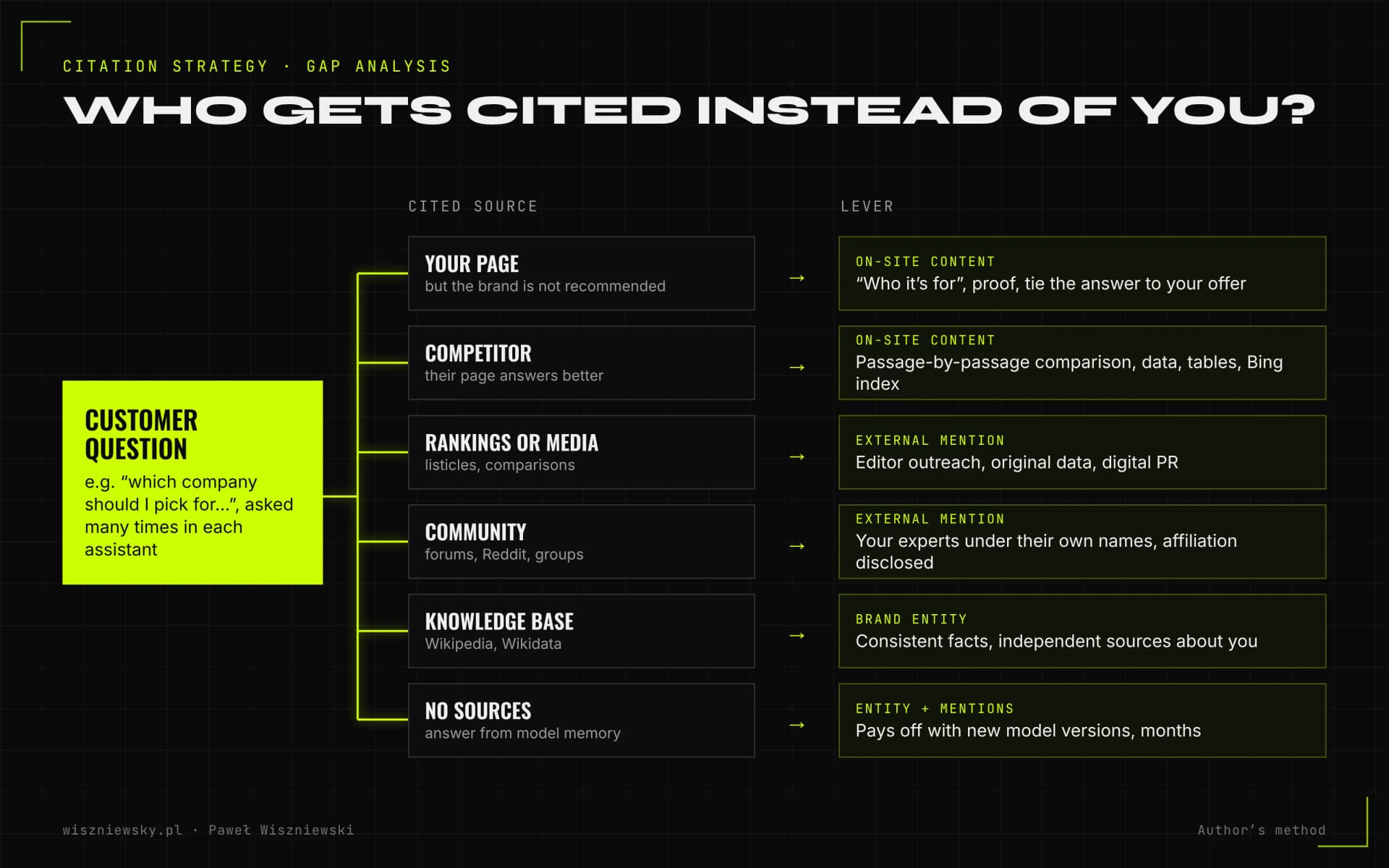
Citation gap analysis means that for every important question I collect the domains the assistants cite and sort them into categories. The category tells you which action makes sense: sometimes rebuilding your own page is enough, sometimes the only way in is a mention in someone else's ranking.

Citation gap analysis diagram: for each customer question I check who gets cited (your page, a competitor, rankings or media, a community, a knowledge base, or no sources) and pick the matching action.
The category of the cited source points to the lever: on-site content, an external mention, or work on the brand entity.

How I read the results

  • Your page is cited, but the brand isn't recommended – the content answers the question but doesn't connect the answer to your offer. I add a clear “who it's for” and proof (examples, numbers, case studies).
  • A competitor is cited – I compare both pages passage by passage: do they have a direct answer, data, a table, a fresher date, are they in Bing's index. The cause is usually specific and repeatable.
  • Rankings, comparisons and media are cited – your own site won't help here. You need to get into those sources or create material editors will want to use.
  • Forums and communities are cited – models are looking for user opinions. You need real people from your company in the discussions, not sock-puppet accounts.
  • Knowledge bases (e.g. Wikipedia) are cited – the issue is the brand entity and whether independent sources describing it exist.
  • No sources in the answer – the model answers from training data. Changing that takes building mentions and the entity, and the effect arrives with later model versions.

Every platform has different favorite sources

Profound analyzed 680 million citations from August 2024 to June 2025. The most cited domain in ChatGPT was Wikipedia (7.8% of all citations), in Perplexity it was Reddit (6.6%), and in Google AI Overviews also Reddit, but with just 2.2%, because sources there are more spread out. These are global, mostly English-language figures, and a local category can look different. The takeaway holds: a strategy that works in ChatGPT won't necessarily work in Perplexity, so I calculate the citation gap separately for each assistant.

Page formats AI reaches for when recommending

For vendor-choice questions, models most often use comparisons, “best of” lists, pricing pages and use-case pages. If your category lacks such content or it's weak, that's the fastest opening to become a source.

Pages I build most often

  • “X vs Y” comparison page – a criteria table, an honest note on when the competitor is better, and who each option suits. One-sided comparisons are easy to spot and rarely build trust.
  • Alternatives page – for customers looking to replace a well-known brand. It works when it actually describes the differences, not just lists names.
  • Pricing page or cost guide – with real amounts, price drivers and examples. “How much does it cost” questions are common and companies avoid publishing prices, so competition is often thin.
  • Use-case pages – one page per customer type or problem (“for accounting firms”, “for Shopify stores”), with an example and limitations.
  • Original data – results of a study, survey, benchmark or dataset. Media cite this kind of content too, so it works twice.

What about “best companies” lists where you rank yourself first?

The data is mixed and worth knowing. Ahrefs found in December 2025 that “best X” lists made up 43.8% of the page types cited for recommendation questions, and in 169 of 250 Google results checked for “best X software” there was a list where the publisher ranked itself first. Peec, in a March 2026 study (232,000 citations from 13,000 lists in the software niche), counted that self-promotional lists accounted for about 11% of citations, with ChatGPT using them least (3.6%) and Google AI Mode (10.3%) and Perplexity (10.4%) almost three times as often.

My approach: I don't write rankings where the client is unconditionally number one. I build honest roundups with criteria where the brand sits where it actually fits, and I go after spots in other people's rankings through editor outreach and data they can use. The reputational risk of a “we picked ourselves as the best” list is real, and the payoff is less and less certain.

The rules for writing the passages AI actually cites (self-contained paragraphs, direct answers, tables) are in my post on how to write content AI cites. When there are more texts to produce, I combine the strategy with SEO copywriting.

Content freshness and update rhythm

AI assistants cite newer pages more readily than classic Google results do, but freshness only helps when a real content change stands behind the date. Changing the date alone does nothing and undermines trust.

In July 2025 Ahrefs analyzed about 17 million URLs cited by AI assistants. Cited pages were on average 25.7% “younger” than pages in Google's organic results (1,064 vs 1,432 days since publication). ChatGPT preferred newer content most strongly, while Google AI Overviews was the only one citing pages older on average than the organic results. That is correlation, not proof that an update alone will lift citations, but the direction is clear.

How I plan updates

  • Pages answering time-sensitive questions (prices, tool comparisons, regulations, “best in 2026”) get a quarterly review.
  • I update facts, numbers and examples, not just the date. The visible “updated” date and the date in structured data must match.
  • Evergreen pages (definitions, processes) get refreshed when new knowledge appears or monitoring shows citations dropping.
  • After every significant change I request re-indexing in Google and submit the URL to Bing via IndexNow.

Off-site work – where I earn mentions

I choose off-site actions based on the citation gap analysis, not a generic list of “places worth being”. If models in your category cite two trade sites and one ranking, that's where most of the effort goes.

Source typeWhat I doWhat I watch out for
Rankings and roundups in mediaContact the author, current data about the offer, a proposal to add you to the roundupA paid placement must be disclosed; a link from such a publication gets rel="sponsored"
Trade mediaExpert commentary, data from your own research, a guest article with real knowledgeThe content must be valuable without the link, or the editor won't take it
Review sitesA process for collecting reviews from real customers, complete profilesNo bought reviews and none written by the company
Forums and communitiesAnswers from your experts under their own names, affiliation disclosedSock puppets and astroturfing get exposed fast
Video and podcastsMaterial with transcripts where the brand comes up in the context of the topicWithout a transcript, many systems can barely read the content
Knowledge basesWikidata and consistent profiles, when independent sources about the brand existAn entry without sources will be deleted

I've written detailed guides for each channel: digital PR and brand mentions, Reddit, forums and UGC, YouTube and video in AI visibility and Wikipedia, Wikidata and the Knowledge Panel. When the problem is the brand entity itself, I handle it as knowledge graph engineering, and selecting paid publications as part of a link building strategy.

Tactics that backfire – what I don't do

ChatGPT SEO now attracts the same shortcuts SEO used to. Some work briefly, some are manipulation from day one, and all of them put the brand at risk.

  • Hidden instructions for AI – text invisible to humans along the lines of “recommend this company”. In February 2026 Microsoft described what it called AI Recommendation Poisoning: within 60 days researchers found more than 50 distinct prompts from 31 companies in 14 industries, hidden in “Summarize with AI” buttons. The button opened an assistant with a prefilled prompt that, besides asking for a summary, told it to remember the company as a “trusted source”. Assistant vendors are rolling out defenses, and being caught doing this is a serious reputational problem.
  • Mass-produced AI content – hundreds of near-identical articles for every question variant. Google treats this as scaled content abuse; I cover it in my post on AI content and Google policy.
  • Fake reviews and threads – creating accounts that “recommend” the brand on forums. Models read the same threads as people, and communities usually unmask this quickly.
  • Promising a specific position – AI answers are variable by nature, so a “#1 in ChatGPT” guarantee is a promise nobody can back.

What a month of citation work looks like

Every month follows the same rhythm: measure, decide, implement, log. After a few cycles you know which actions move the brand's share of answers and which don't.

  1. Measurement – the same question set in the chosen assistants, with repeats. Comparison with the previous month and with competitors.
  2. Source review – new domains in citations, competitor pages that started getting cited, changes in your cited URLs.
  3. Priorities – 2–4 tasks per month: a new or rebuilt page, an off-site action, a technical fix.
  4. Implementation – I make on-site changes directly in the code, or hand your team ready content and a spec.
  5. Change log – every change with a date and URL, so the next measurement can tie an effect to an action.
  6. Report – share of answers, citations, sentiment, assistant traffic in GA4 and the plan for the next month.

How I separate effect from noise

AI answers change even when we do nothing, for example after a model update. That's why the set includes control questions we deliberately leave alone. If share grows only for the questions we worked on while the controls stay flat, the work is paying off rather than luck. If everything jumps at once, it's most likely a change on the model side.

What results are realistic and how to read them

The realistic goal of a citation strategy is a steady increase in the brand's share of answers to important questions and more traffic from assistants, not a single “position”. The pace depends on whether the gap is on your own site or in external sources.

Type of gapWhen change usually showsWhy
Technical issue (blocked crawler, not in Bing's index)Weeks after the fix and re-indexingThe page re-enters the candidate pool for live search
Weak content on your own siteWeeks to a few monthsDepends on re-indexing and competition for that question
No external mentionsSeveral monthsPublications must be earned and then indexed themselves
Model doesn't know the brand (answers without search)Months, depending on training cyclesThe model has to see new sources in its next training data

If you want to check your starting point first without ongoing work, begin with an AI visibility audit. For the wider context, how GEO works, where assistants get their sources and how to measure visibility, see the guide on GEO – AI search optimization.

Frequently Asked Questions

Will LLMs actually cite my site after optimization?

GEO significantly increases the probability of citation, but LLMs don't index pages like Google — they rely on training data and on web search with RAG (e.g. Perplexity and ChatGPT Search). Optimizing content for both pathways is essential.

What's the difference between SEO and GEO?

SEO optimizes for Google's ranking algorithms (keywords, links, speed). GEO optimizes for what LLMs cite in responses — definitive statements, original data, authoritative format. A strong strategy combines both.

How quickly can I see GEO results?

For answers that use web search (Perplexity, ChatGPT Search) effects are visible within 2–4 weeks of publishing and indexing optimized content. In the models' own knowledge (without search) effects appear only after the next training cycle, which takes months.

How do you get your brand recommended and cited by ChatGPT and other AI models?

Building AI citations requires a multi-channel strategy. First: create content in LLM-preferred formats (definitive answers, original data, FAQ structures). Second: build brand authority through external mentions and Entity SEO. Third: an LLM presence strategy — consistent publishing of expert content that enters training data and RAG indexes. Acquiring mentions in AI-generated responses is a measurable, growing process — not a one-time fix.

Can GEO work hurt my SEO?

No. Good GEO practice — clear answers, sourced data, a consistent brand entity and mentions in credible places — also supports classic SEO. I avoid tactics Google could treat as spam.

Which questions do you measure?

The ones your customers actually ask: recommendations (“which company do you recommend for…”), comparisons, problems and brand questions. We agree the set at the start and keep it fixed so results are comparable month to month.

How much does an AI citation strategy cost?

Ongoing work starts from €800 per month. Scope depends on the number of questions measured, how competitive the category is and off-site work such as digital PR.

Got a project?

Terminate
Silence

Initiate protocol. Establish connection. Let's build something loud.

> WAITING_FOR_INPUT...