BACK TO GEO – AI Search Optimization

Knowledge Graph Engineering – Entity SEO & Semantic Brand Authority

Building your brand entity in Google Knowledge Graph via Schema.org and sameAs. AI models like ChatGPT and Gemini will start recognizing you as an industry authority.

Author: Paweł Wiszniewski · Updated:

Key takeaways

Building your brand entity in Google Knowledge Graph via Schema.org and sameAs. AI models like ChatGPT and Gemini will start recognizing you as an industry authority.

  • ›Your brand entity in Google Knowledge Graph
  • ›sameAs connections to Wikidata, LinkedIn, Crunchbase, Google Business Profile
  • ›Schema.org Organization with full attributes: foundingDate, numberOfEmployees, areaServed, knowsAbout

Price: from €1,000

SERVICE DETAILS

I build and optimize your brand's presence as an entity in the Google Knowledge Graph and semantic web. I implement Organization and Person schemas with sameAs attributes linking to Wikidata, LinkedIn, Crunchbase, and industry databases. When language models such as those behind ChatGPT and Gemini — trained on web data — look up your company, they find a rich, consistent entity network, which makes them more likely to cite you.

› INVESTMENT:

from €1,000
const module = new ExecutionProtocol();

// Initializing knowledge-graph-engineering...
› Loading dependencies... OK
› Establishing connection... OK
› Ready for deployment... AWAITING_COMMAND

Paweł Wiszniewski · my approach

What I do differently

A brand entity is the foundation of GEO for me: if Google and AI models don't know unambiguously who you are, no content optimization works fully. I start by checking what Google “knows” about your brand today (Knowledge Graph API) and what ChatGPT, Gemini and Perplexity answer, then clean up the sources these systems draw on. I did the same work for myself: this site has one author entity linked to Wikidata, LinkedIn and GitHub, and for a fashion brand I built the entity architecture described in the case study.

Case study: Fashion Brand SEO/GEO

My take and a real-world example

My take

In the AI era, a brand name without an entity is just a string of characters. A model that can't link your name to an industry, location and people will guess — and guessing ends with you being confused with another company.

From the market

Google described its Knowledge Graph as over 500 billion facts about 5 billion entities (Google, 2020), gathered from public websites and open and licensed databases. If information about your brand is missing from those sources or contradictory, Google and AI models have nothing to build a correct picture of your company from.

Sources: Google: About the Knowledge Graph and knowledge panels

Who this is for

  • Brands that ChatGPT or Gemini describe vaguely, briefly or incorrectly.
  • Companies and experts who want a Google knowledge panel.
  • Brands with inconsistent data online: different names, addresses and descriptions.
  • Companies after a rebrand or merger that want search engines to connect old and new brands.

What you get

  • An entity audit: how Google and AI models recognize your brand and key people today.
  • Organization and Person structured data with complete attributes and sameAs links.
  • A Wikidata record and consistent profiles across databases, directories and industry sites.
  • An About page designed as the primary source of facts about the brand.
  • A mention plan that strengthens the link between your brand and key topics.

How results are measured

  • Presence and content of the Google knowledge panel.
  • Accuracy of AI model answers about the brand.
  • Consistency of company data across key sources.
  • Visibility for brand and brand-plus-topic queries.

Key Benefits

Your brand entity in Google Knowledge Graph — structured data helps Google unambiguously understand who you are as an organization, which tidies up results for branded queries (E-E-A-T is not a direct ranking factor).

sameAs connections to Wikidata, LinkedIn, Crunchbase, Google Business Profile — consistent data across all major knowledge bases that AI models train on.

Schema.org Organization with full attributes: foundingDate, numberOfEmployees, areaServed, knowsAbout — authenticity signals for Google and LLMs.

Knowledge Panel reinforcement — a panel with your logo, description, and social links for branded searches, making your company unmistakable in AI answers.

Foundation for GEO (Generative Engine Optimization) — without a Knowledge Graph entity, LLMs don't know you; with one, you become a cited source in AI-generated responses.

The Process

1

Semantic Presence Audit

I check whether your brand has a Wikidata entry, Google Knowledge Panel, and what Schema.org attributes are already implemented. I identify the gaps.

2

Entity Building & sameAs Setup

I create or update the Wikidata entity, configure Schema.org Organization with full attributes, and add sameAs links to all relevant platforms.

3

JSON-LD Implementation & Recrawl

I implement JSON-LD schemas on the site and request recrawling of key URLs in Google Search Console. An entity can't be submitted to Google — once a knowledge panel appears, I claim it through verification and suggest edits.

4

Knowledge Panel Monitoring

I monitor the Knowledge Panel's appearance and content, verify that LLMs (ChatGPT, Gemini) correctly describe your brand, and correct factual inaccuracies at their sources.

Knowledge Graph / Entity SEO vs classic SEO vs no action

CriterionEntity SEO (Knowledge Graph)Classic SEONo action
Optimizes forYour brand as an entityKeywords and backlinksNothing
AI / LLM recognitionHigh — cited as a known entityIndirect at bestBrand often unknown to AI
Google's understanding of the brandHigh — unambiguous entity and factsModerateLow
Knowledge PanelActively built and reinforcedOccasional, unmanagedUsually absent
Branded query controlConsistent across platformsPartialFragmented data
EffortOne-time build plus monitoringOngoing content and linksNone
Best forBrands wanting AI authorityRanking individual pagesBrands ignoring AI search

Common mistakes

  • Different company names, addresses and descriptions across directories, social media and the site.
  • Creating a Wikidata item without credible sources that confirm it.
  • sameAs links to profiles that are empty, outdated or belong to someone else.
  • An About page with no specifics: founding date, people, location, specialization.

When this service is not worth it

  • Your brand is brand new with no external mentions yet — those need to come first.
  • Your name is very generic or shared with a larger brand and you're not planning a rebrand.
  • You expect a knowledge panel within days — it depends on Google, not a single implementation.
/// GUIDE

Knowledge graph engineering – how I build a brand entity step by step

Knowledge graph engineering means organising every fact about your brand so Google and AI models can recognise it unambiguously, tell it apart from others and describe it without guessing. Below I show what I check in an entity audit, what the fact sheet and the structured data graph look like, how I handle Wikidata and the knowledge panel, and how I measure progress. The theory of entities lives in a separate article, Entity SEO and the Knowledge Graph; this guide is about implementation.

Entity audit – what I check first

An entity audit answers one question: what do Google and AI models “know” about your brand today, and where did they learn it? Before changing anything I collect the picture from several places at once, because each one shows a different layer of the same problem.

SourceHow I check itWhat I record
Results for the brand name (brand SERP)Searching the name, name plus city and name plus industry in a private windowWhether there is a knowledge panel, how many of the top 10 results belong to the brand, whether other companies with similar names show up
Knowledge Graph Search APIQuerying the brand name and key peopleThe entity ID (in the kg:/m/ or kg:/g/ format), type, description and match score; no result is information too
Wikidata and WikipediaSearching the name and its variants, including old namesWhether an item exists, whether there are duplicates, which statements and references it has
Google Business Profile and MapsFinding the listing and comparing it with the siteName, category, address, hours, website link
Registries and databasesCompany registries, industry directories, review sitesLegal name, registration date, address, business description and any mismatches
Brand and people profilesCompany and founder LinkedIn, YouTube, other official channelsWhether the business description matches, whether profiles are active and link to the site
AI assistantsA fixed set of questions in ChatGPT, Gemini, Perplexity and CopilotWhat the models say about the brand, which sources they cite, where they get it wrong

I treat the Knowledge Graph Search API with care. Google's documentation describes it as a read-only API that returns individual entities without the connections between them, and says it is not suitable as a production-critical service. So I use it as an indicator (does the entity exist, how is it described, does that change over time), not as an oracle.

Questions I ask AI assistants

  1. What does [brand] do? (checks category and description)
  2. Who founded [brand] and who runs it? (checks people)
  3. Where does [brand] operate and since when? (location, date)
  4. Which companies offer [service] in [city or country]? (does the brand appear in recommendations)
  5. [brand] or [competitor] – what's the difference? (what the model associates the brand with)

I ask each question several times, because a single model answer is random. The method is described in the AI visibility audit, which I often run alongside this service.

The brand fact sheet – one source of truth

The fact sheet is a table in which every fact about the brand has one approved value, a source that confirms it and a list of places where it appears. It is the most important output of the audit, because every later step (About page, JSON-LD, Wikidata, profiles) copies values from this sheet rather than from memory.

FactExample valueWhy it matters
Canonical nameOne form, always spelled the same wayThe basis of entity recognition
Legal nameFull name as registeredConnects the brand to the company registry
Alternate namesAbbreviation, former name, version without diacriticsLets variants merge into one entity
One-sentence descriptionWho you are, what you do, for whom, whereThe same text on the site, in profiles and in Wikidata
Founding dateYear or full date from the registryEasy to verify and often wrong in directories
Key peopleFounders, management, named expertsPerson entities linked to the company
Location and service areaHeadquarters, branches, marketsSeparates you from same-name companies elsewhere
IdentifiersVAT number, company registration and tax IDsThe strongest signal of unambiguity
Category and topicsIndustry, specialisms, technologiesTies the brand to the topics it should be known for
Official profilesThe list of URLs that genuinely belong to the brandThe candidate list for sameAs

Every fact gets a status: confirmed, conflicting (with a list of places showing a different value) or missing. The list of conflicts is a ready-made correction plan, ranked by how much each source matters to Google and to AI answers.

Entity home – the page that defines the brand

The entity home is one page on your site, usually About, that presents every fact from the sheet in a form readable by people and machines. Other sources should confirm it, and it should link to them.

I design it as a fact page, not a brand-image page. A typical layout:

  • The first paragraph is the description from the fact sheet: name, what you do, for whom, where and since when.
  • People by name, with their role and a link to their profiles or author pages.
  • Company details in the footer or a separate block: legal name, registration and tax numbers, address.
  • Specialisms named plainly, in the same words you use in your offer and profiles.
  • External confirmation: publications, talks, awards, linked to their sources.
  • Links to official profiles that users can see, not just hidden in the code.

Google's Organization structured data documentation recommends placing the markup on your home page or on a single page that describes your organisation. I pick one of those as the entity definition and only reference it from every other page.

The JSON-LD graph – Organization, Person and WebSite linked by @id

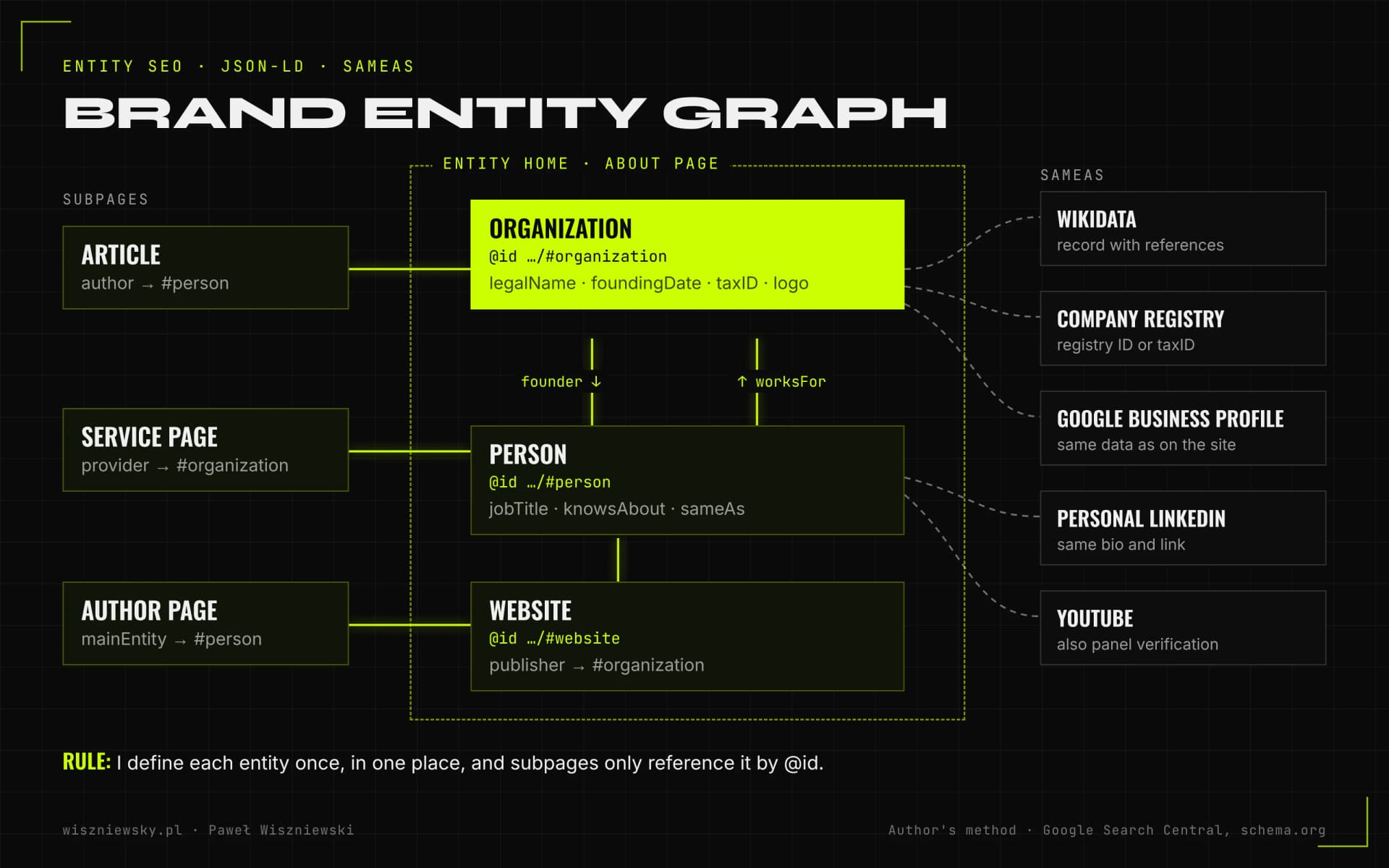
A JSON-LD graph is a set of structured data in which every entity (company, person, website) has a stable @id, is defined once, and other pages and entities refer to it. The whole site then describes one consistent company rather than dozens of unconnected things.

Entity graph: the About page with Organization, Person and WebSite entities linked by @id, plus sameAs links to Wikidata, a registry, LinkedIn and Google.
How I connect entities on and off the site; author's method based on Google's documentation (Organization, Article) and schema.org.

Properties I fill in

Google's Organization documentation (updated September 2026) has no required properties but recommends, among others, name, alternateName, legalName, url, logo, description, address, contactPoint, sameAs, foundingDate, numberOfEmployees and the identifiers vatID, taxID, iso6523Code and naics. It says the last two help distinguish your organisation from others, and that logo helps Google pick the logo shown in results and knowledge panels.

EntityKey propertiesLinks
Organization (or a subtype such as ProfessionalService or LocalBusiness)name, legalName, alternateName, description, foundingDate, address, logo, taxID, vatID, sameAsfounder and employee point to the people's @id
Person (founder, expert, author)name, jobTitle, description, image, knowsAbout, sameAsworksFor points to the company's @id
WebSitename, url, inLanguagepublisher points to the company or person @id
Article or BlogPosting on subpagesheadline, datePublished, dateModifiedauthor and publisher as @id references

This site is built that way: one Person entity with the ID https://wiszniewsky.pl/#person and a business entity that point to each other (founder and worksFor), with a Wikidata item among the person's sameAs links. Blog posts don't redefine the author; they reference that @id. Google's author guidance for Article is simple: list each author separately, put only the name in author.name, and use author.url or sameAs to point to a page that identifies the person.

An important limit: Google's documentation on AI features in Search says no special markup is needed to appear in AI Overviews or AI Mode. The JSON-LD graph is not a ticket in, just a machine-readable version of facts that are already on the page. I implement it directly in code, as in my Schema.org implementation service, and cover types and syntax in the structured data guide.

sameAs – which profiles to add and which to leave out

I only add URLs to sameAs that unambiguously identify the same brand or person and that the brand controls or that are recognised knowledge bases. schema.org defines sameAs as the URL of a page that unambiguously indicates the item's identity, so every wrong link weakens the entity instead of strengthening it.

Profile typeDo I add it?Condition
WikidataYesThe item exists, has references and describes the right entity
WikipediaYesOnly if an article already exists and is about this brand
Company or personal LinkedInYesActive, with the same description and a link to the site
YouTube, X, Facebook, InstagramYesOfficial accounts in regular use
Company registrySelectivelyOnly if the registry has a stable public URL for the company; otherwise the identifier goes into taxID or vatID
Industry directories and review sitesSelectivelyOnly recognised ones with a complete profile
Abandoned profiles, an employee's page, articles about the brandNoThese aren't identity pages; articles are mentions, not profiles

Wikidata in practice – criteria and risks

A Wikidata item makes sense when the brand meets the inclusion rules and serious public sources describe it. Without that the item gets nominated for deletion, and attempts to force it through stay visible in the edit history.

Wikidata's notability policy lists three criteria, and meeting one is enough: the item has a sitelink to a page in a Wikimedia project (such as Wikipedia), it refers to a clearly identifiable entity that can be described using serious and publicly available references, or it fulfils a structural need by making statements in other items more useful. Companies without a Wikipedia article usually rely on the second criterion, which is why I prepare the sources before creating the item.

  • Sources that work as references: a registry entry, articles in trade or local media, publications, award announcements.
  • Weak sources: your own site as the only confirmation, press releases reprinted without editing, social profiles.
  • The item description should distinguish the entity from others with the same name (e.g. “Polish software company, Białystok”), not advertise it.
  • Closing the loop: the item points to the official website, and the site adds the item URL to sameAs.

Step-by-step instructions, with properties and order, are in Wikipedia, Wikidata and the Knowledge Panel. I don't edit Wikipedia on clients' behalf: it's conflict-of-interest territory, and the only honest thing I can do is help earn the independent sources an article could one day be based on.

The knowledge panel – how to claim and correct it

You can't order a knowledge panel or “submit” one through Search Console. It appears when Google has enough confirmed information about an entity, and only then can you claim it and suggest changes.

According to Google's help pages, the process looks like this:

  1. Search for the brand or person and find the knowledge panel.
  2. At the bottom of the panel (sometimes in the About section) click “Claim this knowledge panel”.
  3. Sign in to one of the official accounts Google lists, such as YouTube or the site's Search Console. If Google can't link any account, it asks for more information to verify your identity.
  4. Once verified, suggest changes through Feedback: flag the specific fact, describe what should change and add links that support it.
  5. A verified owner can add other people to manage the panel.

Search Console is only one of the verification routes here. That's why, during implementation, I make sure the site is verified in Search Console on an account the company controls and the official YouTube channel is listed in sameAs. It shortens the path once a panel appears.

Person entities – founders, experts and authors

In many companies, especially service and expert businesses, the founder is the most recognisable entity. A model asked “who is an expert in [topic]” looks for people, not just companies, so I treat Person entities as part of the same job.

  • An author or expert page on the site with a bio, specialism, photo and profile links.
  • Person in JSON-LD with one @id, linked to the company via worksFor and founder.
  • A consistent byline across articles, interviews and talks: the same name, the same role.
  • External profiles (LinkedIn, author pages in the media) with the same description and a link to the company site.

How to build an expert's recognition in AI answers is covered in Expert Personal Brand in the AI Era. The service includes key people if we agree on that at the start, because the number of people drives part of the cost.

Hard cases – rebrands, mergers and names shared with another company

The most work goes into situations where brand data is not just incomplete but contradictory by definition: a name change, a merger, or a name someone else also uses.

SituationRiskWhat I do
RebrandModels and directories keep using the old name; the panel may show the old logoOld name in alternateName and Wikidata aliases, a note about the name change on the entity home, profile updates in order of importance, 301 redirects from the old domain
Merger or acquisitionTwo entities instead of one, or facts from both companies mixed upDecide which entity remains primary, describe the relationship on the site, update Wikidata according to facts and sources
Name shared with another companyThe model mixes up facts or recommends the other companyA strong distinguishing description (industry, city, identifiers), consistent use of the name with a qualifier in profiles, mentions that tie the name to your topic
Multiple locationsData drifting between branchesOne organisation entity plus separate location entities linked to it, each with a complete listing
Personal brand plus a company with a different nameThe model doesn't connect the person and the companyTwo-way Person and Organization links in JSON-LD, on the site and in profiles

When the domain changes, the entity is only one piece. If a rebrand includes a new site address, I combine this work with an SEO migration so you don't lose rankings while tidying the data. If a model keeps repeating false information, see what to do when ChatGPT says something untrue about your company.

Linking the brand to topics – mentions that build the entity

An entity that is recognised but not associated with any topic won't make it into recommendations. The second goal of this service is to connect the brand name with the categories you want to be recommended for.

I do it in three ways: consistently tying the name to topics on your own site (description, specialisms, knowsAbout in structured data), making sure external profiles describe the same specialisms, and planning mentions in places that write about your category. The mention plan is part of the deliverables, but actually earning coverage is separate work, described in LLM citation strategy and in the article on digital PR and brand mentions.

A full path from entity architecture through content to coverage in trade media is shown in the fashion brand case study, where searches for the brand name grew from 840 to 2,350 a month.

How I measure progress in building the entity

I measure progress with a fixed set of indicators, checked before implementation and then monthly, rather than with a single screenshot of the knowledge panel.

IndicatorHow I measure itWhat a change means
Presence in the Knowledge GraphKnowledge Graph Search API: is there a result, what type and descriptionGoogle has recognised the brand as an entity or changed its description
Knowledge panelSearching the name, screenshot and list of facts in the panelGoogle has enough confirmed data to show a panel
Brand SERPHow many of the top 10 results are the brand's pages and profilesControl over what someone searching the name sees
Accuracy of AI answersA fixed set of factual questions, each asked several times; share of answers without errorsModels are using the corrected sources
Source consistencyNumber of conflicts left in the fact sheetProgress of off-site clean-up
Branded searchesQueries containing the brand name in Search ConsoleGrowing recognition, beyond AI too

For testing AI answers I use my own tool described in the AnswerLyzer case study, which scores model answers with an LLM-as-a-judge method. A manual version of this measurement is in the article on the AI visibility audit.

Timeline – what depends on me and what depends on Google and AI models

Part of the work has a predictable timeline because I do it myself. The rest depends on when Google reprocesses the pages and when external sources and models pick up the changes, and nobody can honestly guarantee that date.

StageWho controls itWhat to expect
Entity audit and fact sheetMe, with your sign-off on the factsReady at the start of the engagement
Entity home and JSON-LD graphMe (implemented in code or CMS)Live once the fact sheet is approved
Profile and directory fixesMe or you, depending on accessSome immediately, some waiting on each site's verification
Wikidata itemMe, but ultimately the Wikidata communityCreated once sources exist; editors may discuss it
Google reprocessing the siteGoogleFrom a few days to a few weeks
Knowledge panel and correct AI answersGoogle and model providersUsually a matter of months, with no guarantee

This service is part of broader GEO, or AI search optimisation. If you're not sure where to start, I usually suggest the visibility audit first, because it shows whether the problem is the entity, the content or a lack of mentions.

Frequently Asked Questions

Can any company get a Knowledge Graph entry?

Yes, but Google favors organizations with sufficient web visibility — links from credible sources, press mentions, a Wikidata entry, or listings in industry databases. For very new companies, I first build these signals.

How do I check if my company is in the Knowledge Graph?

Search your company name in Google. If a Knowledge Panel appears on the right side with a logo, description, and links, you're in the KG. No panel doesn't mean no entity, though: Google's Knowledge Graph Search API is a more reliable check.

How does this relate to ChatGPT and Gemini?

The models behind ChatGPT and Gemini were trained on billions of web pages including Schema.org structured data and Wikidata. Companies with rich KG entities are recognized by LLMs as credible sources and are cited in AI responses far more often than unknown brands.

What is Entity SEO and how does Knowledge Graph engineering affect search rankings and AI visibility?

Entity SEO is the practice of optimizing your brand as a recognized semantic entity — not just for keywords but for who you are as an organization in the knowledge graph. Knowledge graph SEO and semantic entity positioning help Google unambiguously understand your brand as an organization (E-E-A-T is not a direct ranking factor), while building LLM brand authority makes AI models more likely to cite you in generated responses. Knowledge Graph engineering is the foundation of any serious GEO strategy.

How long before Google and AI recognize the brand correctly?

Google sees site and structured data changes after recrawling, usually within weeks. A knowledge panel and correct AI answers require consistent signals from many sources, so it's measured in months rather than weeks.

Can my company have a Wikidata item?

If independent, credible sources describe it (media, registries, industry publications), usually yes. The criteria are looser than Wikipedia's. I help prepare an item that follows the rules so it doesn't get deleted.

How much does knowledge graph engineering cost?

It starts from €1,000. The price depends on how many sources need cleaning up, the current state of your brand data online and whether key people such as founders or experts are included.

Got a project?

Terminate
Silence

Initiate protocol. Establish connection. Let's build something loud.

> WAITING_FOR_INPUT...