2,500-4,000 word articles written to compete for Google's top positions and convert readers. Every piece starts with SERP analysis, semantic structure, and built-in CTAs.
›2,500-4,000 word article with full semantic optimization: primary keyword, related terms and subtopics, and entities in natural context
›Semantic H1→H2→H3 structure based on SERP analysis of top 10 ranking results
›5-8 internal links with matched anchor text
Price: from €500 / article
SERVICE DETAILS
I write expert articles (2,500-4,000 words) optimized for both Google (full topic coverage, related terms and subtopics, internal linking) and the reader (readability, concrete value, natural CTAs). Every article starts with deep SERP analysis for the target keyword — I understand what Google wants to rank and build a better version of what's already there.
› INVESTMENT:
from €500 / article
constmodule = newExecutionProtocol();
// Initializing seo-copywriting... › Loading dependencies... OK › Establishing connection... OK › Ready for deployment... AWAITING_COMMAND
Paweł Wiszniewski · my approach
What I do differently
I start every article by analysing what's missing from the texts currently in the top 10 and in AI answers — partly with my own Content Intelligence tool. I use AI as a research assistant but never mass-generate articles: each one has specific sourced data, direct answers and an element of experience that can't be copied from other sites. If you have an in-house expert, I run a short interview — their knowledge is the strongest differentiator a text can have.
I have nothing against writing with AI — I use it myself. I do have a lot against publishing AI text without editing and fact-checking. The tool isn't the problem; the lack of responsibility for content is.
From the market
In early 2023 CNET had to correct 41 of 77 articles written with an internal AI tool, some with factual errors, and paused its use. Google's guidance stresses it rewards quality regardless of how content is produced — but errors and a lack of experience aren't quality.
Companies that need expert articles, not text written to a character count.
Specialist industries: tech, finance, law, healthcare and B2B.
Brands whose current content doesn't rank or keeps slipping.
Teams without time for research and writing but with knowledge worth showing.
What you get
A brief based on SERP analysis and the questions users ask AI assistants.
An article with direct answers, data, sources, tables and an FAQ.
On-page optimization: title, meta, headings, internal links and structured data.
An interview with your in-house expert so the text contains real experience.
Agreed revision rounds and suggestions for graphics or tables.
How results are measured
Article rankings and organic traffic over the following months.
Citations in AI Overviews and assistant answers.
Reading time and clicks through to offer pages.
Leads and enquiries from the article.
Key Benefits
2,500-4,000 word article with full semantic optimization: primary keyword, related terms and subtopics, and entities in natural context — no keyword stuffing, no thin filler.
Semantic H1→H2→H3 structure based on SERP analysis of top 10 ranking results — your article covers the topic more completely than anything currently ranking.
5-8 internal links with matched anchor text — distributes link equity across your domain and extends average session time.
Built-in CTAs at natural conversion points in the text — not disruptive banners, but smooth transitions to your offer exactly when the reader is primed.
Article structured data (author, publish and update dates) that helps Google understand the piece, plus a meta title and description written for CTR — a compelling title and snippet earn more clicks from the same position.
The Process
1
SERP analysis and brief
I analyze the top 10 results for your target keyword: their length, structure, topical coverage, and backlink anchor texts. I build a brief that targets every gap they leave open.
2
Expert research
I gather current data, studies, and statistics from authoritative sources (industry reports, Statista, academic research) — E-E-A-T demands concrete evidence, not vague claims.
3
Writing and semantic optimization
I write the article with natural keyword integration, use Surfer SEO or Clearscope for semantic coverage verification, and optimize the structure for Featured Snippet capture.
4
Editing, formatting, and meta data
I edit for readability (Flesch score), add visual breaks, optimize the title tag (60 chars) and meta description (155 chars) for maximum CTR in the SERP.
Common mistakes
✕Writing to a character count instead of the reader's questions.
✕Repeating what's already in the top 10 without any new information.
✕Mass-generating articles with AI without editing or fact-checking.
✕No sources, author or date — signals Google and AI use to judge credibility.
When this service is not worth it
—You need a large volume of short filler texts — that's not how I work.
—The topic needs expertise nobody in your company can verify.
—You're looking for the lowest per-word rate.
/// GUIDE
SEO copywriting – how an expert article gets made, from SERP analysis to publishing
In SEO copywriting, the writing itself takes less time than what happens before and after it: reading the results, choosing an angle, getting knowledge out of an expert, checking facts, preparing the on-page elements and judging the article once it is live. Below I walk through each of those steps in detail, with the checklists I use on every piece. The general rules for writing for Google and AI live in the content marketing guide; this page is about the craft of a single article.
SERP analysis before writing – what exactly I record
SERP analysis answers three questions: what format Google expects for the query, what every top result has in common, and what all of them are missing. The answer to the third question is where the idea for an article with a real reason to rank higher comes from.
I go through the top ten results in a private window, on desktop and on mobile, and fill in the same row of a spreadsheet for each one.
What I record
Example observation
What it tells me
Page type
Blog guide, service page, store category, forum thread, video
Whether an article is the right format at all
Angle and title promise
"step by step", "2026 pricing", "X vs Y"
Which intent Google treats as dominant
Topic coverage
List of H2s and questions the page answers
Must-have subtopics and the ones everyone skips
Evidence
Own data, screenshots, tests, or just generalities
The bar my first-hand element has to clear
Freshness
Update date, outdated figures, dead links
A chance to overtake a page that has aged
Author
Expert byline, editorial team, no author
How much author credibility matters in this niche
SERP features
AI Overview, People Also Ask, video, forum results, map pack
Where else the page can appear and how to phrase answers
In parallel I ask several AI assistants the same question and note which sources they cite and which follow-up questions they split the topic into. I describe how I find those questions in the post on keyword research and query fan-out.
When I tell you an article is the wrong move
The top results are product pages or store categories. Google sees purchase intent, and a blog guide rarely beats a page where you can buy.
Tools dominate the results (calculators, converters, search tools). An article won't replace a working tool.
Local results and a map sit on top. Your Business Profile and a location page matter more than a post.
The query is really a competitor's brand name. Writing for someone else's name seldom brings traffic that turns into clients.
The first-hand element – where I get it for every article
A first-hand element is the part of an article that can't be rebuilt from other pages or generated by a language model: data, a test, an implementation story, an opinion grounded in experience. It decides whether the piece is yet another version of the same thing or a source worth citing.
Google's May 2025 post on doing well in AI search encourages unique, "non-commodity" content, and its guidance on high quality reviews (updated December 2025) explicitly asks for evidence of first-hand experience: visuals, measurements, comparisons. So before I write, we agree which of the types below your company can realistically provide.
Type
Example
How I verify it
Own data
Breakdown of client enquiries, average turnaround, the most common faults reported to support
Export from a system or sheet with the period it covers; no client-identifying data
Test or comparison
Two tools run on the same task
Written test conditions and screenshots
Process description
How the company quotes, delivers or onboards
Confirmed by the person who does it every day
Example from practice
A typical client situation and the decision taken
Permission to publish, or an anonymised, generalised example
Expert opinion
A position in an industry debate, with reasoning
Quote approved by the expert
Visual material
Photo from a project, a diagram, a dashboard screenshot
Origin and usage rights
If none of these can be obtained, I say so before starting. Then we either switch to a topic where the company has something to say, or book the interview described below.
Expert interviews – turning in-house knowledge into content
An expert interview is a short, prepared conversation with someone in your company who knows the topic from practice. One call usually yields material for the whole article: examples, exceptions, figures from daily work and opinions that no other page has.
How it runs
The day before, I send the expert the questions and a draft outline so they know what I'm after.
We talk online; I record with permission and transcribe.
From the transcript I pick passages that fill the gaps found in the SERP analysis and mark them in the draft.
Quotes and facts go back to the expert for approval together with the finished article.
If the expert will be the author or reviewer, I draft a short bio and we agree on the byline.
Questions I ask almost every time
What do clients ask most often before they buy or sign?
What do people get wrong here, and what does it cost them later?
Where do you disagree with what others in the industry write?
What does this process look like at your company, step by step, and where does it usually stall?
When do you talk a client out of this solution?
What data from your work could we show without exposing clients?
Types of SEO articles and how their structure differs
Structure follows intent, not a single template. A how-to, a comparison and a pricing article answer different questions, so they have different mandatory parts and a different place for the call to action.
Type
Typical query
Mandatory parts
Where it leads to the offer
Step-by-step guide
how to do X
Numbered steps, prerequisites, common problems, end result
At the step where readers most often need help
Definition and explainer
what is X
Definition in the first sentence, an example, differences from related terms
At the end, as the next step
Comparison or ranking
X vs Y, best X
Criteria, a table, a verdict for different situations, test evidence
At the verdict, clearly labelled if your offer is one of the options
Cost and pricing
how much does X cost
Cost components, sourced ranges, factors that push the price up or down
High up, because the intent is close to a decision
Checklist
X checklist
Tick-off list, order, "done" criteria
At the items that need a specialist
Case study
X implementation example
Starting point, decisions, result with a date and measurement method
At the end and in the results summary
Comparisons and rankings need the most care. Google's guidance on high quality reviews (updated December 2025) expects, among other things, an explanation of what sets products apart, pros and cons based on your own research, a justification for any "best" pick, and ranked lists that stand on their own. If the company has no experience with the options being compared, I advise against a ranking and propose a piece on selection criteria instead.
Title, meta description and URL – how I write them and why Google rewrites them
The title and meta description are the first thing a searcher sees, but Google treats them as a suggestion, not an instruction. Well-written ones are more likely to be shown as they are.
According to Google's documentation on title links (updated December 2025), the title element has no length limit; in results it is truncated to fit the device width. Google may generate its own title when the original:
is incomplete, for example has an empty part before or after a separator,
is outdated, for example contains an old year that conflicts with the visible heading,
doesn't accurately describe the page,
is the same boilerplate across many pages,
competes with several headings of similar weight, so no main title is clear,
is in a different language or script from the content,
repeats the site name that Google already shows in the result.
Descriptions work the same way. Google's snippet documentation (updated April 2026) says snippets are created primarily from page content, and the meta description is used when it describes the page more accurately. There is no length limit; descriptions should be unique per page and genuinely descriptive, not a list of keywords.
My rules
Title: main phrase first, around 60 characters in total so the important part shows on mobile, no year unless I commit to updating it every year.
H1: same topic as the title, but it can be longer and more natural. Exactly one per page.
Meta description: 120–160 characters, full sentences, a concrete promise of what's inside, never cut off mid-thought.
URL: short, includes the phrase, no dates or words that will age. I don't change it after publishing.
Variants: you get two alternative titles so we can test another one after a few weeks if CTR is low.
Fact-checking and sources – my protocol
Every number, date and quote in my articles has a source I checked myself, and that source is named in the text. It's the simplest way to make a piece credible to readers, to Google and to AI models, which like to cite passages with specifics.
Primary source, not a middleman. If a blog quotes a statistic, I look for the report or documentation it came from. If I can't find it, the number stays out.
Date and scope. I note when the data was collected and which country and sample it covers. A US study from a few years ago is described as exactly that, not as a fact about your market.
Exact wording. I compare the figure with the original, including the unit and whether it's a median, a mean or a share.
Publisher and year in the sentence. I write "according to Google's 2026 documentation", not "studies show". A paragraph like that can be quoted without context.
A source list under the article with links, so editors and readers can check.
Link checks after publishing. A dead link to the report behind a figure undermines the whole paragraph, so I check links again during updates.
Topics where a mistake can hurt someone
Google's Search Quality Rater Guidelines (September 2025 version) define YMYL topics by the risk of harm to people's health, safety or financial stability, or to the welfare of society, and note that most topics are not YMYL. For health, finance or legal pieces I require a review by a suitably qualified person on your side and show them on the page as the reviewer. Without that I don't take the article, which is also listed under "not for you".
Editing in practice – the same paragraph before and after
The difference between text written "for SEO" and text that ranks and gets cited is easiest to see in a single paragraph. Below is a typical version I get to fix and the version after my edit, using the question of title length.
Before editing
After editing
"In today's digital landscape, the right title length is extremely important for SEO. Titles that are too long get cut off, which hurts your rankings, so it's worth keeping the optimal length in mind."
"Google sets no length limit for the title tag, but it truncates titles in results to fit the device width (Google Search Central, 2025). That's why I put the main phrase at the start and keep the whole title around 60 characters, so the important part stays visible on a phone."
What changed:
The first sentence answers the question instead of announcing it.
An unverifiable claim about rankings is gone, replaced by a fact with a source and a year.
The paragraph ends with the author's decision and the reason for it, which is the experience element.
Filler is cut ("in today's digital landscape", "extremely important", "worth keeping in mind").
I edit a client's existing article the same way. I go deeper into paragraphs that AI models pick for answers in How to write content AI cites, and into the limits of using AI for writing in the post on AI content and Google policy.
What you get with the article – on-page elements ready to ship
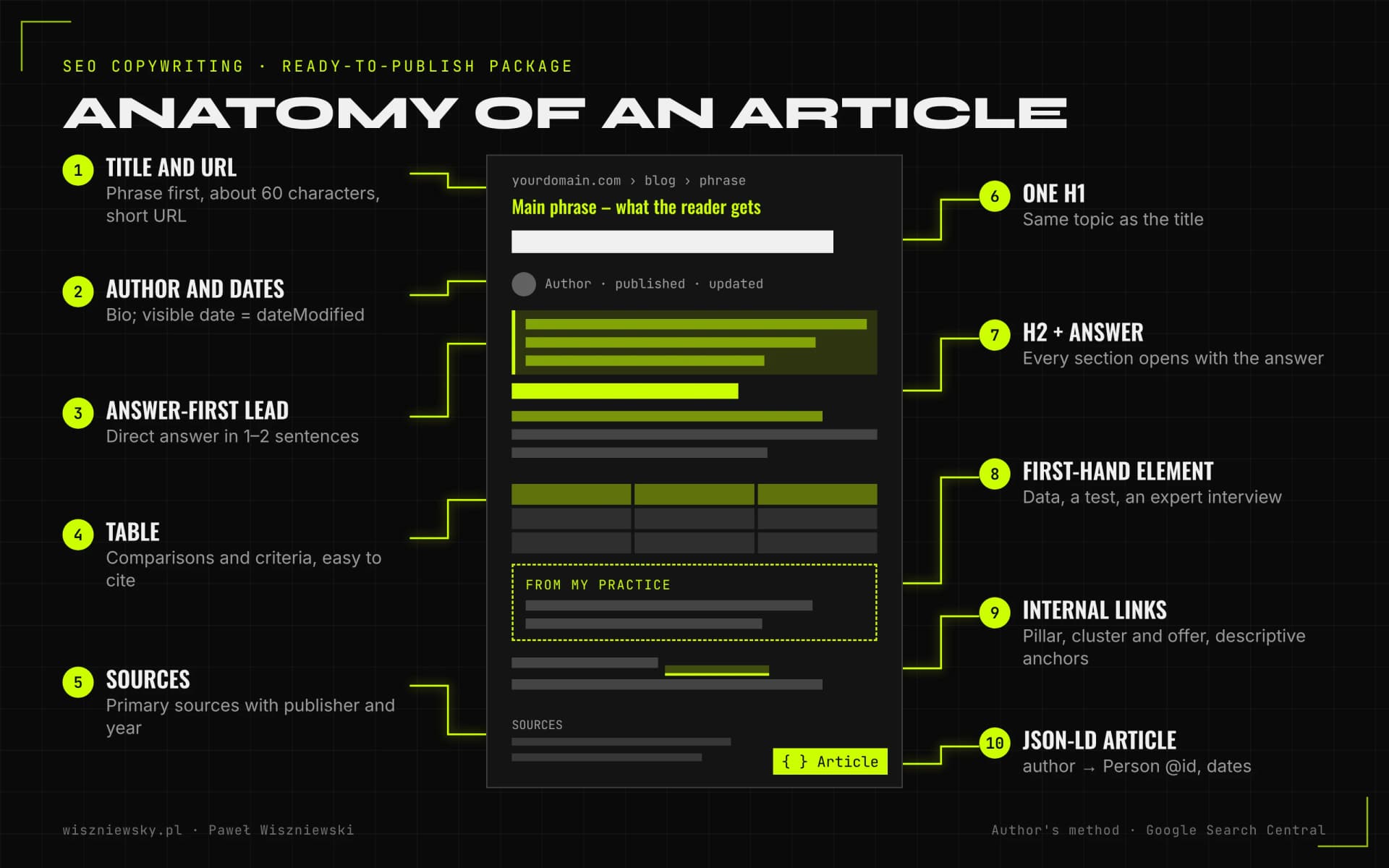
I hand over an article as a ready-to-publish package: text, metadata, image proposals, links and structured data. If I have access to your CMS, I publish it myself; if not, you get instructions on which field takes what.
What goes into an article I hand over for publishing; author's method based on Google Search Central documentation.
Element
What I prepare
What it's based on
Metadata
Title with two alternatives, meta description, URL
Google's documentation on title links and snippets
Structure
One H1, H2s and H3s as questions or phrases, an answer-first lead
SERP analysis and follow-up questions from the brief
Tables and lists
Comparisons in tables, processes in numbered lists
Readability and easy citation of passages
Images
Image or diagram proposals, short descriptive file names, alt text
Google's image guidelines: descriptive alt without keyword stuffing, image near related text
Internal links
Links to the pillar, cluster posts and the offer with descriptive anchors, plus a list of older posts that should link to the new one
Google's link documentation
Source links
Links to primary sources in the text and a source list underneath
The fact-checking protocol
Author and dates
Byline linked to a bio, visible published and updated dates
Google's documentation on publication dates
Structured data
Article or BlogPosting JSON-LD with author, datePublished and dateModified
Google's Article structured data documentation
Details developers ask about most
Author in structured data: Google's Article documentation (updated September 2026) recommends a separate entry per author, only the name in author.name, and author.url or sameAs pointing to a page that identifies the person. If the site already defines a Person entity, I reference its @id instead of redefining the author.
Dates: the visible date and dateModified must match. Google also asks that the date describe when the page was published or updated, not the event the article is about.
FAQ at the end: I add questions when they help the reader, but I don't promise rich results. Since August 2023 Google shows FAQ rich results mainly for well-known, authoritative government and health sites.
Link anchors: the test in Google's documentation is simple: read the anchor text alone and check whether it's clear where it leads. "Click here" fails it.
If your site doesn't yet have a sound article template (author, dates, structured data), that's a separate job under Schema.org implementation. Types and properties are covered in the structured data guide.
The first 90 days after publishing – how I judge an article and what I fix
I don't judge a new article after a week. For the first three months I check in Search Console whether it's indexed, which queries it shows up for and how impressions move, and only then decide on changes.
What the data shows
Most common cause
What I do
Page isn't indexed
No internal links, a technical problem, page judged low value
Check the URL with Search Console's URL Inspection, add links from strong pages
Impressions for different queries than planned
Google reads the piece differently from the brief
Sharpen the title and opening paragraphs, or re-plan if those queries are valuable
Rankings on page two or three
Missing subtopics or weak topical context on the site
Add sections from People Also Ask, strengthen the cluster and internal links
High impressions, low CTR
Title or description misses the intent
Test an alternative title from the package
Traffic but no clicks to the offer
No natural path from content to service
A new call to action, a link to the service in the section where the reader has the problem
A competitor overtook it
Newer data or a better example
Update the facts and add a first-hand element
Traffic from AI Overviews and AI Mode is counted in Search Console's regular performance report, so I check presence in AI answers separately by asking assistants the questions from the brief. How to set up tracking for visits from ChatGPT and Perplexity in GA4 is in How to measure traffic from ChatGPT, Perplexity and AI Mode. Older posts that lose traffic over time are a different problem, covered in the post on content decay.
What I need from you and how I hand the article over
I don't need much to write a good article, but a few things are essential. Without them the piece will be correct, but it won't have the edge you're paying for.
Access to an expert for a short call, or written answers to the questions above.
Read-only Search Console access, to see which queries the site already appears for and make sure the new piece won't compete with an old one.
Offer details: which service or product the article should lead to and what sets it apart.
Brand rules, if you have them: tone, banned words, how to address the reader.
One approver who collects the team's feedback, rather than several parallel threads.
You get the text in a document with comments explaining the key decisions (why this title, why this section, which source backs a figure). I write the Polish version from scratch rather than translating, and if you publish in several languages I make sure the versions are linked, as described in the post on hreflang and international SEO.
When an article alone isn't enough
A single article solves the problem of one topic. If weak visibility has a different cause, a better text won't change much, so before ordering it's worth checking whether you're in one of these situations.
Situation
What helps more than another article
You don't know what to write about or in what order
5-7 business days from brief approval to final delivery with metadata and Schema.org markup included. For orders of 4+ articles, we can negotiate a rolling monthly schedule.
What languages do you write in?
English and Polish. For Western European or US clients — EN, written natively. For the Polish market — PL native. No machine translation — each language version is written from scratch.
How many revisions are included?
Two revision rounds are included in the price. With a detailed brief, one round is usually enough. Third round and beyond — €75 each.
Do you write with AI?
AI helps me with research, competitor analysis and first structure drafts. Content, facts, examples and editing are mine, and every text is checked for sources. Google judges quality, not the tool, but mass-produced low-value content hurts.
Will the article be optimized for AI Overviews and ChatGPT?
Yes. Every section opens with a clear answer, and the text includes sourced data, tables or lists and follow-up questions — the format most often cited in AI answers.
How much does an SEO article cost?
Articles start from €500. The price depends on length, how specialized the topic is and whether an expert interview and graphics are included.