BACK TO GEO – AI Search Optimization

Perplexity, Copilot & ChatGPT Search Optimization

Content and site architecture optimization for next-gen AI search engines — Perplexity, ChatGPT Search, and Gemini. Be the cited source, not just a link in the results.

Author: Paweł Wiszniewski · Updated:

Key takeaways

Content and site architecture optimization for next-gen AI search engines — Perplexity, ChatGPT Search, and Gemini. Be the cited source, not just a link in the results.

  • ›Content structure optimization for AI data extraction
  • ›E-E-A-T signals for AI search: author expert bio, last-updated date, external source citations
  • ›Technical compatibility with AI crawling: no JavaScript-only content rendering, fast TTFB, clean semantic HTML

Price: from €1,200

SERVICE DETAILS

Perplexity and ChatGPT Search don't return a list of links — they synthesize an answer from multiple sources and cite them as references. I prepare your site for this model: I optimize information structure (headers as questions/answers, bullet lists, definitions), tune meta data, implement structured data, and build E-E-A-T authority that makes AI choose you as its source.

› INVESTMENT:

from €1,200
const module = new ExecutionProtocol();

// Initializing perplexity-searchgpt-optimization...
› Loading dependencies... OK
› Establishing connection... OK
› Ready for deployment... AWAITING_COMMAND

Paweł Wiszniewski · my approach

What I do differently

Few people remember that Copilot relies entirely, and ChatGPT partly, on Bing's index — companies optimize for Google and wonder why they're missing from AI answers. So I start with basics most skip: Bing Webmaster Tools, IndexNow, AI crawler access in robots.txt and the firewall, and content visible without JavaScript. Only then do I rebuild content for citations. I describe the whole process step by step in my post on Bing, Copilot and IndexNow.

Read my guide on the blog

My take and a real-world example

My take

A common AI search visibility problem isn't content but access. A company invests in articles while its firewall has been turning AI crawlers away for months.

From the market

On 1 July 2025 Cloudflare announced it would block AI bots by default on customer sites, after more than a million customers had already switched on such blocking. Many companies don't know their site became unreachable for some AI search engines. On top of that, ChatGPT search relies heavily on Bing's index, which many companies ignore completely.

Sources: MIT Technology Review: Cloudflare blocks AI bots by default (2025) · Notebookcheck: ChatGPT search relies on Bing

Who this is for

  • Companies whose customers use Perplexity, Copilot or ChatGPT Search instead of Google.
  • B2B and tech brands whose audience adopts new tools early.
  • Sites that rank well in Google but are absent from AI search engines.
  • Sites with expert content that should be cited as a source.

What you get

  • Bing Webmaster Tools and IndexNow setup, used by Copilot and some ChatGPT answers.
  • A check of AI crawler access (robots.txt, firewall, rendering without JavaScript).
  • Content rebuilt into passages with data, sources and a clear answer.
  • Comparison and ranking pages that AI search engines reach for.
  • Citation monitoring in Perplexity, Copilot and ChatGPT Search.

How results are measured

  • Citations of your domain in AI search engines.
  • Traffic from Perplexity, Copilot and ChatGPT in GA4.
  • Page indexing in Bing.
  • Brand share of answers to key questions.

Key Benefits

Content structure optimization for AI data extraction — Perplexity prefers pages with clear question/answer headers, bulleted lists, and specific dates and numbers.

E-E-A-T signals for AI search: author expert bio, last-updated date, external source citations — signals that content comes from someone with genuine first-hand expertise.

Technical compatibility with AI crawling: no JavaScript-only content rendering, fast TTFB, clean semantic HTML — Perplexity crawls differently from Googlebot.

Topical authority building: content strategy covering an ENTIRE topic, not just selected keywords — AI prefers sources with deep subject-matter expertise over broad content farms.

Citation monitoring in Perplexity and ChatGPT Search with a monthly report measuring AI visibility growth and referral traffic from AI search engines.

The Process

1

AI Search Visibility Analysis

I test your key industry phrases in Perplexity and ChatGPT Search, identify who is being cited instead of you, and analyze why.

2

Technical Audit for AI Crawling

I check page speed (TTFB, LCP), content rendering method (SSR vs. CSR), and HTML semantics — factors affecting whether Perplexity can efficiently extract your content.

3

Content & Structure Optimization

I restructure key pages into the format preferred by AI search engines: Q&A sections, specific lists, update dates, author bios, and citations of external sources.

4

Implementation & Monitoring

I implement changes, resubmit updated sitemaps in Google Search Console and Bing Webmaster Tools, notify search engines of changes via IndexNow (Perplexity has no sitemap submission — I make sure PerplexityBot is allowed in robots.txt), monitor citations and referral traffic from AI search engines for 90 days.

Perplexity / ChatGPT Search optimization vs classic SEO vs no action

CriterionPerplexity / ChatGPT Search optimizationClassic SEONo action
Target engineAI answer engines that synthesizeGoogle link rankingsNone
Desired outcomeBe a cited source in answersRank a blue linkInvisible to AI search
Content structureQ&A headers, lists, dated factsKeyword-focused pagesUnstructured
E-E-A-T signalsAuthor bio, dates, citationsModerateWeak
Technical requirementAI crawler access, server-side rendering, Bing indexRecommendedOften unmet
Referral traffic sourceperplexity.ai, chatgpt.comGoogle organicNone new
Best forBrands in AI-search nichesTraditional organic trafficBrands ceding AI search

Common mistakes

  • AI crawlers blocked by a firewall or CDN without the site owner knowing.
  • The site never verified in Bing Webmaster Tools.
  • Content loaded only via JavaScript, which AI crawlers don't render.
  • Pages without dates, authors and sources — AI search engines prefer content they can verify.

When this service is not worth it

  • Your audience doesn't use Perplexity or Copilot and Google dominates your niche.
  • You have no expert content worth citing — it needs to be created first.
  • You expect instant results without content changes.
/// GUIDE

Perplexity, Copilot and ChatGPT Search optimization – how I prepare a site step by step

Perplexity, Microsoft Copilot and ChatGPT Search pick their sources differently from Google, so ranking well in Google doesn't mean any of them will cite you. Below I explain how I diagnose missing citations, what I implement on the technical side, how I rework content and how I check whether the changes worked. It builds on the GEO guide and focuses on these three engines.

Why Perplexity, Copilot and ChatGPT don't cite you – a four-layer diagnosis

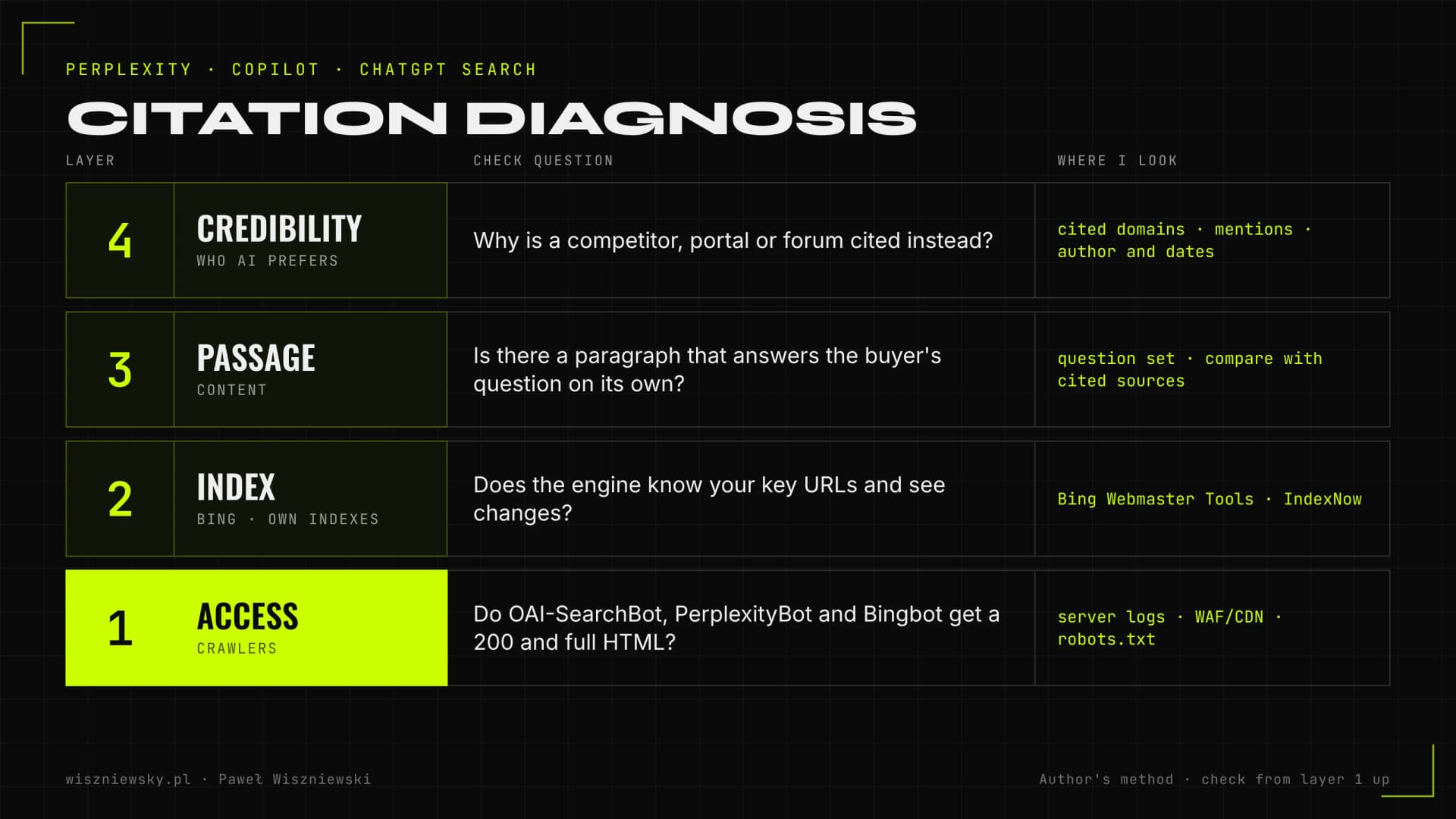
Missing citations almost always come down to one of four layers: the crawler can't fetch the page, the engine doesn't have it in its index, the page has no passage that matches the question, or other sources look more credible. I check them in that order, because each layer only matters once the one below it works.

The order matters for a practical reason. Rewriting content is the most expensive part of the job, and it achieves nothing if the firewall answers PerplexityBot with a 403 or Bing only knows your homepage. So I always spend the first week on the technical layers and only then choose which pages to rewrite.

Four layers for diagnosing missing citations in Perplexity, Copilot and ChatGPT: crawler access, search index, answer passage and source credibility, each with a check question and the tool used.
I work from the bottom up: without access and indexing, content work has nothing to stand on.
LayerCheck questionWhere I look
1. AccessDo OAI-SearchBot, PerplexityBot and Bingbot get a 200 status and the full content?Server logs, WAF and CDN rules, robots.txt, a test with JavaScript disabled
2. IndexDoes Bing know the key URLs, and how quickly does it see changes?Bing Webmaster Tools (URL inspection, indexing report), IndexNow
3. PassageIs there a paragraph that answers the customer's question on its own?Content review against the question set, comparison with the sources being cited
4. CredibilityWhy does AI prefer to cite a competitor, a portal or a forum?Analysis of cited domains, brand mentions, author and dates on the page

AI crawler access – how I check robots.txt, the firewall and server logs

A correct robots.txt is only the first of three checkpoints. A crawler can be allowed in the file and still be blocked by a WAF rule, a CDN bot-protection setting or a rate limit. That's why I confirm access in the server logs, not in the configuration.

I covered the split between training and search crawlers, and how to configure robots.txt, in the GEO guide and in the post on AI crawlers. Here I focus on verifying it in practice.

Verify by IP address, not by name

Anyone can send a user-agent string, so a rule like "let in everything that calls itself PerplexityBot" also opens the door to impostors. OpenAI and Perplexity publish the IP ranges of their crawlers as JSON files, and Microsoft documents how to verify Bingbot with a reverse DNS lookup. In firewall rules I therefore pair the crawler name with its official address pool.

CrawlerWhat it doesHow to verify it
OAI-SearchBotSearch results in ChatGPTIP list: openai.com/searchbot.json
ChatGPT-UserFetches a page when a user asks for itIP list: openai.com/chatgpt-user.json
PerplexityBotBuilds the Perplexity results indexIP list: perplexity.com/perplexitybot.json
Perplexity-UserFetches a page during a user's questionIP list: perplexity.com/perplexity-user.json
BingbotBing's index, which Copilot relies onReverse DNS (host under search.msn.com) or the Verify Bingbot tool in Bing Webmaster Tools

What I look for in the logs

  1. I filter visits from the crawlers above over the last 30 days and group them by status code.
  2. I look for 403, 429 and 503 responses, which usually mean a WAF block, a rate limit or bot protection.
  3. I compare the URLs the crawler fetches with the pages I want cited. If key pages never show up in the logs, the problem is internal linking or the sitemap.
  4. I check that the response contains the full content without running JavaScript, because AI search crawlers generally don't render pages like a browser. Details are in the post on JavaScript SEO and AI crawlers.
  5. After every rule change I go back to the logs a few days later. OpenAI's documentation says a robots.txt change for ChatGPT search takes effect after roughly 24 hours.

A case worth knowing about

In August 2025 Cloudflare described tests on its blog in which content from domains blocking Perplexity's crawlers still appeared in Perplexity answers. According to Cloudflare, some of the traffic came from undeclared IP addresses and posed as a regular Chrome browser. Perplexity disputed the findings. The practical lesson for a site owner: robots.txt is a request, not a lock. If content truly must stay out of AI, it needs access control such as a login.

Bing Webmaster Tools and IndexNow – the setup I do in week one

Copilot runs on Bing's index, and tests from 2024 suggested ChatGPT leans on it heavily too, so verifying the site in Bing Webmaster Tools and implementing IndexNow is the cheapest lever in the whole service. The step-by-step setup and the protocol's background are in the post on Bing, Copilot and IndexNow; here I cover the technical details IT teams ask about most.

IndexNow – how a submission works

  • Key. I generate a key and host it in a text file `{key}.txt` at the domain root. According to the IndexNow documentation the key is 8 to 128 characters long.
  • Submission. A single URL can be sent with a GET request, and many URLs with one POST request carrying a JSON list. The documentation allows up to 10,000 URLs per submission.
  • Sharing. Participating search engines share submissions with each other, so one ping reaches all of them.
  • When I submit. On publishing, on a meaningful update and on deletion. I don't resubmit unchanged URLs, because it wastes quota and can end in a 429.
Response codeWhat it meansWhat I do
200Submission acceptedNothing, I log it in the deployment record
202Accepted, key validation pendingI check a few hours later that the key file is reachable
400Invalid formatI fix the request body
403Key invalid or key file not reachableI check the key file's URL and contents
422URLs don't belong to the host or the key doesn't matchI fix the domain or protocol in the submission
429Too many requestsI limit submissions to changed URLs

On Next.js sites I hook the submission into the CMS publish event or the deployment pipeline. On WordPress a plugin is usually enough, but I always confirm in Bing Webmaster Tools that submissions actually arrive.

The AI Performance report – how I read it

The AI Performance report in Bing Webmaster Tools shows citations in Copilot and Bing's AI summaries, along with the queries that led to them. Those queries are the most valuable part for me: they show how the system rephrases users' questions before it goes looking for sources. I add them to the question set I measure visibility on and to the list of topics the content should cover.

Perplexity – its own index, Perplexity-User and the Comet browser

Perplexity runs its own index and two crawlers: PerplexityBot builds the index and Perplexity-User fetches pages at question time. According to Perplexity's documentation, to be cited you need to allow PerplexityBot in robots.txt and accept traffic from its published IP ranges; behind a WAF you may need to add an exception manually.

Perplexity shows sources with every answer, and in the setups I've analysed, visits from perplexity.ai were usually recognised in GA4 as referrals from that domain. That makes it a good place to check quickly whether reworked pages are starting to bring in visits.

Publishers can also earn from appearing in Perplexity. In August 2025 the company announced the Comet Plus subscription and said 80% of its revenue would go to publishers, based on traffic, citations and agent actions on their content (Axios, Press Gazette). For most service businesses that's a curiosity, but content-heavy sites should check the current terms.

How I rework content for citations in Copilot, Perplexity and ChatGPT

I rework content so every section opens with a sentence that answers the question on its own, and the rest supplies the evidence: figures with sources, steps, comparisons. In October 2025 Microsoft published guidance on writing content its AI systems select for answers, and it lines up with what works in Perplexity and ChatGPT.

Microsoft's guidance (2025)How I apply it
Title, H1 and description consistent and written in natural languageThe title and H1 say the same thing; the description states a benefit instead of listing keywords
Descriptive headings instead of "Learn more"Each heading is a question or a phrase naming the section's topic
Question and short answer pairsThe first one or two sentences of each section answer directly
Lists and tables for steps and comparisonsSpecs, prices and differences go into HTML tables
Specifics instead of generalities"Rollout in 4–6 weeks" instead of "fast rollout"
Don't hide answers in tabs, PDFs or imagesKey information sits in plain HTML, visible without clicking

A paragraph before and after

Before: "Our cutting-edge solutions help clients save time and money through an innovative approach." That paragraph answers no question, so it has no chance of being cited.

After: "Rolling out system X in a company of up to 50 people usually takes 3–4 weeks and covers data import, permission setup and team training. Pricing starts at Y." That sentence can be lifted out of context and dropped into an answer, so AI has a reason to pick it. The values X and Y always come from the client; I never make them up.

More patterns like this are in the post on how to write content AI cites, and trust signals such as authorship and sources are covered in E-E-A-T in 2026.

Comparison pages, rankings and pricing – the formats AI search engines reach for

For questions like "X or Y", "how much does it cost" or "best tool for…", AI search engines look for pages that compare options against clear criteria. If you don't have that page, AI will cite a portal, a forum or a competitor that does.

I build these pages to a few rules that separate an honest comparison from an ad dressed up as a ranking:

  • The comparison criteria are listed at the top and are the same for every option.
  • Competitors are described fairly, including the situations where they're the better choice.
  • Prices and specs carry a checked-on date and a link to the source.
  • The page has an author with real experience in the topic and an update date.
  • The verdict isn't decided in the first sentence. The recommendation depends on the reader's situation.

How I test visibility in Perplexity, Copilot and ChatGPT before and after changes

I measure visibility on a fixed question set, asked repeatedly in each of the three engines, recording the full answer and the cited URLs. A single test is worthless, because AI answers change from one query to the next. The measurement method and metrics are covered in more depth in the GEO guide; here are the settings specific to these platforms.

  1. I run the baseline before any change, otherwise there's no way to show an effect.
  2. I ask questions in the language and location of the target market, and separately for each market if the company sells abroad.
  3. In ChatGPT I make sure the answer actually uses search, because without it there are no citations to measure.
  4. I record not just whether the brand appears, but which URLs are cited and which domains win instead.
  5. I add queries from the AI Performance report in Bing Webmaster Tools to the question set, because they show the real phrasing Copilot uses.
  6. In GA4 I create a separate AI channel with a regex covering chatgpt.com, perplexity.ai and copilot.microsoft.com, placed above the "Referral" channel. The setup is described in the post on measuring traffic from ChatGPT and Perplexity.

For repeatable measurement I use my own tool, described in the AnswerLyzer case study. If you'd rather use an off-the-shelf tool, the options are compared in the post on AI visibility monitoring tools.

A Perplexity and Copilot optimization timeline – the first 90 days

The service usually runs for about three months: the first weeks cover technical work and the baseline, the middle is content rework, and the end is monitoring and fixes. Pricing starts from €1,200 and depends mainly on how many pages need reworking.

PeriodWhat I doWhat you get
Weeks 1–2Baseline, logs, WAF, robots.txt, no-JavaScript test, Bing Webmaster Tools, IndexNowAn access and indexing report with a fix list, working IndexNow
Weeks 3–6Page selection, content rework, comparison pages, structured data, author and datesReworked pages live in production
Weeks 7–12Repeat measurements, cited-domain analysis, fixes to pages that didn't gainA report on changes in citations and AI traffic against the baseline

First citations on reworked pages usually appear once crawlers fetch them again, so IndexNow shortens that wait in Bing and Copilot. If the diagnosis shows the problem is how models see the brand rather than the site itself, I start with an AI visibility audit. When the problem is that the company isn't recognised as an entity, knowledge graph engineering helps.

Frequently Asked Questions

Is Perplexity optimization different from Google optimization?

Yes, but they complement each other. Google rewards backlinks and PageRank. Perplexity rewards content readability for AI, fast loading speed, and information freshness. Good Perplexity optimization usually also helps Google.

Should I block Perplexity in robots.txt?

That's your choice. Blocking prevents citations. Most companies prefer to be cited (and receive referral traffic) rather than block. Perplexity also shares revenue with publishers — since August 2025 through Comet Plus (80% of that subscription's revenue is meant to go to publishers) — it's worth exploring eligibility.

How do I measure traffic from AI search engines?

In Google Analytics 4 or Plausible — referral traffic from perplexity.ai and chatgpt.com is visible in Source/Medium reports; ChatGPT adds the utm_source=chatgpt.com parameter to its links. I monitor this channel separately as an AI visibility growth indicator.

How do I appear in Perplexity and get cited by next-gen AI search engines?

Perplexity SEO and ChatGPT Search optimization require three elements. First: AI-readable content structure — question/answer headers, bulleted lists, specific numbers and dates. Second: E-E-A-T signals — author bio with expertise credentials, last-updated date, external source citations. Third: technical access — PerplexityBot and other AI search crawlers must be allowed in robots.txt and your firewall, and content should be visible without JavaScript (server-side rendering). Visibility in next-gen AI search engines is a direct result of combining all three.

How quickly will Bing and Copilot notice changes?

With IndexNow in place, new and updated URLs are submitted immediately, so Bing can crawl them within hours or days instead of weeks. Appearing in Copilot answers then depends on content quality.

Do I need to change my content to get cited?

Usually yes, but not all of it. I pick the pages with the most potential and rebuild them with clear answers, sourced data, tables and a current date. The rest can stay as it is.

How much does Perplexity and Copilot optimization cost?

It starts from €1,200. The price depends on the number of pages to rebuild and the scope of technical work.

Got a project?

Terminate
Silence

Initiate protocol. Establish connection. Let's build something loud.

> WAITING_FOR_INPUT...