RETURN_TO_BASE

AI Training & Workshops

AI training for companies: prompt engineering, n8n automation, generative AI for leaders and AI literacy aligned with Article 4 of the EU AI Act. Hands-on workshops your team can apply the next day.

Author: Paweł Wiszniewski · Updated:

Key takeaways

AI training for companies: prompt engineering, n8n automation, generative AI for leaders and AI literacy aligned with Article 4 of the EU AI Act. Hands-on workshops your team can apply the next day.

  • ›Prompt Engineering Workshops
  • ›n8n Automation Training
  • ›AI Strategy Workshops for Leadership
  • ›EU AI Act & AI Literacy Training

AI Training & Workshops – how it works

I deliver AI training and workshops for businesses — from generative AI fundamentals for leadership teams, through practical prompt engineering for specialists, to hands-on n8n workshops for those responsible for automation. Every session is tailored to the participants' level and the client's industry, and closes with a set of materials, prompts, and ready-to-use workflows.

› CORE_CAPABILITIES:

  • Prompt Engineering Workshops
  • n8n Automation Training
  • AI Strategy Workshops for Leadership
  • EU AI Act & AI Literacy Training
  • Take-home Materials & Templates
  • Completion Certificate
STRUCT

Paweł Wiszniewski · why me

What I do differently

I teach what I do every day: building agents, n8n automation, working with models and implementing AI in companies. I've created two full courses — AI Engineer and SEO & GEO — and company workshops draw on the same material, adapted to participants' level and industry. I show working demos, not just slides, and always finish with materials the team can use the next day.

See my AI Engineer course

Who this service is for

  • Companies that bought AI licences and want staff to use them effectively.
  • Organizations meeting the AI literacy obligation under Article 4 of the EU AI Act.
  • Teams building n8n automations themselves.
  • Boards and managers preparing an AI strategy.
/// SYSTEM_MODULES

What's included: AI Training & Workshops

/// GUIDE

AI Training for Companies – a Concise 2026 Guide

This guide helps you decide whether your company needs AI training, in which format and for whom, what to prepare before a workshop and how to check whether it worked. It also covers what the 2026 AI Omnibus changed about AI literacy requirements. Every number has a source, and where I describe how I run training myself, I say plainly that it is my own practice.

AI training for companies – what it is and how it differs from an online course

Corporate AI training is a closed session for one team in which people practise with AI tools on their own work, not on generic examples. An online course teaches the tool; company training teaches how to use it in specific processes, under the data security rules that apply in that organisation.

The need is real because people already use AI, often without any preparation. According to Microsoft and LinkedIn's Work Trend Index (2024), 75% of knowledge workers use AI at work, 78% of them bring their own tools, and only 39% of AI users have received AI training from their company. That is exactly the gap good training closes: shared rules and proven ways of working replace quiet use of personal accounts.

Four kinds of training worth telling apart

  • AI literacy for all staff: how models work, where hallucinations come from, which data not to paste and how to check outputs.
  • ChatGPT and prompt engineering training for specialists: working with ChatGPT, Claude, Gemini or Copilot on tasks from their role.
  • n8n training for the people who will build and maintain automations.
  • AI workshops for leadership: what AI can do, what it costs, the risks, and a list of use cases to decide on.

When AI training makes sense and when to wait

Training makes sense when the team has access to an AI tool, or will get it right after the session, and someone in the company owns what happens next. Without a tool and without an owner, even a good workshop becomes a one-off curiosity.

Signs it is the right time

  • The company bought ChatGPT, Copilot or Gemini licences and most of them are used only occasionally.
  • Staff use personal AI accounts and nobody knows what data ends up there (I cover this in my piece on shadow AI).
  • An operations team has a list of repetitive tasks it wants to automate on its own.
  • Leadership has to set a budget or direction for AI and needs a shared understanding first.

When it is better to wait

  • Nobody has access to any tool and the company has not decided what it will use.
  • There are no rules for using AI, not even a short list the training could refer to.
  • The key people cannot be gathered for a few hours without constant interruptions.

How to choose an AI training format for each role and goal

I match the format to what people should do afterwards: use AI in daily work, build automations, make decisions or simply use tools safely. One generic session for everyone is the easiest to organise, but usually the least useful for each group.

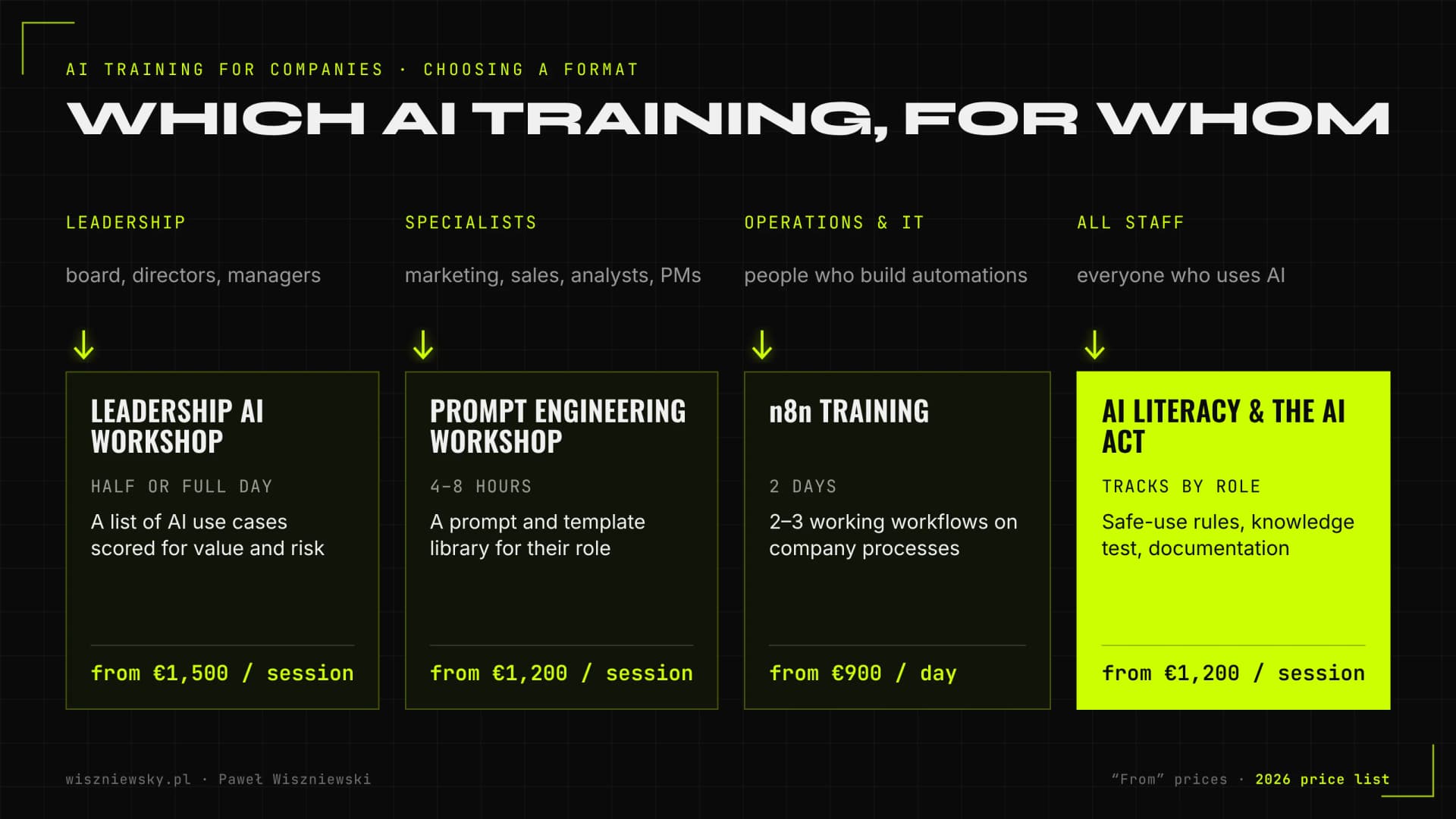
FormatWho it is forLengthWhat participants leave withPrice from
Prompt engineering workshopMarketing, sales, customer service, analysts, PMs4–8 hoursA prompt and template library for their role€1,200 / session
n8n trainingOperations, IT, people who own automation2 days2–3 working workflows built on company processes€900 / day
Leadership AI workshopBoard, directors, managersHalf day or full dayA list of AI use cases scored for value and risk€1,500 / session
AI literacy and the AI ActAll staff who use AISession, tracks by roleSafe-use rules, knowledge test, documentation€1,200 / session
Map matching AI training to roles: leadership takes the leadership AI workshop, specialists the prompt engineering workshop, operations and IT the n8n training, and all staff AI literacy
Matching AI training to participants' roles and goals. Prices from the service price list.

In a larger company these formats add up to a programme: first an AI workshop for leadership to set direction, then safe-use training for everyone, and finally specialist workshops for the teams that will work with AI the most. Online works well for distributed teams and short modules; I prefer on-site sessions when the group works together on a list of use cases.

ChatGPT training for employees and prompt engineering – what is worth teaching

Good ChatGPT training teaches a way of working with the model, not a list of “magic prompts”: how to give context, examples and criteria, how to split a task into steps and how to check the result. That skill carries over between ChatGPT, Claude, Gemini and Copilot, so it keeps working after a single tool is updated.

Showing where AI gets things wrong matters just as much. In a 2023 Harvard Business School and BCG experiment described by Ethan Mollick, consultants with GPT-4 completed 12.2% more tasks on average, 25.1% faster, with results rated 40% higher in quality. On a task outside the model's capabilities, consultants without AI got it right 84% of the time, while those using AI managed only 60–70%. That is why verifying outputs is a separate exercise in my sessions, not a footnote on the last slide.

What the programme should include

  • The anatomy of a good instruction: role, context, example, output format and evaluation criteria.
  • Iterating: improving a result instead of rewriting the prompt from scratch.
  • Tasks from participants' own roles, collected before the session, not textbook examples.
  • Security rules: what data never to paste and which company accounts to use.
  • A shared prompt library that stays in the company and grows after the training.

The full programme is on the prompt engineering workshop page, and the basics of the technique are in my article on prompt engineering for business.

n8n training – when to teach your team automation and when to outsource it

n8n training pays off when someone in the company has time to build and maintain automations and there is more than one or two processes to automate. If you need a single automation, it is cheaper to have it built.

In my n8n training I teach the tool the way I use it on client projects: error handling, logging and secure credential storage from the very first workflow. This is not optional. Critical n8n vulnerabilities disclosed in January 2026 and described by Rapid7 (including “Ni8mare”) were most dangerous for self-hosted instances exposed to the internet, so updates and access restrictions have to be part of the programme.

Before choosing a tool, read my comparison of n8n, Make and Zapier. If your team already works in Make or Zapier and is happy with it, n8n training is not always the first step.

AI literacy and the AI Act after the AI Omnibus – what changed in 2026

AI literacy is the set of skills needed to use AI knowingly: understanding how a tool works, its limits and risks, and how to interpret its outputs. I treat training in this area primarily as good practice and as preparing the team to work with AI safely, not as a box-ticking exercise.

Originally, Article 4 of the AI Act required providers and deployers of AI systems to take measures to ensure a sufficient level of AI literacy among their staff. On 27 July 2026 the AI Omnibus entered into force. According to the European Commission, the previous AI literacy requirement for companies has been simplified, with the Commission and Member States taking a stronger role in promoting AI literacy.

What this means in practice

  • The Commission's AI literacy Q&A states that no certificate is required, and that simply pointing staff to a tool's instructions is usually not enough.
  • Deployers of high-risk AI systems still have to assign human oversight to people with the necessary competence and training (Article 26 of the AI Act).
  • Confirm the exact scope of requirements for your company after the changes with a lawyer, especially if you use high-risk systems.

Whatever the legal detail, the business reasons stay the same: less customer data in personal accounts, fewer decisions based on hallucinations and shared rules people can point to. The role-based programme is on the AI literacy training page, the wider background is in my guide to AI literacy training, and training works best alongside an AI policy.

What AI training looks like and what to prepare beforehand

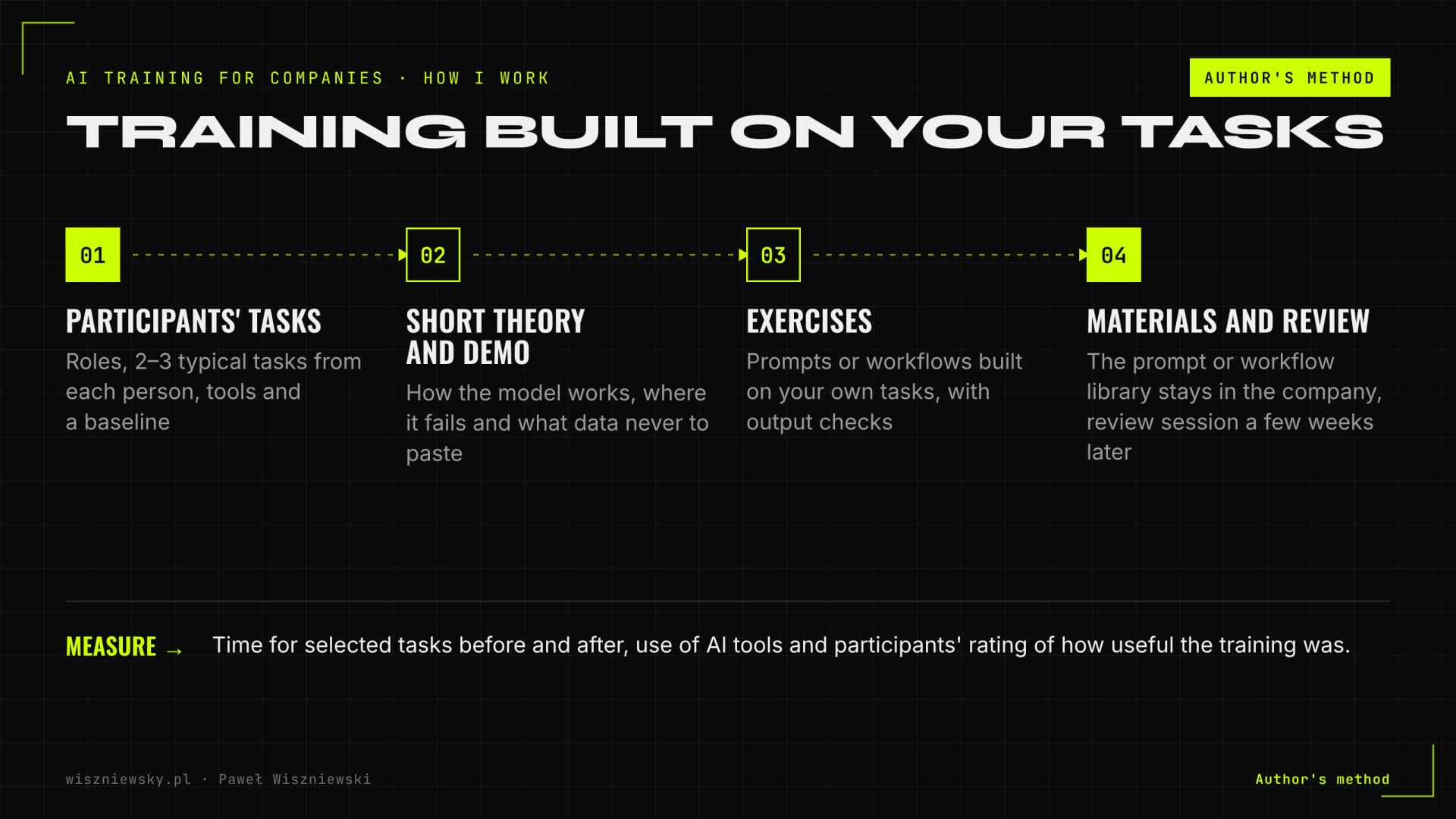
I run every training in four steps: collecting participants' tasks, a short theory block, exercises on those tasks and materials that stay in the company, with an optional review session a few weeks later. The first step, what the company prepares before the session, has the biggest effect on results.

Author's method for AI training in four steps: participants' tasks collected before the session, short theory with a live demo, exercises on their own tasks, materials and a review session a few weeks later
Author's method: AI training built on participants' own tasks, measured before and after.

Checklist for 1–2 weeks before the training

  1. A list of participants with their roles and experience with AI.
  2. Two or three typical tasks from each person where AI could help (without customers' personal data).
  3. Which AI tools the company uses or may use, and access for every participant.
  4. Your current rules for using AI, even if it is just a few points in an email.
  5. For n8n training: a list of processes to automate and a decision on n8n Cloud or your own server.
  6. A baseline: how long two or three chosen tasks take today, so there is something to compare against.

The baseline looks like a formality, but without it all you have a month later is participants' impressions. A few numbers collected before the session let you show leadership what actually changed.

How much AI training for companies costs and what drives the price

My AI training starts from €900 per day of n8n training, €1,200 per session for prompt engineering or AI literacy, and €1,500 per session for the leadership workshop. The final price depends on the number of participants, the length of the training and how much the programme is tailored.

What raises or lowers the cost

  • Participants and groups: I split large teams into several sessions so everyone has time to practise.
  • Tailoring: exercises based on company tasks need preparation before the session.
  • Number of tracks: separate modules for staff, managers and technical teams take more work than one session.
  • Format: online or on-site at your premises.
  • Extras: for example installing n8n on your server or recording the session.

With per-session pricing, the cost per person drops as the group grows, but only up to a point. Beyond a dozen or so people participants practise less and listen more, so I would rather split the group than lower the quality. Full terms for each format are on the individual training pages.

How to measure the effects of AI training

I measure training on the four levels of the Kirkpatrick Model: participants' reaction, learning, change in behaviour at work and results for the company. A satisfaction survey covers only the first level and on its own says nothing about whether anything changed.

Level (Kirkpatrick)What I checkWhen
1. ReactionParticipants' rating of how useful the training wasRight after the session
2. LearningKnowledge test, confidence with AI before and after (1–10 scale)At the end of the training
3. BehaviourUse of AI tools, number of prompts and workflows in daily useAfter 2–6 weeks
4. ResultsTime for selected tasks before and after, pilots launched, hours savedAfter 1–3 months

Level three usually shows whether the training was enough. BCG's AI at Work 2025 survey (over 10,600 workers in 11 countries) reports that people who received five or more hours of training, especially in person and with coaching, are significantly more likely to become regular AI users. Only 36% felt adequately trained. A short presentation is unlikely to change a team's habits.

It also helps to know where to look for the biggest gains. An NBER study (Brynjolfsson, Li, Raymond, 2023) of customer support agents found an AI assistant raised productivity by 14% on average and by 34% for less experienced workers. So I compare new and experienced staff separately, not just the team average. Why licences often sit unused even after training is covered in my piece on AI adoption in teams.

How to choose an AI trainer and which mistakes to avoid

Choose a trainer who works with AI every day and can show live how the tool handles your team's tasks. A trends presentation with no exercises and no security rules is the most common reason nothing changes after training.

Questions to ask before you book

  • Will the exercises use our tasks, and how will they be collected beforehand?
  • Does the programme cover data security and verifying outputs?
  • What stays with us afterwards: prompts, workflows, materials, a recording?
  • How will we measure the effect, and is there a review session a few weeks later?
  • Does the trainer build AI solutions themselves or only talk about them?

The most common mistakes

  • One generic session for every role, with no link to real tasks.
  • Teaching tricks for one model that stop working after its next update.
  • Training without tool access afterwards and without anyone owning adoption.
  • No baseline, so the effect cannot be shown.
  • Skipping security: customer data ends up in personal AI accounts.
/// KNOWLEDGE_BASE

Read more

Articles that dive deeper into this service.

/// FAQ

Frequently Asked Questions

Can AI training be expensed as a business cost?

Yes — AI training and workshops qualify as business expenses. My invoice specifies the training topic and number of participants. For EU entities I issue invoices with reverse charge.

What is the minimum group size for cost-effectiveness?

For prompt engineering and n8n workshops — minimum 4 people. For leadership workshops — 2-3 people, as the per-person price is higher. For groups over 20 — discounts are available for package orders.

Can training be part of a larger AI transformation programme?

Yes — and that is the best approach. Leadership workshops (setting direction), n8n training for operations (implementation competency), and prompt engineering for specialists (daily AI use) together form a coherent AI competency-building programme.

How quickly can training be booked?

Open slots are typically available 2-4 weeks ahead. For companies needing urgent training — I respond within 24 hours and look for an accelerated date.

Are trainings tailored to participants' level?

Yes. Before the training I gather information about participants' roles, experience and tools, and adapt the program: from basics for non-technical staff to workshops for IT teams.

Do you invoice companies for training?

Yes. Training is invoiced to the company, and participants receive completion certificates.

Got a project?

Terminate
Silence

Initiate protocol. Establish connection. Let's build something loud.

> WAITING_FOR_INPUT...