BACK TO AI & Automation

AI Sales Automation – Lead Generation Bot & Customer Acquisition

AI bot qualifying inbound leads 24/7 against your ICP, booking meetings into your calendar, and auto-populating your CRM. Increases booked demos by 30–60%.

Author: Paweł Wiszniewski · Updated:

Key takeaways

AI bot qualifying inbound leads 24/7 against your ICP, booking meetings into your calendar, and auto-populating your CRM. Increases booked demos by 30–60%.

  • ›24/7 lead qualification—inbound leads are engaged and scored instantly at any hour, with no response-time delay that causes drop-off.
  • ›ICP qualification logic tailored to your exact criteria (company size, budget range, role, pain point) before a human sales call is ever booked.
  • ›Direct calendar booking via Google Calendar or Calendly—no email back-and-forth to schedule demos, qualified leads book in under 2 minutes.

Price: from €1,000

SERVICE DETAILS

I build conversational AI sales bots that engage website visitors and inbound leads, qualify them against your Ideal Customer Profile through natural dialogue, and automatically book meetings into your team's calendar. The bot integrates with your CRM (HubSpot, Salesforce, Pipedrive) and triggers personalized follow-up sequences after each conversation—different paths for qualified, unqualified, and undecided leads.

› INVESTMENT:

from €1,000
const module = new ExecutionProtocol();

// Initializing sales-outreach-bot...
› Loading dependencies... OK
› Establishing connection... OK
› Ready for deployment... AWAITING_COMMAND

Paweł Wiszniewski · my approach

What I do differently

I design sales bots together with salespeople, not instead of them. I start with interviews with the sales team and an analysis of won and lost deals in the CRM — that's where the qualification questions and ICP criteria come from. The bot doesn't pretend to be human: it introduces itself as an AI assistant, gathers context and books the meeting, and the salesperson gets a conversation summary in the CRM before calling. I lay out the whole B2B lead generation automation process step by step on the blog.

Read my guide on the blog

My take and a real-world example

My take

In my view lead generation loses the most money not on bad campaigns but on slow responses. A lead waiting until tomorrow has often already spoken to a competitor.

From the market

Harvard Business Review analysed 1.25 million leads across 42 companies. Firms that contacted a lead within an hour were seven times more likely to qualify it than those responding an hour later, and over 60 times more likely than those waiting a day. A bot that answers instantly doesn't replace a salesperson — it buys them time.

Sources: Harvard Business Review: The Short Life of Online Sales Leads

Who this is for

  • B2B companies whose leads wait hours for a reply and end up with competitors.
  • Sales teams wasting time on calls with people outside their target market.
  • High-traffic sites with forms nobody qualifies in real time.
  • Companies that want meetings booked automatically, without email ping-pong.

What you get

  • An ideal customer profile (ICP) and qualification questions defined with your team.
  • A bot on your site, in email or messaging that holds a natural conversation.
  • Calendar booking and the conversation outcome saved to your CRM.
  • Follow-up sequences for leads not yet ready to talk.
  • A conversation report: lead sources, disqualification reasons, common questions.

How results are measured

  • Response time to new leads.
  • Sales meetings booked and held.
  • Share of leads qualified against the ICP.
  • Lead-to-opportunity conversion in your CRM.

Key Benefits

24/7 lead qualification—inbound leads are engaged and scored instantly at any hour, with no response-time delay that causes drop-off.

ICP qualification logic tailored to your exact criteria (company size, budget range, role, pain point) before a human sales call is ever booked.

Direct calendar booking via Google Calendar or Calendly—no email back-and-forth to schedule demos, qualified leads book in under 2 minutes.

CRM auto-population: lead data, qualification score, and full conversation summary pushed to HubSpot, Salesforce, or Pipedrive automatically.

Personalized follow-up sequences triggered by conversation outcome—qualified leads get demo confirmation, unqualified get nurture content.

The Process

1

ICP & Qualification Logic

I document your Ideal Customer Profile, define qualification questions, scoring model, and routing rules—book demo vs. nurture sequence vs. politely disqualify.

2

Conversation Design

I design conversation flows that feel natural and conversational, not interrogative—covering qualification, objection handling, and meeting scheduling in one smooth exchange.

3

Build & Integrations

I build the bot using a large language model (LLM) or a dedicated conversational AI platform, integrate it with your calendar, CRM, and website, and configure lead routing rules.

4

Testing & Launch

I test the bot across 50+ conversation scenarios, measure qualification accuracy, tune edge-case responses, and deploy with analytics tracking every conversation outcome.

AI lead-gen bot vs SDR team vs manual prospecting

CriterionAI lead-gen botSDR teamManual prospecting
Availability24/7/365, instant responseWorking hours onlySporadic, founder-dependent
Cost at scaleFlat cost, scales without headcountHigh — salaries grow with volumeHidden cost of founder time
Lead qualificationConsistent ICP scoring every timeQuality varies by repInconsistent and ad hoc
CRM hygieneAuto-populated after each chatManual entry, often skippedRarely logged
Response speedEngages leads in secondsMinutes to hoursHours to days
ScalabilityHandles many chats at onceLinear — more leads, more repsDoes not scale
Best forInbound qualification and bookingComplex enterprise outreachVery early stage, low volume

Common mistakes

  • Qualification criteria invented by marketing without salespeople.
  • A bot firing form-style questions one after another instead of holding a conversation.
  • No conversation record in the CRM, so the salesperson starts from scratch.
  • Mass AI-generated cold email without personalization that ruins domain reputation.

When this service is not worth it

  • You get a few leads a month and handle each one personally.
  • You sell only through tenders or referrals.
  • You have no CRM or defined sales process for the bot to hand leads to.
/// GUIDE

AI sales bot – how I build lead qualification and meeting booking

This guide shows how an AI sales bot works under the hood: how I turn your ideal customer profile into a conversation, how the bot decides who gets a meeting and who gets a follow-up sequence, what lands in the CRM and how to measure it. I also cover the legal limits separately, because consent rules for sales email and calls are stricter than many sales automation tools assume, and in Poland they tightened in November 2024.

How an AI sales bot works – from the first message to a booked meeting

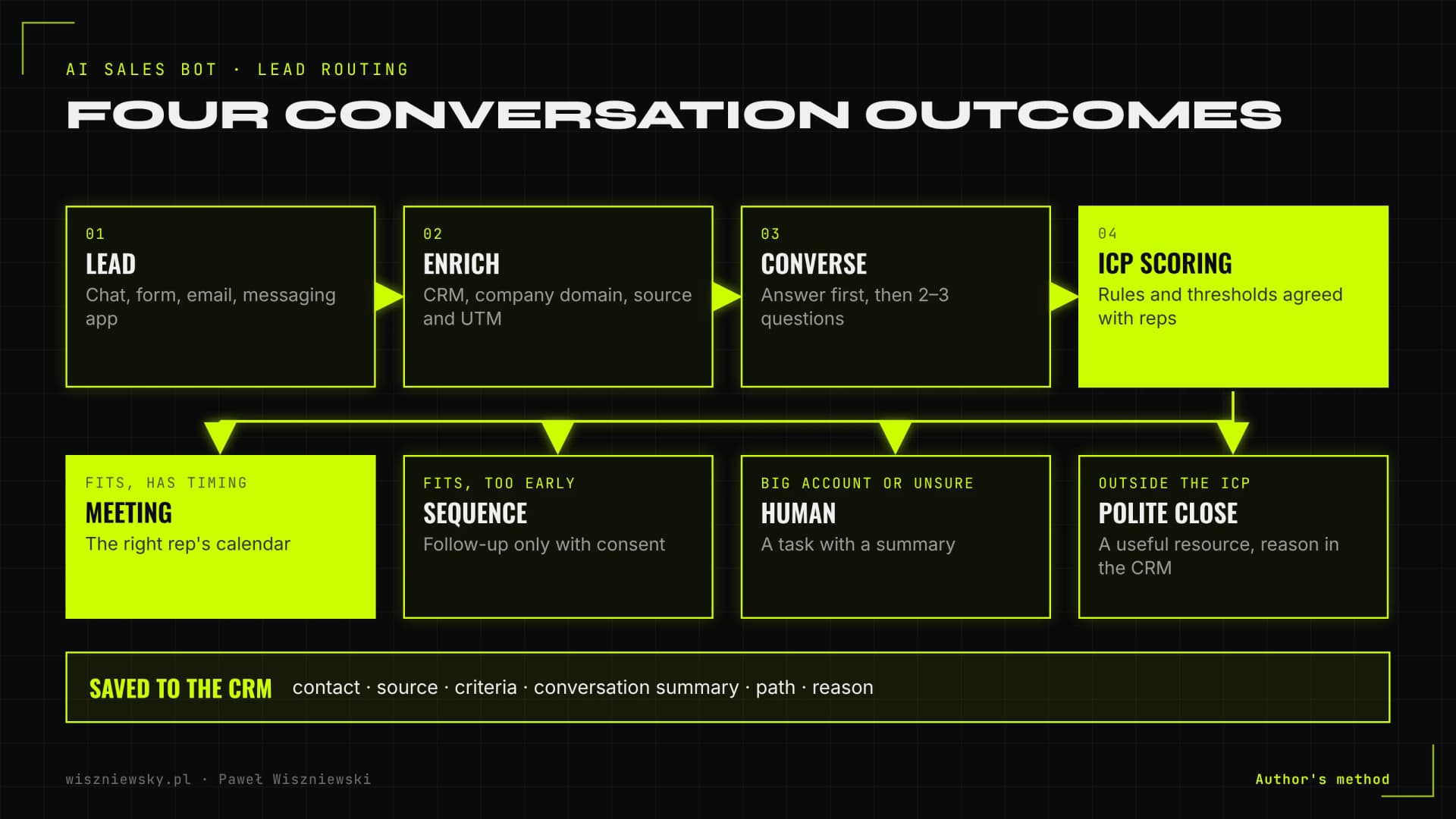
A sales bot takes over the first contact with an inbound lead: it answers questions, collects missing details, checks fit against your customer profile and steers the conversation to one of a few outcomes. A qualified lead books a meeting, a lead that isn't ready goes into a follow-up sequence, and a poor fit gets a polite answer and something useful to read.

  1. Entry. A chat message, a submitted form, an email to the sales address or a messenger thread. The bot sees the source (campaign, landing page, UTM parameters), because it changes the context of the conversation.
  2. Enrichment. Before asking anything, it checks what's already known: is the contact in the CRM, does the company have an open deal, what company does the email domain belong to. It doesn't ask what it can find out itself.
  3. Qualifying conversation. It answers the lead's questions and picks up the missing criteria along the way: the problem, scale, timing and the person's role in the decision.
  4. Scoring and routing. The criteria turn into a score and a path: a meeting with a rep, a sequence, a handoff to a person or the end of the conversation.
  5. Action. It books a slot in the right rep's calendar, saves the contact and a summary to the CRM and starts the sequence.
  6. Handoff. Before the meeting the rep gets a note: who it is, which company, what problem, what was already said and what to probe.
Lead routing in an AI sales bot: a lead from chat, form or email, data enrichment, qualifying conversation, ICP scoring and four paths: meeting, follow-up sequence, handoff to a human, polite close
The four outcomes of a sales bot conversation. Each one ends with a CRM record and a summary.

Speed is the main argument here: the bot replies while the lead is still on your site. I describe the whole acquisition funnel, including finding companies and enriching data, in B2B lead generation automation. This service is mainly about inbound leads, people who contacted you on their own.

Lead qualification criteria – turning your ICP into bot questions

I set qualification criteria from your CRM data and from talking to your reps, not from a generic framework. I look at what separates won deals from lost ones and from leads that never reached a proposal. Those differences become the bot's questions.

BANT or MEDDIC – what works in a bot conversation

BANT (budget, authority, need, timeline) is a simple filter you can check in a short conversation. MEDDIC (metrics, economic buyer, decision criteria, decision process, identified pain, champion) is for running complex deals and needs information a lead on a chat widget rarely gives. So the bot collects a BANT-style baseline and the rep fills in the MEDDIC parts in the meeting.

CriterionWhere I get itDoes the bot ask?
Industry and company sizeEmail domain, CRM, enrichmentNo, unless the data is missing
Problem to solveMessage content, landing pageYes, it's the first question
Scale (users, volume, locations)ConversationYes, with one simple question
TimingConversationYes, with answer buttons
Role in the decisionJob title from the CRM or the conversationCarefully, never "are you the decision-maker?"
BudgetConversation, often only after showing pricingIndirectly: the bot shares a range and asks whether it fits the plan

Disqualifying signals

  • A service or market you don't serve (another country, consumers when you sell B2B).
  • Scale below the break-even point your reps identified from past deals.
  • Inquiries from competitors, students writing a thesis or vendors who want to sell to you. The bot points them to the right address.
  • Job applicants. The bot shares the careers page instead of creating a deal.

Conversation design – qualifying leads without interrogating them

A good qualifying conversation starts by answering the lead's question, not by asking the bot's. I collect the criteria along the way, with two or three questions at most, and only about what can't be found out another way.

Buyers increasingly want to do their own research before talking to a rep. In a Gartner survey published in March 2026 (646 B2B buyers, fielded in August and September 2025), 67% of respondents preferred a rep-free buying experience. A bot that answers a pricing question with "it depends, let's book a call" works against that preference.

Rules I apply to every bot

  • Value first. The bot answers the question concretely from the offer knowledge base, then asks for context.
  • Straight answers on price. If you publish prices or ranges, the bot shares them. If you don't, it explains what drives the price and offers a quote.
  • One question at a time. Closed questions come with answer buttons, which shortens the conversation on a phone.
  • No promises. The bot never promises discounts, delivery dates or features that aren't in the knowledge base. Negotiation stays with the rep.
  • Objection answers from the field. The usual concerns (price, implementation time, integrations, security) get answers written from what your best reps say.
  • A way out at all times. The lead can ask for a person at any moment, or leave a number and come back later.

Example conversation

  1. Lead: "How much does it cost for a company with three warehouses?"
  2. The bot gives the range from the price list, explains what affects the price and asks which warehouse system they use.
  3. The lead names the system. The bot confirms the integration exists and asks about the planned start date, with answer buttons.
  4. The timing fits and the company behind the domain matches the profile. The bot offers three slots with the rep who covers that segment.
  5. After booking, the lead gets a confirmation and the rep gets a CRM note with the whole conversation.

Handoff rules are the same as in the customer support AI agent: a request for a human is a hard rule, not something the model gets to interpret.

Lead scoring and routing – who gets a meeting and who gets a sequence

I calculate the outcome with rules applied to the data the bot collected, not with the model's gut feeling. The model extracts structured fields from the conversation, and thresholds agreed with the sales team and stored in configuration decide the path.

PathWhenWhat the bot does
MeetingFits the ICP, has a concrete problem and timingOffers slots in the right rep's calendar and confirms the booking
Handoff to a humanLarge account, unusual request, uncertain score, request for contactCreates a task for a rep with a summary and promises contact within a set time
Follow-up sequenceFits the ICP, but timing is far off or the lead is still researchingWith consent, sends materials and checks back at an agreed interval
Polite closeOutside the ICP or the offerShares a useful resource or the right contact, and records the reason

Who the lead goes to

  • Existing customer or open deal: always to the account owner in the CRM, with no new booking by the bot.
  • Segment or region: to the rep who owns it, round-robin within the team, holidays taken into account.
  • Large accounts: human review before booking, even with a high score.
  • Borderline score: a manual review queue instead of an automatic decision.

Technically, I extract fields from the conversation with structured outputs and run calendar and CRM actions through tool calling with limited permissions.

Meeting booking and CRM integration – exactly what the rep receives

The bot books the meeting directly in the rep's calendar and saves the contact, company, deal and a conversation summary to the CRM. A rep should never open a call by asking questions the lead has already answered.

Fields I write to the CRM after every conversation

  • Contact and company details, after checking whether the record already exists (deduplication by email and domain).
  • Source: channel, campaign, landing page, UTM parameters.
  • Qualification criteria values and the resulting path.
  • A summary of a few sentences: problem, scale, timing, questions asked and objections.
  • The reason for disqualification or handoff as a picklist rather than free text, so it can be reported on.
  • A link to the full transcript.

The calendar, and meetings that actually happen

  • The bot shows only free slots, with buffers between meetings and a minimum notice period.
  • The confirmation includes the meeting link, an agenda and one prep question, such as which system the company uses.
  • A reminder before the meeting with one-click rescheduling. A moved meeting beats a missed one.
  • If the lead doesn't show up, the CRM gets the status and the bot offers a new slot.

The service page lists the systems I work with most often; anything else I connect through its API. More on what AI changes in CRM work is in AI CRM and sales automation, and on generating proposals after the meeting in AI sales proposal automation.

Follow-up, cold email and the law – consent rules, GDPR and the AI Act

The bot can send follow-ups to a lead who agreed to be contacted in that channel. I don't automate mass sending to people who never got in touch, because in Poland sending commercial information by email or phone requires prior consent, including between businesses. Rules in other EU countries come from the same ePrivacy framework but differ in detail, so check the market you sell into.

What the rules say in 2026

  • Poland's Electronic Communications Law (PKE). In force since 10 November 2024. Article 398 prohibits using telecommunications terminal equipment and automated calling systems to send commercial information, including direct marketing, without the prior consent of the subscriber or end user. As the Prawo.pl (Wolters Kluwer) commentary notes, the protection covers all subscribers, legal entities included, and consent has to be specific to the channel.
  • GDPR. Consent under telecom rules doesn't replace a legal basis for processing personal data. You still need a privacy notice, a retention period and an easy way to object. More in GDPR and AI.
  • AI Act. According to the European Commission, the Article 50 transparency obligations apply from 2 August 2026. A bot talking to leads introduces itself as an AI assistant in its first message.
  • Platform terms. Meta requires opt-in before you message someone on WhatsApp, naming the business they agree to hear from. LinkedIn's User Agreement prohibits bots and other unauthorised automated methods, including for sending messages.

How I build follow-up within those rules

  • Consent collected in the conversation or the form, separately for each channel, with the wording, date and source stored in the CRM.
  • The sequence stops when the lead replies, books a meeting or opts out, and an opt-out in one channel reaches the CRM immediately.
  • Every message refers to what the lead actually asked about instead of sending everyone the same template.
  • Before launch I ask your lawyer or data protection officer to approve the consent wording and the legal basis. I describe technical practice, not legal advice.

Email deliverability

Even a compliant sequence fails if it lands in spam. According to Google's email sender guidelines, anyone sending to personal Gmail accounts must set up SPF or DKIM and keep the spam rate in Postmaster Tools below 0.3%. Senders of more than 5,000 messages a day need SPF, DKIM and DMARC, and marketing messages must support one-click unsubscribe. That's why I send follow-ups from the same properly configured domain, at low volume, and only to people who expect them.

Where a sales bot runs – website, forms, email, messaging apps

I launch the bot where most of your leads come from and adapt its behaviour to the channel. On the website it's about fast answers and page context, on forms about an instant reaction to the submission, and in messaging apps about the platform's rules.

ChannelThe bot's roleWhat I watch out for
Website chatAnswers questions and qualifies during the visitPage context (pricing, offer, case study) and an opener that isn't pushy
Contact formReplies straight after submission, asks for missing details, offers a slotA thank-you page with a calendar instead of "we'll be in touch"
Email to the sales addressCategorises inquiries, prepares a reply or a draft for a repDraft mode at first, because email inquiries are longer and more complex
WhatsApp, MessengerContinues a conversation the customer startedOpt-in, the service window and Meta's template costs
PhonePicks up after hours and books a callbackShort turns and confirming details; more in voice AI agents

If pre-sales questions are mostly about products in an online shop, e-commerce AI automation or a support agent that answers from the catalogue is a better starting point.

Built-in CRM chatbot or a custom sales bot – how to choose

A chatbot built into your CRM or marketing platform is enough when qualification comes down to a few questions and all of sales lives in that one system. A custom build makes sense when the bot needs data from several systems, has to hold a natural conversation backed by knowledge of your offer, or needs routing the platform can't do.

CriterionBuilt-in CRM chatbotCustom bot
StartFast, configured in a dashboardLonger: ICP, conversation design, integrations, testing
ConversationOften a question tree or a simple assistantNatural dialogue with an offer knowledge base and objection handling
DataMostly from the same CRMCRM, calendars, enrichment, internal systems
RoutingWhatever rules the platform offersAny rules, a review queue, exceptions for large accounts
CostPlatform subscriptionImplementation from €1,000 plus model and hosting costs
Switching CRMThe bot stays with the vendorThe bot moves with you

Testing and measuring a sales bot

Before launch I check that the bot qualifies leads the way your reps would. After launch I measure held meetings with well-matched leads and what happens to them further down the funnel, not the number of conversations.

Pre-launch tests

  • Agreement with reps. A set of past inquiries gets scored twice, once by the bot and once by a rep. The disagreements show which criteria need work.
  • Difficult leads. Someone who only asks about price, answers in fragments, writes in another language or angles for a discount.
  • Abuse attempts. Instructions hidden in a message, attempts to extract the system prompt or other customers' data. More in prompt injection.
  • Integrations. Booking an already taken slot, an existing CRM contact, a rep on holiday, a different time zone.
MetricHow I calculate itThe trap
Time to first responseFrom form or message submission to the first real replyCounting an automatic "thanks" as a response
Held meetingsMeetings that took place, not just bookingsReporting bookings and ignoring no-shows
Qualification accuracyShare of meetings the rep rated a good fit afterwardsNo CRM field where the rep records that rating
Conversion to opportunityMeetings that ended with an open deal in the CRMComparing with a period when lead sources were different
Disqualification reasonsDistribution of reasons from the CRM picklistFree text that can't be counted
Abandoned conversationsThe point where the lead stopped replyingNo analysis, so nobody knows which question puts people off

Every week I review a sample of conversations with a rep, including the disqualified ones. Methods for automated conversation scoring are in LLM evaluation, and how to calculate the return in AI automation ROI. Other services in this area are on the AI & Automation page.

Frequently Asked Questions

Will leads know they're talking to a bot?

Yes. The bot introduces itself as an AI assistant ("Hi, I'm an AI assistant"). I strongly recommend transparency—it builds trust, and since 2 August 2026 the EU AI Act transparency rules (Article 50) apply: people interacting with an AI system must be informed of it unless that is obvious from the context.

What if the bot qualifies someone incorrectly?

I build a human review queue for low-confidence edge cases. Conversations below a set confidence threshold are flagged for manual review before a demo is booked, preventing wasted sales time.

Which calendar and CRM systems do you support?

Google Calendar, Outlook/Microsoft 365, and Calendly for scheduling. HubSpot, Salesforce, and Pipedrive for CRM. Other systems via API on request.

How does AI sales automation differ from traditional cold outreach bots?

AI sales automation uses LLMs for natural qualification dialogue rather than rigid template sequences. AI cold outreach bots personalize messages based on company context and firmographic data. Lead generation AI automation integrates with your CRM, tracks the full funnel, and routes leads based on qualification score — not just open/click rates. The result: 30–60% more booked demos with zero manual effort. Note: in Poland, sending commercial information by email or phone requires the recipient's prior consent, including businesses (Article 398 of the Electronic Communications Law, in force since 10 November 2024), and other EU countries have their own rules. That's why I design bots mainly for inbound leads, and an outbound campaign is worth checking with a lawyer first—this isn't legal advice.

Will a sales bot replace a salesperson?

No. The bot takes over first contact, qualification and meeting booking — the tasks that take most of a salesperson's time. Sales conversations, negotiation and relationships stay with people.

Where can a sales bot run?

On your website, in response to forms, by email and in messaging apps such as WhatsApp or Messenger. The channel depends on where your leads come from.

How much does a lead qualification bot cost?

Implementations start from €1,000. The price depends on the number of channels, qualification complexity and CRM and calendar integrations.

Got a project?

Terminate
Silence

Initiate protocol. Establish connection. Let's build something loud.

> WAITING_FOR_INPUT...