Independent AI consultant for businesses. AI readiness audit, implementation strategy, and board-level advisory — before you engage any vendor.
›AI Readiness Audit
›AI Implementation Strategy
›Board & C-Suite Advisory
›Technology Vendor Assessment
AI Consulting – how it works
I help businesses understand where AI will genuinely save time and money, and where it is just a buzzword. I conduct AI readiness audits, develop implementation strategies tailored to budget and technological maturity, and advise boards on vendor selection and priorities. I am an independent expert with no conflict of interest — I do not sell a specific tool, I help you make the best decision for your business.
› CORE_CAPABILITIES:
AI Readiness Audit
AI Implementation Strategy
Board & C-Suite Advisory
Technology Vendor Assessment
Independent Opinion, Zero Conflict of Interest
12–24 Month AI Roadmap
STRUCT
Paweł Wiszniewski · why me
What I do differently
I'm an advisor who implements AI myself — I build agents, RAG systems and automations — so my recommendations are based on what works in practice, not vendor presentations. I don't sell tools or take commissions, so I can say plainly when AI doesn't make sense. I also publish practical guides for companies: how to choose an AI implementation partner, how to prepare data and what the EU AI Act means.
AI Consulting for Business – A Pre-Implementation Guide for 2026
This guide answers the questions boards ask me before they spend anything on AI: where to start, how to pick use cases, when to buy a ready-made tool and when to build, how to check whether your data is ready and how to estimate the return. I write it as a consultant who builds agents, RAG systems and automations myself, so it reflects what I see in real projects. Every number has a source, and where I describe my own method, I say so.
AI consulting – what it is and how it differs from implementation
AI consulting is help with a decision: where AI makes sense in your company, in what order, at what cost, with what risk and with whom. Implementation is building a specific solution. An AI consultant answers "what and why"; an implementation partner answers "how".
The line can blur, but it matters because it defines what you are paying for. Consulting produces decisions and documents: a readiness assessment, a prioritised list of use cases, a plan and budget, vendor selection criteria, rules for using AI. Implementation produces a working system. If someone sells you an "AI strategy" whose only conclusion is to buy their product, that was a sales pitch, not consulting.
Consulting usually takes one of three forms: an AI readiness audit when you don't know where to start; an AI implementation strategy when you need priorities, a timeline and a budget; and AI advisory for the board when the board faces a specific decision, such as assessing a vendor's proposal.
When you need an AI consultant, and when you don't
An AI consultant is worth it when the AI decision is expensive, hard to reverse, or nobody in the company can assess it honestly. If you have one small, well-defined process to automate, a conversation with an implementation partner and a quote are enough.
Signs you should start with consulting
The board is about to set an AI budget but has no list of use cases with estimated impact.
You are running pilots that drag on for months without a success criterion.
You have proposals from several vendors and nobody can compare them on data, running costs and ownership of the solution.
Employees use personal accounts in AI tools and there are no rules on what data they may paste in.
There is no technical person (CTO, architect) who can judge whether a vendor's promises are realistic.
When consulting is unnecessary
When the decision has already been made and you only need someone to build it, or when your processes change week to week. In the second case, stabilise them first; no AI strategy survives a reorganisation.
AI implementation in a company – where to start
I start an AI implementation from a business problem and a process, not from picking a tool or a model. The first question is: which work takes people the most time or produces the most errors, and do we have the data to support it?
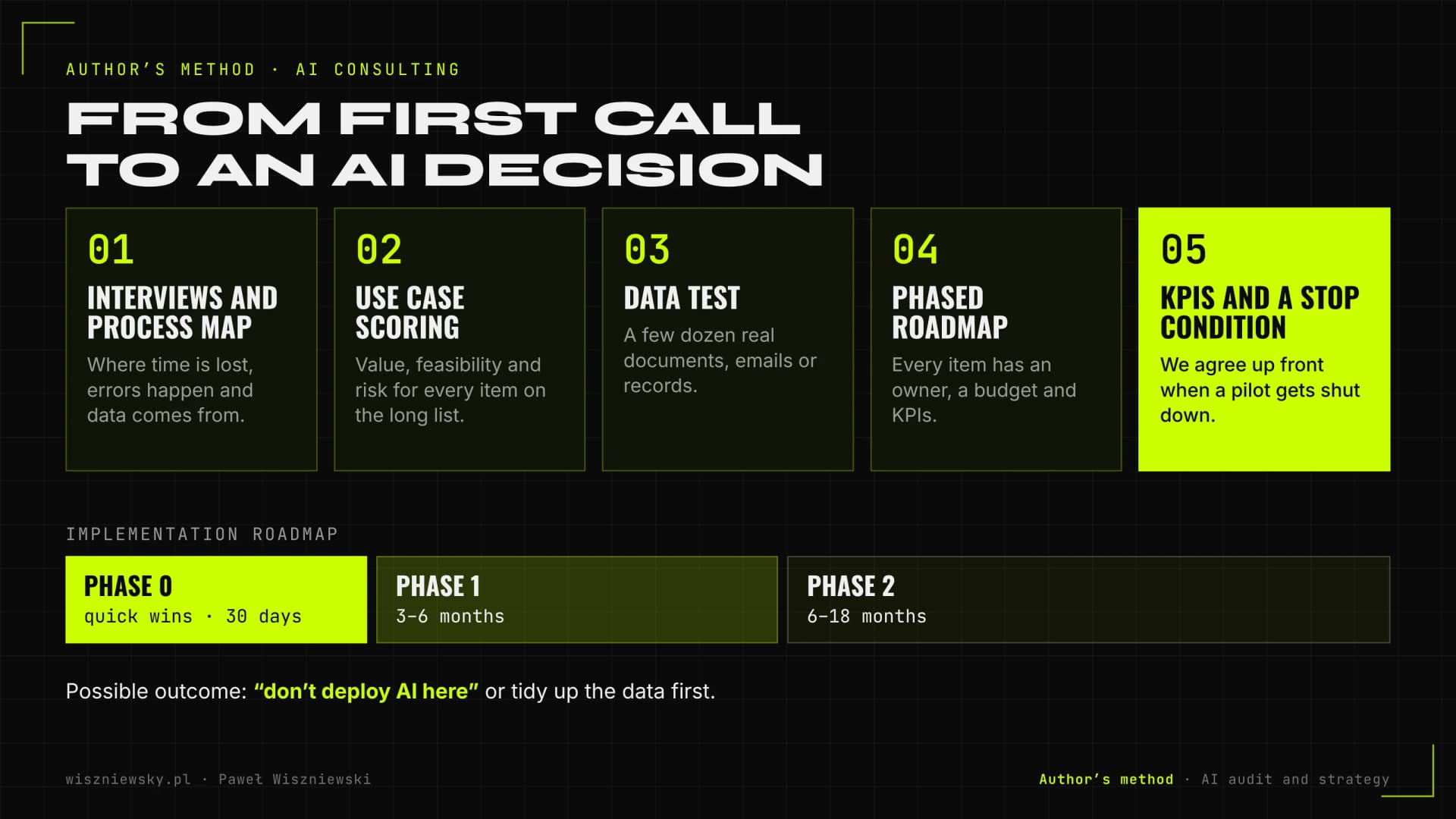
My path from the first conversation to a decision has five steps. The order matters more than the tools, because most expensive mistakes come from skipping one of them.
Interviews and a process map. I talk to the people who do the work every day and write down where time is lost, where errors happen and which systems the data comes from.
A long list and scoring. I score each potential use case on value, feasibility and risk (details in the next section).
A data test on real examples. Before a use case goes into the plan, I check on a few dozen real documents, emails or records whether the data actually allows it.
A phased roadmap. Phase 0 is quick wins within 30 days, phase 1 covers 3–6 months, phase 2 runs from 6 to 18 months. Every item has an owner, a budget and KPIs.
A stop condition. For each pilot we agree in advance how we will know it isn't working and when we shut it down.
My path from the first conversation to a decision. One possible outcome is a recommendation not to deploy AI in a given area.
How to choose AI use cases – value, feasibility and risk
I choose AI use cases on three axes: business value (time, cost, revenue), feasibility (data, integrations, skills) and risk (cost of an error, personal data, regulation). We start with high-value, high-feasibility items, even if they aren't the most impressive.
Category
Value
Feasibility
What I do with it
Quick wins
Medium or high
High: data available, stable process
Phase 0, start within 30 days
Strategic bets
High
Low: missing data or integrations
Prepare the data first, then pilot in phase 1 or 2
Incidental improvements
Low
High
Off-the-shelf tools and team training, no separate project
Park it
Low
Low
Don't build; revisit at the next strategy review
Then comes a risk filter. A high-value use case that involves assessing people (e.g. CV screening) or financial decisions about customers needs extra safeguards and legal input, so it rarely makes a good first project.
The 2025 MIT NANDA report, as covered by Fortune, found that more than half of generative AI budgets go to sales and marketing tools, while the authors saw the biggest returns in back-office automation. So I always check back-office processes: documents, invoices, reporting, ticket handling. What those processes look like after implementation is covered under AI and automation.
AI readiness assessment – data, systems and people
An AI readiness assessment checks whether the company has the processes, data, systems and people for the chosen use cases to work. Data is the most common blocker: scattered, incomplete, without an owner and without API access.
In February 2025 Gartner predicted that through 2026 organisations will abandon 60% of AI projects unsupported by AI-ready data. The same release reported a survey result: 63% of organisations either do not have, or are unsure whether they have, the right data management practices for AI.
What I check in the data
Where the data for the use case lives and whether it can be pulled automatically (API, export, database).
Whether documents have one current version and who keeps them up to date.
How complete the key fields are, e.g. in the CRM or ERP, on a sample of real records.
Which personal and confidential data would reach the model, and whether it may leave the company.
Who on the team will own the solution and has the time for it.
I describe a detailed checklist in data readiness for AI. Sometimes the outcome of an assessment is a preparation plan instead of an implementation, and that is a legitimate result, not a failure.
Build vs buy in AI – off-the-shelf tool or your own solution
I buy a ready-made tool when the problem is common and doesn't need deep integration with your systems. I build when your advantage lies in your process or your data and off-the-shelf tools would force you to work around their limits.
According to the MIT NANDA report (2025, via Fortune), deployments built on solutions from specialised vendors and partnerships succeeded about 67% of the time, while purely internal builds succeeded only about one-third as often. I don't read that as "always buy", but as a warning against building everything from scratch without experience.
Option
When it makes sense
What to watch
Off-the-shelf tool (licences, SaaS)
Common tasks: writing, summarising, notes, office documents
Vendor data terms, team adoption, per-seat fees at scale
Ready platform + integration
Standard process, but data lives in your systems (CRM, ERP, email)
Who maintains the integrations and what happens when pricing or the API changes
Custom solution
Unique process or data, high volume, security requirements
Running costs, quality testing, dependence on one contractor
Don't deploy AI
A rule or an organisational change would simplify the process
Pressure to "have AI" without a business case
With every option I check three things in the contract: who owns the solution and the data, whether the vendor may train models on your data, and how you exit the relationship.
AI governance – policy, GDPR and the EU AI Act in 2026
AI governance is the set of rules on who in the company may use which AI tools, with what data, who is accountable for the output and how the risk of new use cases is assessed. Without it, a company has either a ban nobody follows or freedom without control.
According to the 2024 Work Trend Index from Microsoft and LinkedIn, 75% of knowledge workers use AI at work, and 78% of them bring their own tools. So an AI policy should come early and stay short: a list of approved tools, data classes that must never be pasted in, a duty to verify outputs and a route for proposing new use cases.
Frameworks I rely on
NIST AI Risk Management Framework (2023) – a voluntary framework with four functions: Govern, Map, Measure, Manage. A good structure for assessing the risk of each use case.
ISO/IEC 42001 (2023) – the AI management system standard, useful for companies that want to formalise governance or plan certification. More in AI policy and ISO/IEC 42001.
EU AI Act – obligations depend on the use case. According to the European Commission, the AI Omnibus entered into force on 27 July 2026 and moved obligations for Annex III high-risk systems to 2 December 2027, and for AI in regulated products under Annex I to 2 August 2028.
I cover the obligations in practical terms in the EU AI Act in practice. This is a practitioner's overview, not legal advice: for use cases in HR, finance or decisions about individuals, I recommend involving a lawyer or data protection officer.
Why AI pilots don't make it to production
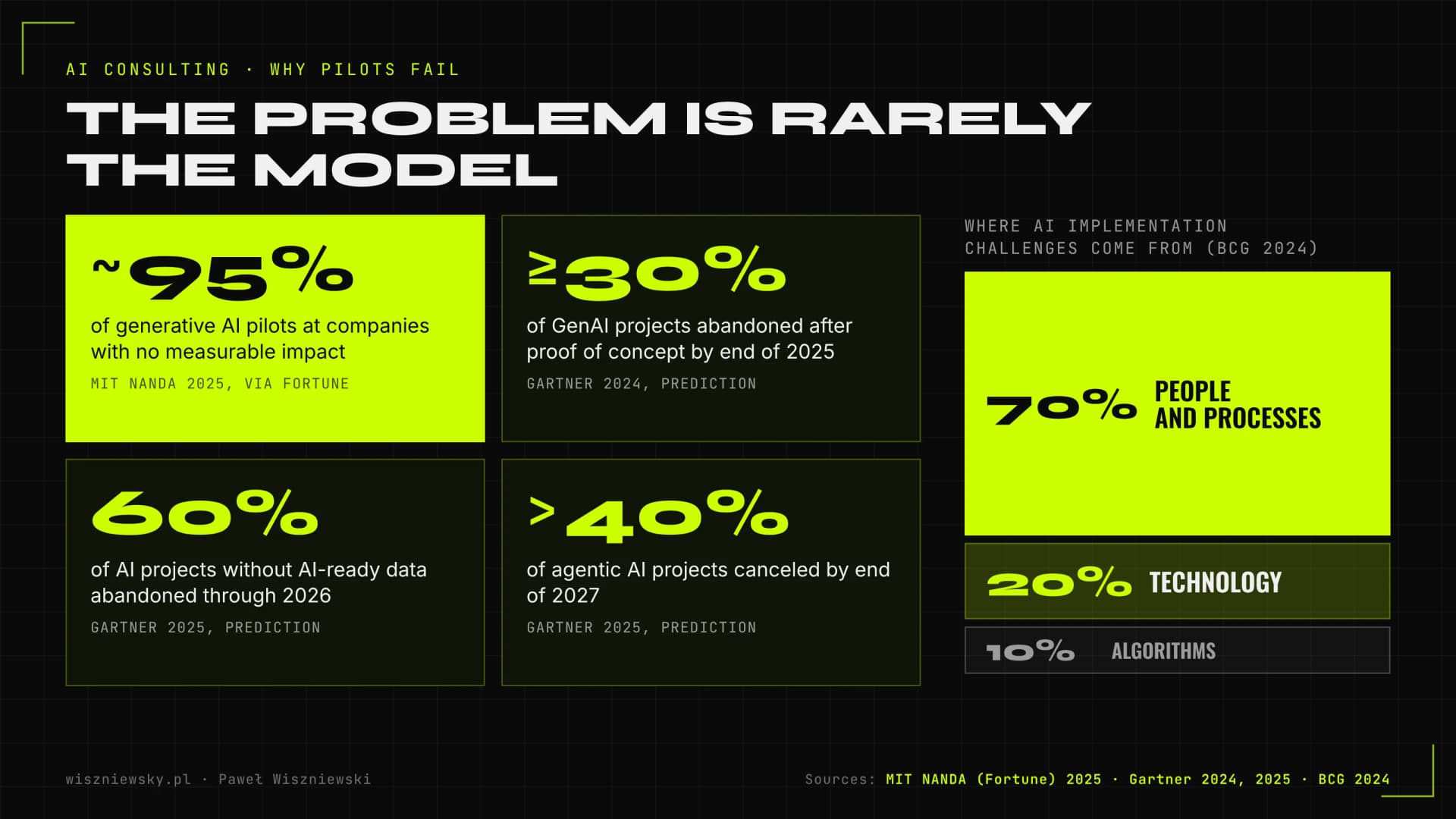
AI pilots fail mainly for organisational reasons: no measurable goal, unprepared data, rising costs and no owner. A weak model is the cause less often than people think.
Gartner (2024) predicted that at least 30% of generative AI projects would be abandoned after proof of concept by the end of 2025, citing poor data quality, inadequate risk controls, escalating costs and unclear business value.
Gartner (2025) predicts that over 40% of agentic AI projects will be canceled by the end of 2027.
The MIT NANDA report (2025, via Fortune) found that about 95% of generative AI pilots at companies deliver no measurable impact.
BCG's "Where's the Value in AI?" study (2024, 1,000 executives in 59 countries) found that 74% of companies have yet to show tangible value from AI, and that around 70% of implementation challenges stem from people and processes, 20% from technology and only 10% from algorithms.
Figures from MIT NANDA (2025, via Fortune), Gartner (2024, 2025) and BCG (2024).
BCG's split explains why an AI strategy must cover the people side: training, new ways of working and communication. I write about why licences sit unused in AI adoption in your team.
AI consulting cost, time to results and measuring ROI
My AI consulting starts from €1,000 for a board strategy session, from €1,500 for a readiness audit and from €2,500 for an implementation strategy. The price is driven mainly by company size, the number of departments covered and system complexity.
Board session – from €1,000 per session; ongoing advisory as a monthly retainer from €1,800.
AI readiness audit – from €1,500; usually 2–4 weeks, about 2 weeks for companies under 50 people.
AI implementation strategy – from €2,500; a 12–24 month plan with a detailed plan for the first quarter.
Vendor proposal review before signing – analysis within 5–7 business days, priced by contract complexity.
When you see results
You have decisions and priorities after the audit or session. I plan the first operational results in phase 0, within 30 days of adopting the strategy, and larger initiatives over 3–6 and 6–18 months. If someone promises to transform the whole company in a quarter, ask what data that promise is based on.
How to measure the return
Measure a baseline before you start: handling time per case, error count, process cost.
Set 2–3 KPIs per initiative in hours, money or the share of cases with no corrections.
Estimate ROI as a range, not a single number, and count the full cost: build, licences, maintenance and team time.
Measure adoption: a tool nobody uses returns nothing, however good it is.
How to choose an AI consultant – independent advisor or vendor
Choose a consultant who earns only from fees, has built AI systems themselves and can tell you when AI doesn't make sense. A free consultation with a vendor is useful for learning about their product, but it doesn't replace a comparison of options.
Questions to ask before you hire
Do you take commissions from tool vendors or act as their reseller?
Which AI systems have you built yourself, and can you show them live?
In how many projects did you recommend not building something, and why?
What does the output look like: a document, priorities with budgets, KPIs, stop conditions?
Can I implement your recommendations with any contractor?
How do you handle GDPR, the AI Act and data security?
I collected similar questions, plus contract clauses, in how to choose an AI implementation partner. I apply the same criteria when helping a board assess vendor proposals.
Why do I need an independent AI consultant when tool vendors offer free consultations?
A vendor will always recommend their own tool — an obvious conflict of interest. As an independent AI consultant I evaluate different options without preference and earn only my fee, not sales commissions.
At what stage should I engage an AI consultant?
Ideally before engaging any vendor or contractor — at the opportunity assessment stage. But I also engage mid-project when an implementation has stalled or is delivering worse results than expected.
Is AI consulting suitable for small businesses?
Yes — especially for companies of 20-200 people that do not have an internal CTO or AI R&D team. For small businesses I most often start with a single strategic session that provides clear priorities without large upfront costs.
How do you measure the ROI of AI consulting?
The ROI from consulting is indirect but concrete: you avoid wrong purchasing decisions (one bad AI software contract can cost €20,000-100,000), shorten time to first results, and prioritise initiatives with the highest return.
How is AI consulting different from a tool vendor's offer?
A vendor recommends its own solution. An independent advisor compares options, including not using AI, and helps pick what best fits your processes, data and budget.
Can you also implement the solution after consulting?
Yes, if you want. I can implement selected solutions myself or help choose a contractor and oversee the implementation on your side.