BACK TO TECHNICAL-SEO/ SERVICES / TECHNICAL-SEO / CRAWL-BUDGET-OPTIMIZATION

Crawl Budget Optimization

Crawl budget optimization for large e-commerce and portal sites. Google indexes your most important pages faster — less crawl waste, higher rankings for money pages.

SERVICE DETAILS

For sites with thousands of pages (e-commerce, portals, aggregators), I manage crawl budget so Google's bots spend their allocated crawl time on valuable pages, not on filter pages, pagination, or duplicate content. I optimize robots.txt, canonical tags, noindex for low-value pages, and internal link architecture — shortening the time for Googlebot to fully re-index your most important content.

> INVESTMENT:

from €900
const module = new ExecutionProtocol();

// Initializing crawl-budget-optimization...
> Loading dependencies... OK
> Establishing connection... OK
> Ready for deployment... AWAITING_COMMAND

Key Benefits

Elimination of crawl waste pages (filters, faceted navigation, URL parameters, pagination) — Googlebot focuses on pages that generate traffic and conversions.

robots.txt configuration blocking session URLs, search parameter URLs, and duplicates — immediate 30–70% reduction in unnecessary crawl requests for large e-commerce.

Canonical strategy: which pages are canonical, how to handle CMS-generated duplicates, pagination, and parameter variants — a clear framework, not ad-hoc noindex tags.

Internal link architecture optimization — I prioritize your most important pages by click depth and PageRank sculpting, accelerating re-indexing after content updates.

Log file analysis — I analyze HTTP server logs to see exactly what Googlebot crawls and how often, surfacing hidden crawl waste invisible to other tools.

The Process

1

Log Analysis & Google Search Console Crawl Stats

I analyze server logs (or Search Console Crawl Stats) to understand how Googlebot currently crawls the site — how much time it spends on valuable pages vs. noise.

2

Low-Value Page Identification

I identify URLs generating crawl waste: parametric URLs, faceted navigation filters, noindex pages still being crawled, and thin-content pages not yet blocked.

3

Optimization Implementation

I implement changes to robots.txt, canonical configuration, noindex/nofollow tags, and sitemap architecture — reducing crawl waste and directing Googlebot to valuable pages.

4

Results Verification

I monitor Crawl Stats in Search Console for 4–8 weeks post-implementation, verify increased % crawling of valuable pages, and measure accelerated indexing of new content.

FAQ

How large does a site need to be before this matters?

Crawl budget becomes critical at several thousand pages or more. For sites under 1,000 pages, Google typically crawls everything anyway — there, load speed and content quality matter more.

Does noindex remove pages from Google?

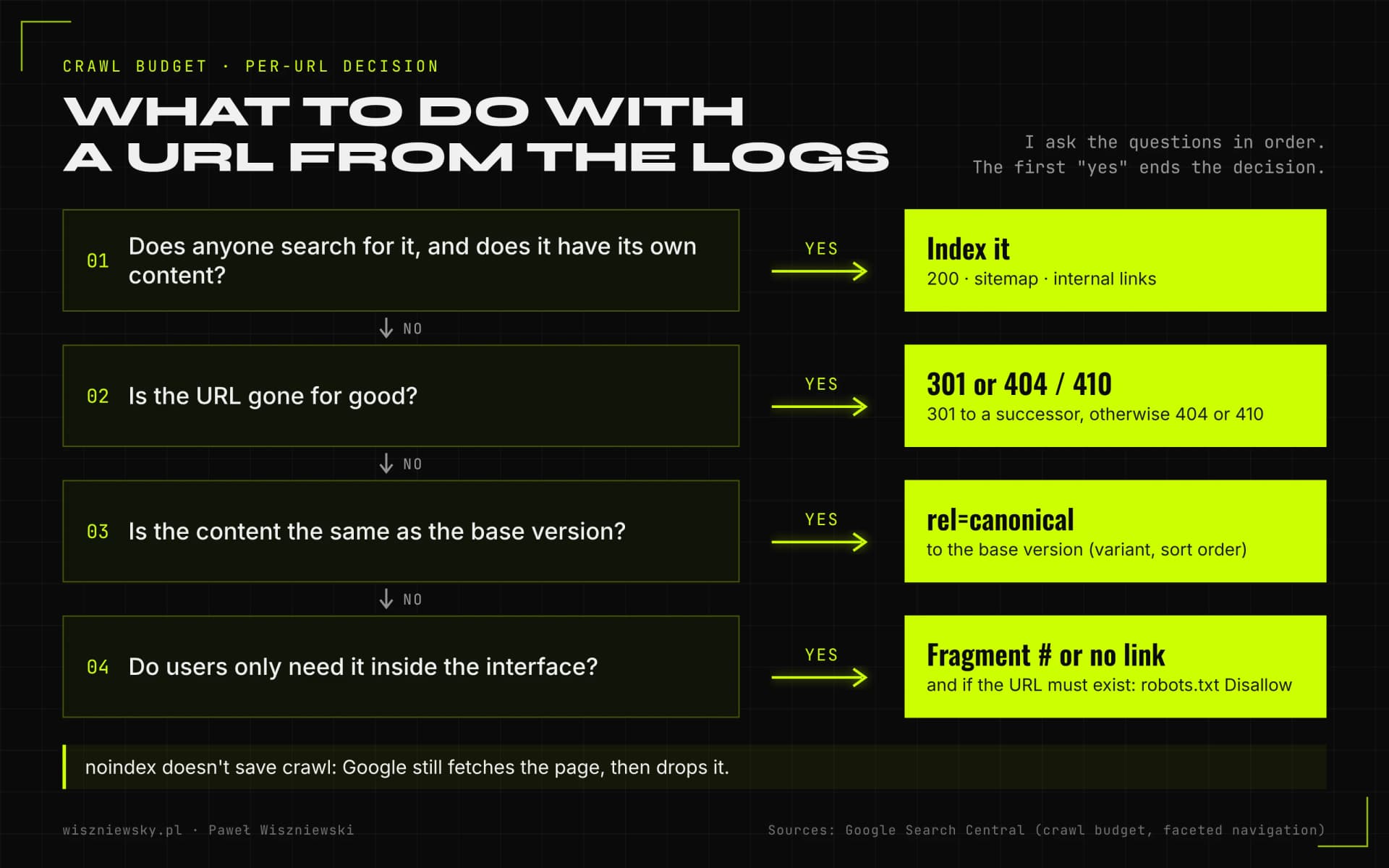
Noindex removes a page from search results but doesn't save crawl budget — Googlebot still visits it. Blocking in robots.txt saves crawl budget but prevents Google from following links from those pages. The right strategy depends on each specific case.

How do you measure crawl budget optimization results?

I measure via Google Search Console → Crawl Stats: the ratio of crawled pages with errors vs. content pages, average daily crawl requests, and whether the percentage of 'discovered but not indexed' pages decreases.

Got a project?

Terminate
Silence

Initiate protocol. Establish connection. Let's build something loud.

> WAITING_FOR_INPUT...