BACK TO GEO – AI Search Optimization

AI Visibility Audit – GEO Brand Analysis

Audit report: how ChatGPT, Gemini, Claude, and Perplexity perceive and recommend your brand. What LLMs know about your business and how to change the narrative.

Author: Paweł Wiszniewski · Updated:

Key takeaways

Audit report: how ChatGPT, Gemini, Claude, and Perplexity perceive and recommend your brand. What LLMs know about your business and how to change the narrative.

  • ›Report from 100+ query tests in ChatGPT, Gemini, Claude, and Perplexity
  • ›Comparative analysis against Top 5 competitors
  • ›Identification of incorrect or outdated information about your company in LLM responses, with a recommendation on how to correct it.

Price: from €500

SERVICE DETAILS

I conduct a systematic audit of your brand's visibility across major AI assistants (ChatGPT, Gemini, Claude, Perplexity, Copilot). I test 100+ industry queries, document how LLMs describe your company, products, and services, benchmark against your competitors, and deliver a prioritized action plan for improving your position in AI-generated responses.

› INVESTMENT:

from €500
const module = new ExecutionProtocol();

// Initializing ai-visibility-audit...
› Loading dependencies... OK
› Establishing connection... OK
› Ready for deployment... AWAITING_COMMAND

Paweł Wiszniewski · my approach

What I do differently

My audit isn't typing a few questions into ChatGPT and taking screenshots. I run your customers' questions through several models and repeat the measurement, because AI answers are non-deterministic and a single test can mislead. Answers are scored by AnswerLyzer, my LLM-as-a-judge tool, and a random sample is checked by hand. You get not just a score but the list of sources that decide who AI recommends in your category — usually the most valuable part of the report.

Case study: AnswerLyzer AI Analytics

My take and a real-world example

My take

In my view, tools that show your “position in ChatGPT” as a single number are misleading. AI answers are random by nature, so reliable measurement needs many repeats and looks at share of answers, not a single rank.

From the market

A SparkToro and Gumshoe.ai study that ran brand recommendation prompts 60–100 times each in ChatGPT, Claude and AI Overviews found less than a 1-in-100 chance of getting the same brand list twice. That's why my audit measures every question repeatedly and reports share of answers.

Sources: Search Engine Land: AI recommendation lists rarely repeat

Who this is for

  • Companies that want to know whether and how AI recommends their brand before investing in GEO.
  • Boards and marketing teams that need data rather than hunches about AI search.
  • Brands that AI assistants describe with outdated or wrong information.
  • Agencies and companies benchmarking their AI visibility against competitors.

What you get

  • A customer question set split by intent: recommendations, comparisons, problems, brand.
  • Measurement in ChatGPT, Gemini, Perplexity, Copilot and Google AI Mode.
  • Analysis of who gets recommended, in what order, with what sentiment and based on which sources.
  • A list of errors and knowledge gaps models have about your company.
  • A report with an action plan ranked by impact.

How results are measured

  • Brand share of answers by assistant and question type.
  • Brand position in answers versus competitors.
  • Most-cited domains in your category.
  • Factual errors in answers about the brand.

Key Benefits

Report from 100+ query tests in ChatGPT, Gemini, Claude, and Perplexity — a complete map of how AI perceives your brand today.

Comparative analysis against Top 5 competitors — who is cited more frequently than you, what content and signals they use to achieve that position.

Identification of incorrect or outdated information about your company in LLM responses, with a recommendation on how to correct it.

GEO gap map: industry topics where your brand should be the cited authority but isn't — a ready list of content opportunities.

Prioritized action plan with difficulty estimates and potential impact on AI visibility for each recommended action.

The Process

1

Test Query Set Design

I create a set of 100+ queries covering brand queries (company name), category queries (industry, services), informational queries, and comparison queries — tailored to your market.

2

Testing Across Major LLMs

I systematically test all queries in ChatGPT, Gemini, Claude, Perplexity, and Copilot, document each response, and record your brand's mention frequency.

3

Analysis & Benchmarking

I analyze results vs. competitors, identify patterns in content and signals that cause more frequent citation, and document factual errors in brand descriptions.

4

Report & Action Plan

I deliver a detailed PDF report with findings, root cause analysis, and a prioritized action list with ROI estimates for each GEO recommendation.

AI visibility audit vs classic SEO audit vs no action

CriterionAI visibility audit (GEO)Classic SEO auditNo action
What it measuresHow LLMs describe and cite youRankings, links, technical SEONothing
Channels testedChatGPT, Gemini, Claude, PerplexityGoogle search resultsNone
Competitor benchmarkingAI citation share vs rivalsKeyword and backlink gapsBlind to position
Error detectionFinds wrong AI facts about youFinds on-site issuesErrors go unnoticed
OutputPrioritized GEO action planSEO fix listNo insight
Recommended cadenceQuarterly as models updatePeriodicNever
Best forBrands targeting AI searchTraditional search performanceBrands ignoring AI

Common mistakes

  • Drawing conclusions from one query typed once into ChatGPT.
  • Measuring only questions containing the brand name instead of questions where customers look for a solution.
  • Ignoring Google AI Overviews and AI Mode, which are the biggest source of AI answers for many businesses.
  • No competitor comparison — a brand score alone says little.

When this service is not worth it

  • You only have a business idea and there's no information about it online yet.
  • You don't plan any action after the audit — a report without implementation changes little.
  • Your customers don't use AI at all when choosing in your category.
/// GUIDE

AI visibility audit – how I run it step by step

An AI visibility audit answers whether assistants such as ChatGPT, Gemini, Perplexity, Copilot and Google AI Mode recommend your brand, how they describe it and which sources they rely on. Below I show how I design the measurement so the result can be trusted, how I score answers and errors about the brand, what I check on the technical side and what the report looks like. At the end there's a mini audit you can run yourself in an hour.

What an AI visibility audit covers – four layers

A solid GEO audit checks four layers: what assistants answer, which sources they lean on, whether the facts about your brand are true, and whether AI search crawlers can reach your site at all. Measuring answers without the other layers tells you there's a problem, but not where it comes from.

LayerQuestion it answersWhat exactly I check
AnswersDoes AI mention the brand, and how often?Share of answers, position in lists, the brand's role (recommended, mentioned, discouraged), sentiment, competitors
SourcesWhat does the model base the answer on?Cited domains and URLs by assistant and question type, whether your brand appears on those pages
Brand factsIs AI telling the truth about you?Offer, prices, locations, owners, history, confusion with other companies, outdated data
Technical accessCan the assistant read your site?Crawlers in robots.txt and the firewall, Bing and Google indexes, content without JavaScript, Bing Webmaster Tools and GA4 data

Every recommendation in the report comes from one of these layers, so it's immediately clear whether a fix concerns content, external sources, the brand entity or the tech stack. For the wider context, how assistants pick sources and how GEO differs from SEO, see my guide on GEO – AI search optimization.

How I design the audit question set

The question set determines the value of the whole audit: if it's mostly questions containing your brand name, the result will be inflated and useless. Most questions are phrased the way a customer asks before they even know your company exists.

The proportions I stick to

  • About two-thirds of questions without the brand name – recommendations (“which firm should I choose for…”), category comparisons, problems and costs. This is where the customer decides who they'll consider at all.
  • Questions with the brand name – “what do you think of X”, “X vs Y”, “how much does X charge”. Mainly for catching errors and sentiment.
  • Control questions – a few where the brand has no chance of appearing. They help in later measurements to tell a model change from the effect of your work.

How I phrase questions

  • In the customer's words, with the context people actually add: city, budget, company size, industry, constraints. Conversations with AI are longer than the phrases people type into Google.
  • No leading questions. “Is X a good company?” almost always gets a positive answer, so it says nothing about real visibility.
  • In the language your customers search in. For a company selling in several markets I measure each language separately, because answers and cited sources differ between languages.
  • I agree a list of 3–6 competitors with you whose presence I also count. I often add one or two that AI recommends but you didn't consider competitors.
IntentExample question (accounting firm)What I measure
RecommendationWhich accounting firm in Manchester would you recommend for a limited company with about fifteen employees?Whether the brand is listed, in which position, with what justification
ComparisonIs an accounting firm or an in-house bookkeeper better at 30 invoices a month?Whether your content or a competitor's is cited
CostHow much does full bookkeeping for a limited company cost in 2026?Whether the model quotes your prices and whether they're current
ProblemHow do I get ready for Making Tax Digital if I keep my invoices in Excel?Whether the brand comes up as an expert or portals win
BrandWhat do you know about [name] accountants? What are their reviews like?Factual accuracy, sentiment, sources of reviews

The example is illustrative, but it shows the principle: each question has an intent and a defined thing I read from it. More on finding such questions, including the ones no keyword tool will show you, is in my post on keyword research in the AI era.

Measurement conditions – why the same questions give different results

An assistant's answer depends not only on the question, but also on the model, whether search is on, location, language, account history and the date. If you don't control these conditions, you're comparing random screenshots, not brand visibility.

VariableHow it affects the answerHow I control it
Model and versionDifferent models and versions have different knowledge and use search differentlyI log the model and date for every answer and only compare runs with the same settings
Live searchWith search the model cites current pages; without it, it answers from training dataI measure both modes separately, because they lead to different actions
LocationLocal and “near me” questions depend on where the question comes fromI set the target market's location, and measure several cities separately
Personalization and memoryChat history and saved preferences change answers for a given userI measure in clean sessions without memory or personalization, e.g. ChatGPT's temporary chat without personalization
RandomnessThe same question asked twice gives a different list of brandsI repeat every question many times and report share, not a single result
InterfaceThe app, the API and the search engine may answer differentlyMost measurement is automated, and I compare a sample with what a user sees in the app

OpenAI's ChatGPT help pages explain that a temporary chat doesn't use memory or custom instructions by default unless the user chooses the personalized version. That's a good baseline for manual tests, but remember that your customers usually ask from their own personalized accounts. So I treat the audit result as a picture of the “average” user, not an exact replica of every conversation.

How many repeats are enough – a bit of statistics

A few repeats let you tell a brand that appears often from one that appears rarely, but they don't let you measure share of answers precisely. Precision only comes from aggregating many answers across many questions.

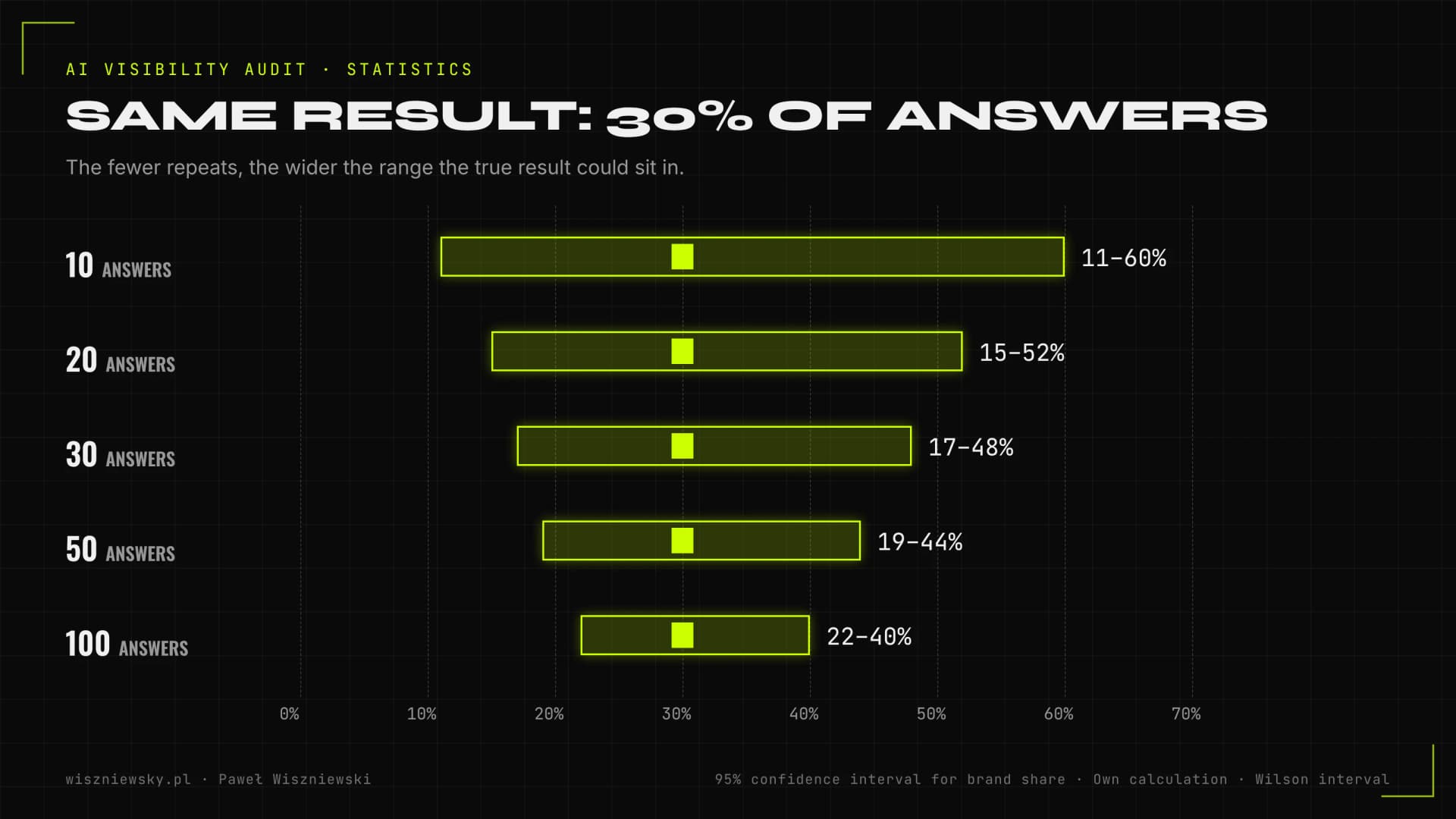
Brand share of answers is a proportion, so you can compute a confidence interval for it. Example: a brand appears in 30% of answers. With 10 answers, the 95% confidence interval (Wilson method) runs roughly from 11% to 60%; with 30 answers, from 17% to 48%; with 100, from 22% to 40%. In other words, with 10 repeats a “30%” result could just as well mean 15% or 50%.

Chart: 95% confidence interval for a 30% brand share at 10, 20, 30, 50 and 100 answers; the interval narrows from 11–60% to 22–40%.
The same “30% of answers” result at different numbers of repeats. Own calculation, Wilson interval, 95% confidence level.

What this means for the audit

  • For a single question, 5–10 repeats per assistant are enough to classify the result as “never”, “sometimes” or “almost always”. I don't report percentages to the point in that case.
  • Aggregate metrics, such as the brand's share across all recommendation questions in ChatGPT, are computed from hundreds of answers, so they're far more stable.
  • When comparing with competitors I check whether the intervals overlap. If they do, I don't write that the brand is “ahead”.
  • In later measurements, a change of a few percentage points on a small sample is usually noise, not the effect of your work.

Why repeating is necessary in the first place is shown by the SparkToro and Gumshoe.ai study discussed in the guide on GEO – AI search optimization: lists of recommended brands almost never repeat in identical form.

How I score answers – rubric and quality control

I score every answer with the same rubric, and the scoring is done by a language model (LLM-as-a-judge) whose work I check by hand on a random sample. Without a fixed rubric, two people, or even the same person on two different days, would score the same answers differently.

Fields I fill in for every answer

  • Brand presence – yes or no, separately for each brand on the competitor list.
  • Position in the list – when the answer names several companies.
  • Role – recommended outright, mentioned neutrally, mentioned with a caveat, or discouraged.
  • Justification – what the model praises or criticizes the brand for. Often the best hint for what to communicate.
  • Factual accuracy – whether the brand data matches the fact sheet we prepare at the start.
  • Sources – cited URLs and domains.

Why I check the judge

Zheng and co-authors, in “Judging LLM-as-a-Judge” (NeurIPS 2023), showed that a strong model acting as judge agreed with human ratings in over 80% of cases, roughly as often as humans agree with each other. They also described typical biases: favoring answers in a certain position, longer answers, and answers from the judge's own model. So I give the judge narrow, closed questions (is brand X named in the text, is it recommended) rather than a general “how well does the brand come across”, and I verify a random share of the scores by hand. When I find disagreements, I fix the rubric and re-score the set.

Errors about your brand in AI answers – how I classify them and where they come from

Every factual error about the brand gets a severity and a hypothesis about its source, because the source determines the fix. An error taken from a cited page is fixed differently from one the model “remembers” from training data.

SeverityExamplesWhy it matters
CriticalCompany described as closed, a service that doesn't exist, wrong price or address, confusion with a company with a bad reputationDirectly costs you customers or invites complaints
MajorOutdated offer, former owner, someone else's reviews attributed to you, wrong specializationDistorts the brand's image when a buyer is choosing a vendor
MinorOld name, outdated headcount, approximate founding dateRarely affects a decision, but signals inconsistent data online

How I look for the cause

  1. I check whether the answer with the error cites a source. If it does, I open it and look for the wrong information: often an old business directory, an outdated article or a profile nobody remembered.
  2. If there's no source, I compare answers with search on and off. An error that appears only without search points to training data and usually fades more slowly.
  3. I check data consistency where the brand is described: About page, structured data, Google Business Profile, company registers, LinkedIn, Wikidata.
  4. When the brand is confused with another company, I look for what links the two entities: a similar name, the same street, a shared domain in the past.

Fixing errors is usually work on the brand entity, which is what knowledge graph engineering covers. What to do step by step when ChatGPT says something untrue about your company is in my post on brand reputation in AI.

Source analysis – the part of the report that pays off most

The list of domains cited in your category usually turns out to be the most practical part of the audit, because it shows directly where you should be. In the report I compile it across all questions and separately for each assistant.

  • Domain ranking – which sites are cited most often and for which question types.
  • Breakdown by category – your site, competitor sites, media and rankings, communities, knowledge bases, directories.
  • The “cited, but without you” list – specific URLs that assistants cite for recommendation questions, which feature your competitors but not your brand. A ready target list for digital PR.
  • Your cited URLs – which pages already work as sources and for which questions. Often not the pages the company considers most important.

Each platform has different favorite sources, so a list for ChatGPT won't replace one for Perplexity or Google AI Overviews. How I turn such a list into an off-site plan is described in my AI citation strategy and ChatGPT SEO service.

The technical part of the audit – can assistants read you

Before you start improving content, rule out the simplest cause of missing citations: an AI search crawler can't fetch the page, or the page isn't in the index the assistant uses. In the audit I check this in several places, because one data source is often not enough.

  • robots.txt – whether you let in search crawlers (OAI-SearchBot, PerplexityBot, Claude-SearchBot, Bingbot, Googlebot), regardless of your decision on training crawlers.
  • Firewall and CDN – whether bot protection rules block those same crawlers. Since July 2025 Cloudflare blocks known AI crawlers by default on new domains (MIT Technology Review), so a correct robots.txt isn't enough.
  • Server logs – which bots actually arrive and which response codes they get.
  • Bing's index – in tests ChatGPT relied heavily on Bing for search, and Copilot runs on it directly. I check indexing in Bing Webmaster Tools.
  • Content without JavaScript – whether the main content, prices and contact details are in the HTML, not only after scripts render.
  • AI Performance report in Bing Webmaster Tools – since February 2026 it shows how often your pages are cited in Copilot and Bing's AI summaries, the cited URLs and a sample of the queries that led to them.
  • GA4 – whether assistant traffic is separated. ChatGPT adds utm_source=chatgpt.com to its referrals, as OpenAI describes in its publisher FAQ.

Crawler configuration is covered in my post on AI crawlers and robots.txt, and traffic measurement in how to measure traffic from ChatGPT, Perplexity and AI Mode. If the audit finds problems in this layer, I fix them as part of Perplexity, Copilot and ChatGPT Search optimization.

What the report contains and how I set priorities

The report ends with a list of actions ranked by impact, effort and who can carry them out. The measurement results are only the justification for that list.

Report structure

  1. A one-page summary: the key numbers, the three biggest problems and the first three actions.
  2. Brand share of answers against competitors, by assistant and intent, with measurement uncertainty marked.
  3. Source analysis with the “cited, but without you” URL list.
  4. A list of factual errors with severity, example answers and a hypothesis about the source.
  5. Technical findings.
  6. The action plan and raw data: questions, answers and scores, so you can repeat the measurement yourself or with another provider.

How I rank actions

Action typeTypical impactEffortWho does it
Unblocking crawlers, Bing indexingHigh, if that was the causeLowMe or your IT team
Fixing wrong data in profiles and directoriesMedium to high for critical errorsLow to mediumYour team with my list
Rebuilding key pages (direct answers, “who it's for”, prices)Medium to highMediumMe, or your team from a spec
New pages: comparisons, costs, use casesMediumMedium to highMe or a copywriter
Mentions on cited sites and in rankingsHigh for recommendation questionsHigh, spread over timeTogether, digital PR
Brand entity workHigh for errors and confusionMediumMe

A one-hour DIY AI visibility mini audit

A simple test on your own won't replace an audit, but it's enough to see whether the topic matters for your company at all. You need a spreadsheet and three assistants.

  1. Write down 10 questions: 7 without your brand name (recommendations, comparisons, costs) and 3 with it.
  2. Pick ChatGPT, Google (AI Mode or AI Overviews) and one assistant your customers use, e.g. Perplexity or Copilot.
  3. Ask each question three times in each assistant, each time in a new, clean session without history or personalization.
  4. In the spreadsheet, record: whether your brand came up, which competitors came up, which domains were cited, and whether the brand description contains an error.
  5. Count how many of the 63 answers to the non-brand questions included you, and how many included each competitor.
  6. List the domains that appeared in citations at least three times.

How to read it: if competitors show up clearly more often and you barely appear, the problem is real and worth investigating properly. Keep the limits in mind, though: 9 answers per question is too few to track month-to-month changes, and manual logging is easy to get wrong. The next steps for measuring on your own are in my post on AI visibility audits and AI share of voice.

Monitoring tool or audit – which to choose

An AI visibility monitoring tool measures regularly but doesn't tell you why the result is what it is. An audit measures once, more thoroughly, and ends with a diagnosis and a plan. In practice they complement each other.

CriterionSaaS monitoring toolAI visibility audit
GoalTracking the trend over timeDiagnosis and action plan
Question setUsually you enter it yourselfDesigned for your category and customer intents
Brand errorsUsually just sentimentA list of errors with severity and a source hypothesis
Technical partUsually noneCrawlers, firewall, Bing index, GA4
InterpretationUp to youConclusions and priorities in the report
When it makes senseWhen you already know what you're fixing and want to track the effectAt the start, or when results drop and nobody knows why

A comparison of popular tools (Profound, Peec, Otterly, Semrush) and when building your own makes sense is in my post on AI visibility monitoring tools.

What happens after the audit

An audit only makes sense if something changes afterwards. The results usually point to one or two main directions, and the action plan assigns them to specific tasks.

After the first changes are live, I repeat the measurement on the same question set and under the same conditions, usually after about three months. Only then does a before-and-after comparison mean anything.

Frequently Asked Questions

Do LLMs have current data about my company?

It depends on the mode. Perplexity and ChatGPT Search (and other assistants with web search enabled) use a live web index. The models' own knowledge, without search, ends at a training cutoff date (typically 6–12 months in the past). The audit shows what each model knows separately.

What can I do if LLMs say incorrect things about me?

Direct correction of LLM data is impossible — but it can be fixed through external sources. Updating Wikidata entries, Wikipedia (if you qualify), industry media, and your own content influences future training cycles and RAG.

How often should I repeat the audit?

I recommend quarterly — models update, new versions have different knowledge and behaviors. For companies actively building GEO, monthly monitoring is standard practice.

How do I find out what AI models say about my brand?

An AI visibility audit systematically tests a set of branded and industry queries across ChatGPT, Gemini, Claude, and Perplexity. The LLM brand presence analysis covers: how each model describes the company, what products/services it mentions, whether information is current, and whether the brand gets cited on category-level questions. The GEO site audit delivers a current-state map plus a corrective action plan.

What exactly is in the report?

Results for a set of customer questions across several AI assistants: who gets recommended, in what order, with what sentiment, which domains are cited, what errors appear in how your brand is described, and an action plan ranked by impact.

How long does an AI visibility audit take?

Usually a few weeks: agreeing the question set, measuring with repeats, analysis and recommendations. Timing depends on the number of questions and assistants covered.

How much does an AI visibility audit cost?

The audit starts from €500. The price depends on the number of questions, assistants and competitors compared.

/// KNOWLEDGE_BASE

From the blog

AI & SEO

AI Visibility Audit - How to Measure Whether ChatGPT Recommends Your Brand (AI Share of Voice)

Do ChatGPT, Perplexity and AI Overviews recommend your brand or your competitors? Google's and Bing's 2026 reports, building a question set, measuring at three levels with a script, calculating and reading AI Share of Voice, and a one-day audit.

12 min
AI & SEO

AI Visibility Monitoring Tools - Profound, Peec, Otterly, Semrush and the "Build Your Own" Option (Comparison)

The AI visibility tools market raised over $300M in funding within a year, and prices span from $29 to $499+ a month - yet the methodological differences are bigger than the price gaps: some tools query models with synthetic prompts, others build on real queries. I compare Profound, Peec, Otterly, Semrush AI Toolkit, Ahrefs Brand Radar and company, show the free zero layer (GSC, Bing) - and calculate when building your own monitoring on the LLM-as-a-judge pattern pays off, which I know from the inside, because that's what my AnswerLyzer is.

15 min
AI & SEO

How to Measure Traffic from ChatGPT, Perplexity and AI Mode - Analytics for the AI Era (GA4 + Server Logs)

AI traffic converts up to ~4.4× better than classic organic and grew to stores by four digits - yet default GA4 hides it well: some lands in referrals, some in direct, and AI Overviews clicks are indistinguishable from regular Google. The complete measurement workshop: an AI channel group in GA4 with a ready regex, dark AI traffic, the AI Overviews signature in GSC, and server logs as the other half of the picture.

13 min

Got a project?

Terminate
Silence

Initiate protocol. Establish connection. Let's build something loud.

> WAITING_FOR_INPUT...