Content marketing for SEO and GEO: content strategy, expert articles and blog management. Content that ranks in Google, gets cited in AI answers and turns readers into customers.
Content marketing for SEO and GEO: content strategy, expert articles and blog management. Content that ranks in Google, gets cited in AI answers and turns readers into customers.
›Content Marketing Strategy
›SEO & GEO Copywriting
›Keyword & AI Prompt Research
›Blog Management
Content Marketing & SEO – how it works
Content in 2026 has to work in two places at once: Google's results and AI answers that increasingly respond on the user's behalf without a click. That's why I plan every piece from data — SERP analysis, the questions people ask AI assistants and gaps in your topic clusters — and write it to be citable: a direct answer at the top of each section, specific numbers, sources, tables and a named expert author. I build 12-month content marketing strategies, write expert SEO articles and run company blogs end to end, from planning to refreshing decaying content. My own blog has 100+ articles in two languages — every method I use for clients is tested here first.
› CORE_CAPABILITIES:
Content Marketing Strategy
SEO & GEO Copywriting
Keyword & AI Prompt Research
Blog Management
Topic Clusters & Internal Linking
Content Refresh & Decay Fixes
RANK_1 DOMINANCE
Paweł Wiszniewski · why me
What I do differently
I write content the way I run my own blog: over 100 articles in two languages organized into clusters, with data, sources, covers and short videos. Every piece is planned for both Google and the questions people ask AI assistants, and older content is refreshed regularly. You can judge the quality of my work before we start — just read a few posts on the blog.
Content marketing for SEO – a practical 2026 guide
This guide explains how I plan, write, refresh and measure content that has to earn traffic from Google and citations in AI answers. It covers building a content strategy step by step, a content brief template, Google's rules on AI-generated content, writing for AI Overviews and large language models, content audits, what SEO content costs and the mistakes I see most often. Every number links to a source, and where I describe my own method, I say so.
Content marketing for SEO vs. SEO copywriting vs. running a blog
Content marketing for SEO is a process: content is created from real demand (your customers' questions and search queries), each piece has a business goal, and pieces are grouped into clusters so they build visibility for the whole domain rather than a single article. SEO copywriting is one part of that process: writing and optimizing an individual piece.
People use these terms interchangeably, but what you buy determines what you should expect. A company that orders “SEO articles” without a strategy gets articles. A company that buys content marketing should get an answer to which topics to publish, in what order and why, plus a way to tell whether it's working.
Content strategy
SEO copywriting
Blog management
Question it answers
What to write, in what order and why
How to write this specific piece so it ranks and gets cited
Who runs the whole channel every month
Main output
Cluster map, calendar, briefs, KPIs
A finished article with on-page optimization
Publishing, refreshes, internal links, reporting
Time horizon
12-month plan
One piece
Ongoing
Most common mistake
A plan built only from a keyword tool
Writing to a word count
Counting posts instead of results
My price
from €1,500
from €500 / article
from €3,000 / month
SEO content is broader than blog posts. It includes pillar guides, comparisons, glossaries, category copy, pages answering pre-sales questions and regularly updated roundups. This guide focuses on expert content, because that's what builds topical authority and most often ends up in AI answers.
How content earns traffic in 2026: Google results, AI Overviews and LLMs
In 2026 the same piece competes in three places: classic Google results, the passages cited by AI Overviews and AI Mode, and answers from assistants such as ChatGPT and Perplexity. The foundation for all three is still an indexable page that answers the question best.
What has changed is how many clicks a good answer earns. Pew Research Center (2025) analyzed 68,879 searches by 900 U.S. adults in March 2025. When the results included an AI summary, users clicked a traditional result in 8% of visits, compared with 15% when there was no summary. Links inside the summary itself were clicked in 1% of those visits. Content still pays off, but its value has to be measured more broadly than raw traffic.
Google's documentation “AI features and your website” states there are no additional requirements or special optimizations needed to appear in AI Overviews or AI Mode. These features may, however, use query fan-out: they break one question into multiple related searches and pick sources for each. The practical takeaway for writers is that a piece covering only the head query has fewer chances to be cited than one that also answers the follow-up questions.
In a May 2025 post, Google added that clicks from results pages with AI Overviews are, in its observation, “higher quality”, meaning users tend to spend more time on the site, and encouraged site owners to look at conversions rather than clicks alone. That's Google's claim, not an independent measurement, but it matches how I report content performance today.
What this changes in content planning
Simple definitions and one-line answers increasingly get resolved on the results page. Have them, but don't build the whole plan around them.
Content that can't be summarized from other pages gains value: your own data, tests, comparisons, procedures and expert opinions.
Brand matters: someone who sees your name in an AI answer may come back through a branded search, which never shows up as traffic from one keyword.
A content strategy is a document that answers three questions: who we're writing for, what we're writing about (and in what order), and how we'll know it works. Without it, content comes from random ideas, and a year later nobody knows which pieces brought in customers.
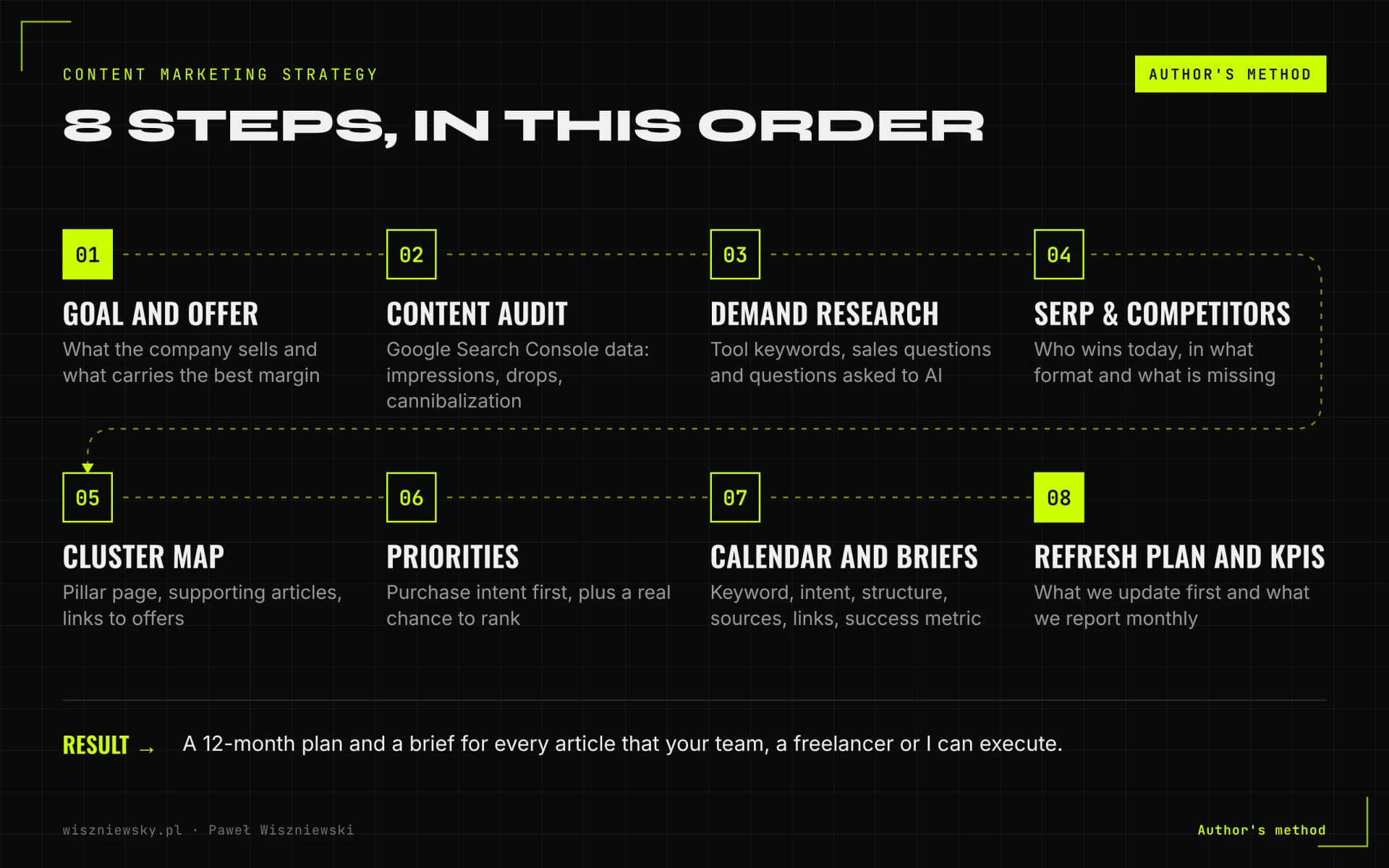
This is the order I work in. The steps are the same for a small service business and for a store with thousands of products; only the scale differs.
Business goal and offer. I start with what the company sells and which services or products carry the best margin. Content that leads to no offer can attract traffic, but not inquiries.
Audit of existing content. I export Google Search Console data and check which URLs get impressions, which are losing clicks and which compete with each other for the same queries.
Demand research. I collect keywords from tools (Ahrefs, Semrush), questions from sales and support, and questions people ask AI assistants. The last group often has no search volume in any tool.
SERP and competitor analysis. For each topic I check which pages win today, in what format (guide, comparison, list, calculator) and what they're missing.
Cluster map. I group topics into clusters with one pillar page and supporting articles, and plan internal links between them and the service pages.
Priorities. I start with topics that have clear purchase intent and a realistic chance of ranking, and push highly competitive educational topics later.
Calendar and briefs. Every planned piece gets a brief: keyword, intent, structure, sources, links and a success metric.
Refresh plan and KPIs. I decide which existing pieces to update first and which metrics we report monthly.
The order I work in on every content strategy; the result is a 12-month plan and a brief for every article.
Content formats I plan and what each is for
Pillar guide: a broad answer to the cluster's main question, and the starting point for detailed articles and service pages.
Comparison or ranked list with criteria: for “X vs Y” queries where the reader is choosing. The easiest place to show your own testing.
“How much does it cost” piece: for purchase-intent queries. It only works if you give real ranges and price drivers, not “it depends”.
Procedure or checklist: for “how to” queries. Numbered steps are easy to follow and often surface in AI answers.
Case study: the strongest proof of experience, as long as it describes a real project and its limits.
Glossary: short definitions that organize the cluster and act as link targets from longer pieces.
I don't fix the mix of formats in advance. How many comparisons versus guides depends on what Google shows for the planned queries and where in the decision process the target customers are.
I deliver this as a standalone content marketing strategy, with a 12-month plan and a brief for every article, written so that your team, a freelancer or I can execute it.
Search intent and topic research
Search intent is the goal behind a query: the person wants to learn something, compare options, buy, or reach a specific site. Content that doesn't match intent won't rank well, however well it's written.
In a 2023 study of around 14 billion pages, Ahrefs reported that 96.55% of them get no traffic from Google. It named three main reasons: no search demand for the topic, no backlinks, and a mismatch with search intent. Two of those three are decided at the planning stage, before anyone writes a sentence.
Intent
Example query
Format that usually wins
Funnel role
Informational
what is topical authority
Guide, definition with examples
First contact with the brand
Comparison
n8n vs make
Comparison, table, criteria-based ranking
Choosing a solution
Commercial investigation
seo content writing cost
Service page with pricing, buyer's guide
Purchase decision
Navigational
brand name + blog
Brand page, blog category
Returning to a known brand
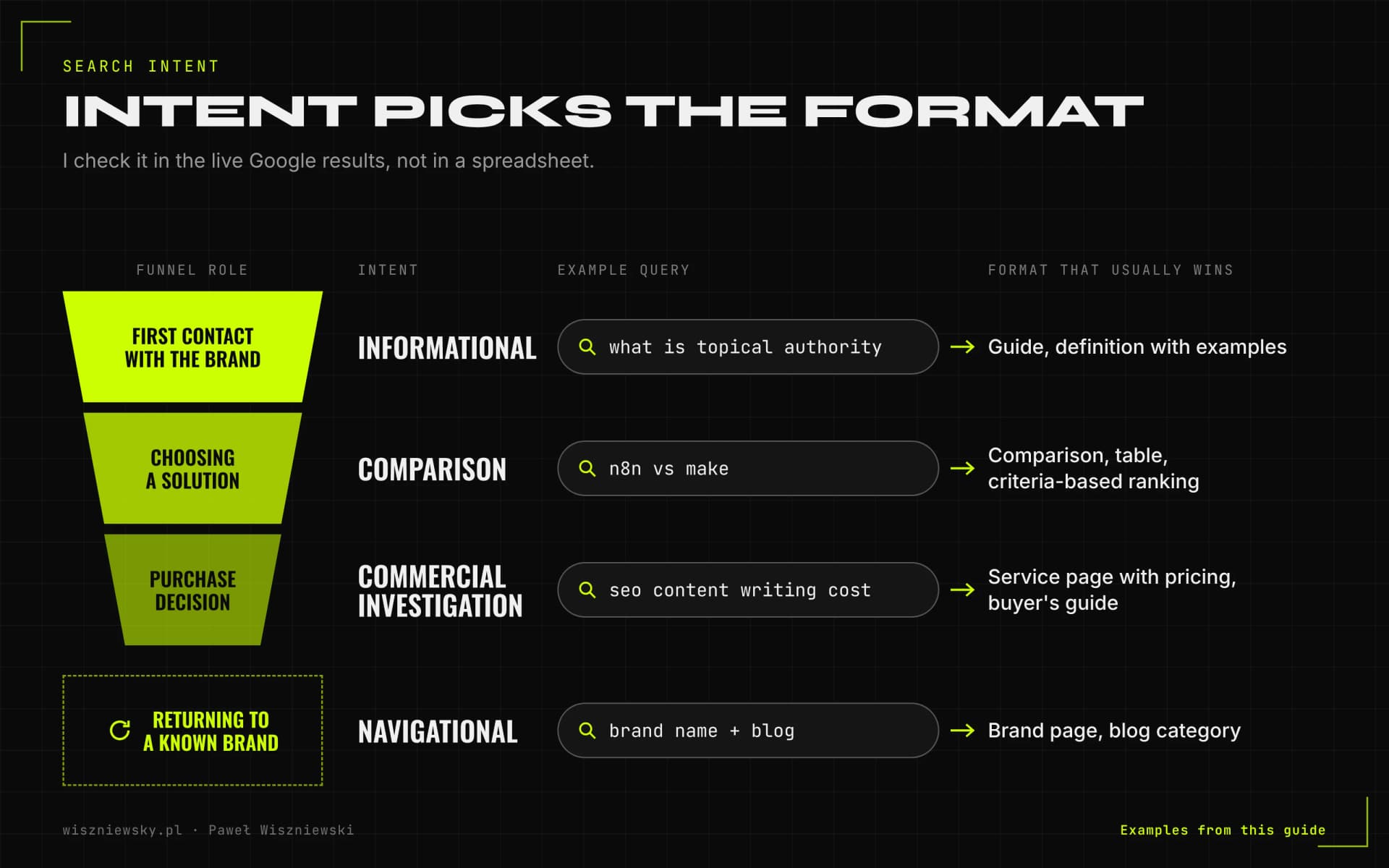
The intent table drawn as a funnel: from first contact with the brand to the purchase decision, plus returning visitors.
I always check intent in the live results, not in a spreadsheet. If Google mostly shows guides for “content marketing strategy”, a service page with a price list is unlikely to rank there, however well optimized. In that case I plan a guide that links to the service instead of forcing the sales page.
Research for AI: questions no tool shows
Conversations with AI assistants are longer than classic queries and often include context (“I run a clothing store on Shopify and I'm wondering whether a blog is worth it”). Keyword tools won't show these, but you can collect them from support tickets, forums, Google's “People also ask” and test conversations with models. I describe my method in keyword research in the AI era and query fan-out.
Topic clusters and pillar pages: building topical authority
A topic cluster is a group of related content: one pillar page that covers a topic broadly and several supporting articles that go deep on its parts. All of them are interlinked, so both search engines and readers can see the domain covers the subject as a whole.
I use the hub-and-spoke model in every strategy. The pillar answers the main question and leads to detailed articles; each detailed article links back to the pillar and to the relevant service page. Google's AI features documentation lists internal linking among the baseline best practices, because it helps content get found and understood.
What a good cluster looks like
The pillar has a clearly defined scope and doesn't try to answer everything. If it keeps growing, I split it into two clusters.
Each supporting article targets a different question. Two pieces with the same intent end up competing (cannibalization).
Internal links use descriptive anchors, not “click here”, and go where the reader actually wants to go next.
The cluster ends at the offer: there has to be a sensible path from an educational article to a service or product page.
Good clusters attract links more easily than isolated posts, but they rarely do it on their own. I don't recommend link packages: they usually land on sites with no traffic and no topical relevance. Carefully selected placements on topical sites with real traffic can make sense, as long as the link is labeled: Google's documentation on qualifying outbound links requires paid links to carry rel="sponsored" (nofollow is still accepted). More on that approach on my link building strategy page.
Content brief: what a good article brief includes
A content brief is one or two pages telling the writer who the piece is for, why it exists, which questions it must answer and how we'll judge success. A good brief cuts writing time and revision rounds more than any tool.
The briefs I write in a strategy and before every article follow a fixed layout. You can use it whoever writes for you.
Brief element
What it contains
Why it matters
Primary keyword and variants
1 primary keyword, 5–15 variants and follow-up questions
Topic coverage and the sub-questions AI splits a query into
Intent and audience
Who searches, at what decision stage, what they need
Determines format and tone
SERP analysis
What the top 10 and AI answers show, and what's missing
Shows how the piece should stand out
Structure
Proposed H2/H3s, where tables and lists go
Makes writing easier and passages easier to cite
First-hand element
A test, data, an implementation, an expert's view
The one thing competitors and AI models can't copy
Sources
Primary sources to check
Credibility and factual accuracy
Internal links
Links to the pillar, cluster articles and the offer
Cluster consistency and a path to conversion
Goal and metric
E.g. rankings, clicks, visits to the offer page
Lets you judge the piece a few months later
SEO copywriting: how to write content that ranks and gets read
Good SEO content answers the question faster and more completely than the pages ranking above it, and it's written for people. Optimization is mostly about order: a clear title, logical headings, answers at the top of each section, sources and links, not squeezing the keyword into every other sentence.
A structure that works in search results and AI answers
A title with the main phrase first that makes sense without context. Google's helpful content guidance asks directly whether the heading or page title provides a descriptive, helpful summary of the content.
A direct answer in the first one or two sentences of each section, then detail, examples and exceptions.
Headings phrased as questions or queries people actually type or ask an assistant.
Tables and lists where you compare options or describe steps. They're easier to read and easier to cite.
Author, last-updated date and sources visible on the page, not buried in the footer.
Internal links to the cluster pillar and the offer, with descriptive anchor text.
How long should an SEO article be?
Google answers this itself in its helpful content guidance: next to the question of whether you're writing to a particular word count because you heard Google prefers one, it adds “(No, we don't.)” Length is a consequence of how much it takes to satisfy the intent. My expert articles usually run 2,500–4,000 words because they cover the topic together with its follow-up questions, but a comparison of two tools can be shorter and a pillar guide longer.
Keywords without stuffing
I put the main phrase in the title, the H1, the first paragraph and some headings, and cover the rest with variants and related concepts. Tools like Surfer SEO or Clearscope are a check that I haven't missed an important subtopic, not a score to push to 100. In the GEO study (Aggarwal et al., KDD 2024), keyword stuffing didn't improve visibility in generative engine answers, and on one metric it scored below the unoptimized baseline.
My writing process with AI as an assistant
I analyze the results and AI answers for the topic and note what's missing.
I use AI to gather and summarize sources, but I check every number against the primary source before using it.
I build the structure with follow-up questions and space for the first-hand element.
I write the piece myself and use the model as a reviewer: missing subtopics, inconsistencies, overly long sentences.
I add internal links, metadata and structured data, then read the whole piece as a reader, not as its author.
That's how I write articles under SEO copywriting: from SERP analysis and the brief, through source research, to metadata and structured data.
E-E-A-T and helpful content in practice
E-E-A-T stands for experience, expertise, authoritativeness and trustworthiness. Google Search Central says trust is the most important of the four, and that E-E-A-T itself isn't a single ranking factor but a set of qualities its systems try to identify.
For topics that can affect health, finances or safety (YMYL), Google says content must be highly accurate and consistent with expert consensus. In those industries I don't publish anything that a specialist on the client's side hasn't reviewed.
The “Who, How and Why” questions
Google's helpful content guidance suggests evaluating content with three questions. I translate them into concrete page elements:
Google's question
What it means on the page
How I check it
Who created the content?
Author byline, short bio, link to an author page
Does the reader know within five seconds who wrote it and why they'd know
How was it created?
Method: tests, data sources, AI involvement where it matters
Is it clear where the numbers and conclusions come from
Why was it created?
To help the audience, not to catch traffic on a trending topic
Would I write this for my clients if search engines didn't exist
Google's self-assessment list also includes warning signs of search-engine-first content: writing about topics just because they're trending, entering a niche without real expertise, or leaving readers feeling they need to search again. I use them as a pre-publish checklist. I go deeper in E-E-A-T in 2026.
AI-generated content, Google's rules and scaled content abuse
Google doesn't penalize content for being made with AI. It penalizes content produced at scale mainly to manipulate rankings, whether a model, a human or both wrote it.
Google's February 2023 statement (“Google Search's guidance about AI-generated content”) says it rewards high-quality content however it's produced, and that using automation primarily to manipulate rankings is spam. The same post recommends asking “Who, How and Why” and adding bylines where readers would expect them.
In March 2024 Google expanded its spam policies. The scaled content abuse policy defines it as generating many pages primarily to manipulate search rankings rather than help users. Examples include using generative AI tools to produce many pages without adding value, scraping and automatically transforming other people's content (synonymizing, translating), and stitching together content from different pages without adding anything. According to Google's March 5, 2024 post (updated April 26), the ranking and spam changes resulted in 45% less low-quality, unoriginal content in results, against the 40% originally expected.
Generally safe uses of AI
Risky uses of AI
Research and summarizing sources you then verify
Publishing generated text without editing or fact-checking
Suggesting structure and follow-up questions for a brief
Hundreds of long-tail pages from one template with no new information
A first draft of a section that an expert rewrites and expands
Auto-translating or paraphrasing other sites' articles
Checking consistency, typos and missing subtopics
Changing dates and a few words so a piece looks fresh
Generating metadata variants for a human to choose from
Content on topics nobody in the company knows
I use AI for research, competitor analysis and outline drafts, but I don't mass-generate articles: facts, examples and editing are mine. I cover the policy's boundaries and a safe workflow in AI content and Google policy – scaled content abuse.
Writing for AI Overviews and citations in ChatGPT, Perplexity and Gemini
AI models cite passages that answer a question on their own and contain verifiable specifics: numbers, sources, definitions, comparisons. Writing for citations is really writing very clear, well-documented paragraphs, not a separate kind of content.
The most-cited research here is “GEO: Generative Engine Optimization” (Aggarwal et al., KDD 2024). The authors showed that targeted content changes can increase a source's visibility in generative engine responses by up to 40%. The three strongest methods were adding quotations, statistics and source citations, with relative improvements of roughly 30–40% on one metric. Keyword stuffing didn't help. It's a benchmark study, not a guarantee for any specific tool, but the direction is consistent with Google's guidance.
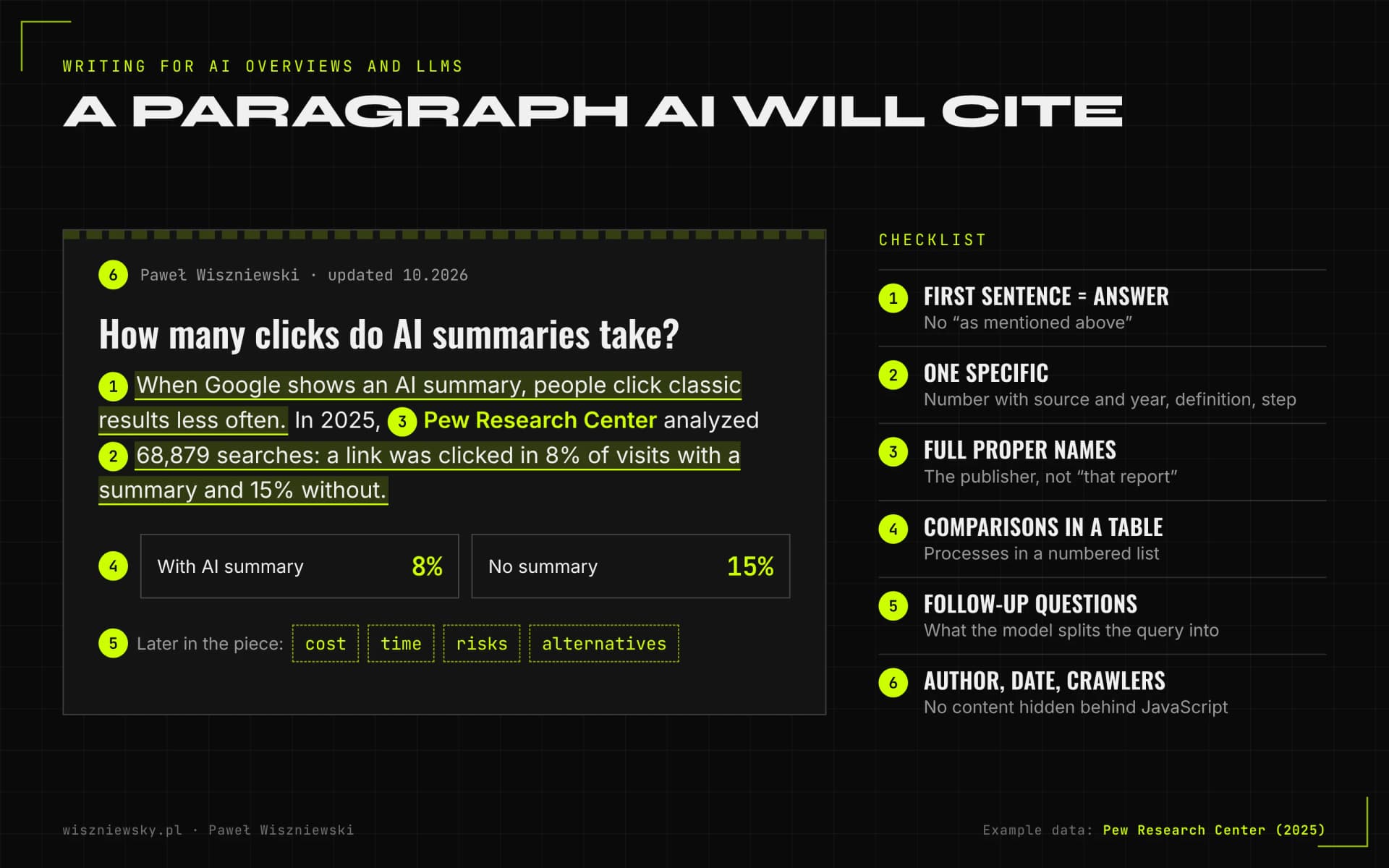
Checklist for a citable paragraph
The first sentence answers the heading's question without relying on earlier sections (“as mentioned above” doesn't work out of context).
The paragraph contains one specific: a number with source and year, a definition, a criterion or a procedure step.
Proper names are spelled out: the tool, the publisher, the country, not “this tool” or “that report”.
Comparisons go in a table and processes in a numbered list.
The piece covers follow-up questions a model may split the query into (cost, time, risks, alternatives).
The page shows an author and a last-updated date, and is accessible to crawlers (no content hidden behind JavaScript the bot won't render).
The citable-paragraph checklist applied to an example; example data: Pew Research Center (2025).
In its May 2025 post on succeeding in AI search, Google emphasizes unique, non-commodity content that satisfies longer, more specific questions. That's exactly why the first-hand element is mandatory in my briefs.
I show the technique of writing self-contained passages with examples in How to write content AI cites. If the goal is broader brand presence in assistant answers (mentions, entity, third-party sources), that's a job for an LLM citation strategy, not copywriting alone.
Content refresh, content audits and pruning
Refreshing existing content (historical optimization) is often the cheapest source of extra traffic, because the piece already has history, links and rankings. A content audit tells you which articles to refresh, which to merge and which to remove or redirect.
The most-quoted data on this comes from HubSpot. Pamela Vaughan reported (post updated in 2025) that 76% of HubSpot's monthly blog views and 92% of its monthly blog leads came from older posts, and that updated and republished articles gained 106% more organic search views on average. That's one very large company's data, so I treat it as an illustration of the mechanism, not a forecast for every blog.
One warning from Google's guidance: among the signs of search-engine-first content it lists changing page dates to make them seem fresh when the content hasn't substantially changed. A refresh has to mean new data, sections, examples or corrections, and only then a new date.
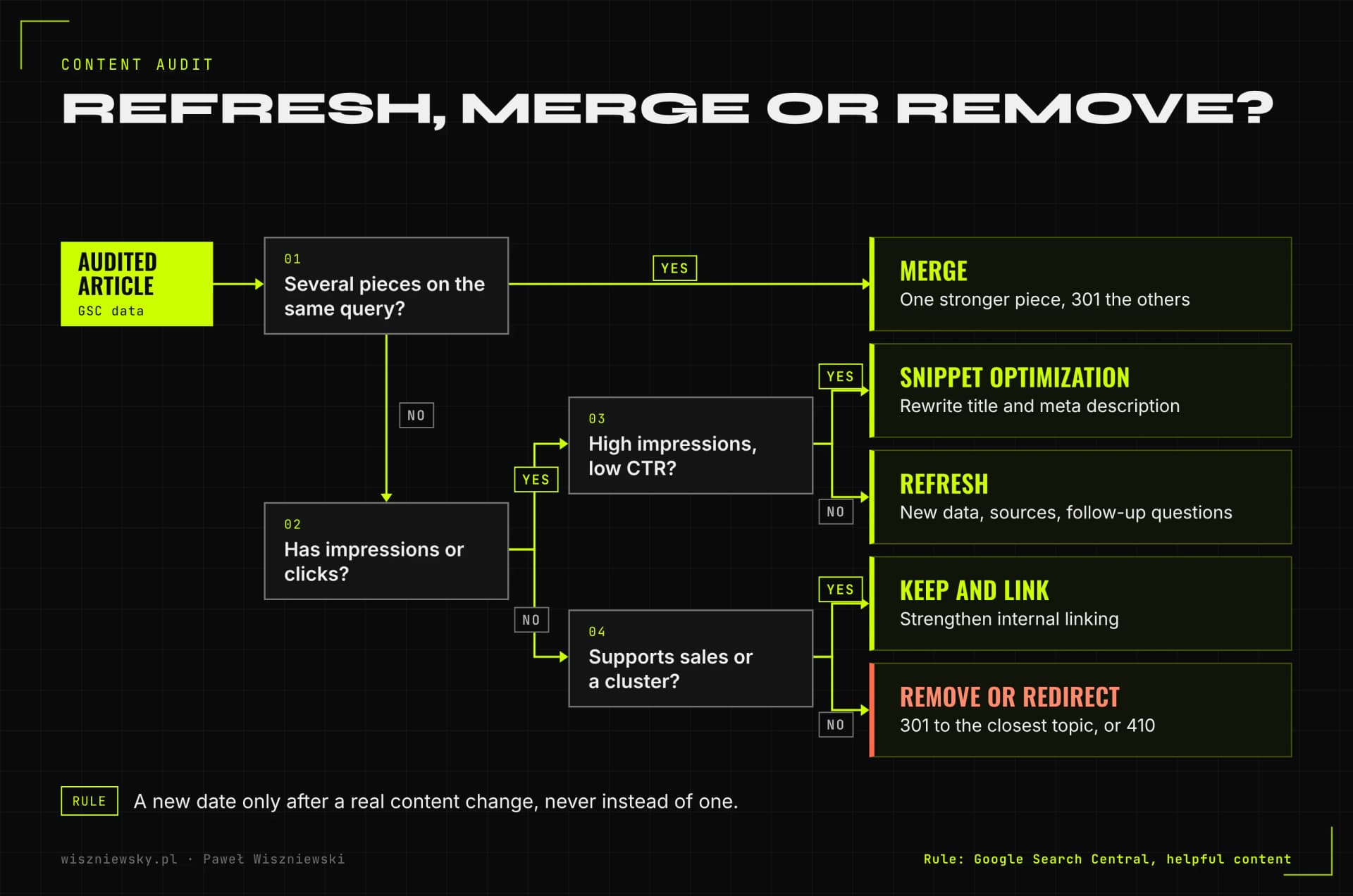
How I decide what to do with an article
What the data shows
Decision
What I actually do
Falling clicks, topic still in demand
Refresh
New data and sources, missing follow-up questions, a better title, links from newer pieces
Two or more pieces targeting the same query
Merge
Combine into one stronger piece and 301-redirect the other URLs
High impressions, low CTR
Snippet optimization
Rewrite the title and meta description, re-check intent match
No traffic, but supports sales or a cluster
Keep and link
Strengthen internal linking rather than deleting for the sake of it
No traffic, no links, outdated or off-offer
Remove or redirect
Redirect to the closest topic, or return 410 if there's no equivalent
The content audit decision table as a tree; a new page date only after a real content change, per Google's guidance.
Google also says that adding or removing lots of content just to make a site seem “fresh” won't help. Pruning makes sense when it tidies the site for readers, not as a quick growth hack. I walk through the full procedure in Content decay – when to update, merge or delete.
How often should a company blog publish?
There's no single right publishing frequency. What matters more than the number of posts is whether each one has a place in a cluster and whether you have the capacity to keep quality up and refresh older pieces.
Google's helpful content guidance says plainly that adding lots of new content just to make a site seem fresh won't help rankings. Consistency matters mainly for you and your audience: it lets you complete clusters in a reasonable time, build a habit among newsletter readers and plan refreshes.
How I set the pace
Small service business with one expert: it's usually better to publish less often, with an interview and real examples, than to post weekly without experience behind it.
B2B company with several services: I set a pace that completes the first cluster around the most important service within a few months, instead of starting five clusters at once.
Store or site with a wide range: more categories and seasonality justify a higher frequency, but maintenance and refresh costs grow too.
Always: part of the budget goes to refreshing existing posts, because older pieces lose rankings faster than people expect.
In blog management I work with 4–8 articles a month, but the number is agreed with the client based on the strategy, and in a month with a big refresh of older content there may be fewer new posts. Post count is not how I measure success.
Measuring content marketing results and ROI
I measure content on three levels: visibility (impressions and rankings), engagement (clicks, visits to the offer) and business (leads, sales, inquiries attributed to content). A fourth level matters more every year: presence in AI answers.
Level
Metric
Data source
Visibility
Impressions, average position, number of queries in the top 10
Google Search Console (Performance report)
Traffic
Search clicks, CTR, traffic from AI assistants
Search Console, GA4, server logs
Engagement
Article-to-offer-page visits, engagement time
GA4 (events, paths)
Business
Forms, inquiries, sales from sessions that started on content
GA4 + CRM
AI visibility
Citations and brand mentions across a fixed set of prompts
Regular prompt testing or monitoring tools
An important technical note from Google's documentation: traffic from AI Overviews and AI Mode is included in the Search Console Performance report under the “Web” search type, together with classic results. You can't see it separately there, so I assess the impact of AI features indirectly: through CTR changes at stable positions and growth in branded searches.
A simple way to calculate content ROI
I take the value of leads or sales attributed to content over a period, subtract the cost (strategy, writing, refreshes, team time) and divide by the cost. Honest attribution is the hard part: an article is rarely the last click before a purchase, so beyond direct conversions I look at assisted conversions and paths where content was the first touch. I usually do the first meaningful review after a few months, because rankings for lower-difficulty keywords typically appear 3–4 months after publishing, and 6–12 months for more competitive ones.
What SEO content costs depends mostly on scope: are you buying the text alone, the text with a brief and research, or the whole process including strategy, publishing, refreshes and reporting? A per-word rate tells you little if you don't know what's included.
Planning, writing, publishing in your CMS, internal linking, refreshing older posts, monthly report
What pushes the price up or down
Topic specialization: a piece on tax law or medicine needs far more research and review than a guide to office organization.
Expert interview: adds time, but it's the strongest differentiator a piece can have.
Number of languages and markets: I write each language version from scratch rather than machine-translating it.
Audit and refresh scope: a blog with several hundred posts needs a different effort than a new section with no history.
Extras: graphics, data tables, structured data, publishing in the CMS.
A third or further revision round on a single article costs €75 each. If you combine the strategy with writing or blog management, the strategy costs less because it's part of a larger project.
How to choose an SEO copywriter or content marketing agency
Judge a content provider by what they've already published and how they work, not by their claims. Ask for examples that still rank, check whether they have sources and a named author, and ask about the process from brief to publication.
Questions to ask before you hire
Where do your topics come from, and how do you check search intent?
What does your brief look like, and can I see an example?
How do you use AI, and who is responsible for fact-checking?
Where does experience come from in the piece: an interview with our expert, your own tests, data?
How do you plan internal links to our offer?
Are refreshes of older content included?
Which metrics do you report, and when will we evaluate results?
Who owns the rights to the content, and do I get it in an editable format?
Red flags
A guaranteed Google position by a specific date.
Pricing per word only, with no brief, research or sources.
Dozens of articles a month for the price of one expert piece, which usually means mass generation.
No published examples with an author, date and sources.
A report whose only metric is the number of posts published.
Link packages thrown in “for free” with the articles.
Copywriter, agency or SEO specialist – how they differ
Model
Strengths
Watch out for
Freelance copywriter
Flexible, often strong writing craft, lower entry cost
Strategy, SERP analysis, internal linking and measurement usually stay with you
Content marketing agency
High throughput, many people and formats at once
Writer rotation, risk of templated content, harder to reach the person who actually writes
SEO specialist who writes
Strategy, writing, on-page implementation and measurement in one pair of hands
Limited capacity, so very large programs need an extra team
In-house team
Best access to expert knowledge and the product
No time, and content often loses out to day-to-day work
No model is best for everyone. If you have an in-house expert who enjoys writing, a strategy and briefs are often enough. If nobody owns planning and measurement, a copywriter alone rarely is, because even very good articles without a plan and internal links don't add up to a cluster. I work as one person responsible for strategy, writing, implementation and reporting, and on topics that need industry knowledge I always involve the client's own expert.
The most common content marketing mistakes
Most failed content projects don't fail on the quality of individual pieces; they fail on missing planning, measurement and maintenance. Here are the mistakes I see most often, roughly from most to least expensive.
Content unrelated to the offer. Traffic grows, inquiries don't, because the articles lead to no service or product.
A plan built only from a keyword tool. It ignores customer questions and AI conversations, and targets broad terms where big publishers beat any company.
Writing to a word or character count. Google says it has no preferred length. Padding a piece to hit a target makes it worse for readers and harder to cite.
Rewriting the top 10. A piece that adds no new information has no reason to outrank the pages already above it.
Mass AI content without editing. That's precisely what the scaled content abuse policy describes.
No author, sources or date. Without them it's hard to build the trust Google calls the most important part of E-E-A-T.
Cannibalization. Several posts targeting the same intent, none of which wins.
No refreshes. New posts keep coming while old ones quietly lose rankings and carry outdated data.
Fake freshness. Changing the date without substantial changes is a signal Google explicitly warns against.
Counting posts instead of outcomes. Post count is a cost, not a result. Results are visibility, leads and citations.
If three or more of these sound familiar, it's usually best to start with a content audit and strategy rather than ordering more articles.
It's planning and producing content — articles, guides, comparisons — that answers your customers' questions and therefore earns traffic from Google and AI answers. Unlike a regular blog, every piece has a target keyword, search intent, a place in a topic cluster and a business goal.
How do you write content that AI will cite?
AI models pick passages that answer a question on their own. So I open sections with a direct 1–2 sentence answer, add specific data and sources, use tables and lists, show the author and update date, and cover the follow-up questions AI breaks a query into.
Does AI-assisted content hurt rankings?
Google judges quality, not the tool. The problem is mass-produced content with no added value (scaled content abuse). I use AI for research and drafts, but every article gets expert editing, first-hand experience, data and sources — which is what separates content that ranks from content that drops after updates.
How much do SEO articles and blog management cost?
An expert SEO article of 2,500–4,000 words starts from €500, a content marketing strategy from €1,500, and full blog management from €3,000 per month.
Can I order a single article?
Yes. You can order a single expert article, a content strategy or ongoing blog management. Single articles are a good way to test working together before a longer project.
Which languages do you write in?
Polish and English — just like my own blog, which I run in both languages.