BACK TO AI-AUTOMATION/ SERVICES / AI-AUTOMATION / LLM-FINE-TUNING

Fine-tuning & Custom LLM Models

Fine-tune Llama 3, Mistral, or Phi on your proprietary data with LoRA/QLoRA. Domain-specific model deployed on your infrastructure via vLLM API.

SERVICE DETAILS

I fine-tune open-source LLMs (Llama 3.1, Mistral 7B, Phi-3) on your proprietary data using LoRA/QLoRA for memory-efficient training on A100 GPUs. Fine-tuning produces a model that speaks your domain's language, follows your output format, and outperforms general-purpose LLMs on your specific task—at a fraction of the API cost of calling GPT-4 at scale. The trained model deploys on your infrastructure via vLLM or TGI, fully under your control.

> INVESTMENT:

from €3,000
const module = new ExecutionProtocol();

// Initializing llm-fine-tuning...
> Loading dependencies... OK
> Establishing connection... OK
> Ready for deployment... AWAITING_COMMAND

Key Benefits

Domain-specific model trained on your exact data—outperforms GPT-4 on your specific task at 10–100x lower inference cost per request.

LoRA/QLoRA training—fine-tune a 7B or 13B model on a single A100 GPU in hours, making custom LLMs economically viable for any scale.

Automated evaluation suite with task-specific metrics (accuracy, F1, BLEU, ROUGE, or custom rubrics) to measure improvement objectively.

Deployment-ready inference server (vLLM or TGI) with OpenAI-compatible API—drop-in replacement for your existing GPT-4 calls.

Full model ownership—your fine-tuned weights are yours, deployable on-premise or in your private cloud, with zero ongoing per-token API costs.

The Process

1

Data Preparation & Quality Review

I collect, clean, and format your data into instruction-following pairs. I review data quality and flag samples that would teach the model bad behaviors before training begins.

2

Training

I fine-tune the base model using LoRA on A100 GPUs with continuous loss monitoring, validation metrics, and early stopping to prevent overfitting.

3

Evaluation & Iteration

I test the model on a held-out test set using task-specific metrics, compare against the baseline, and iterate on hyperparameters or training data until targets are met.

4

Deployment & API Setup

I deploy the fine-tuned model on vLLM or TGI with an OpenAI-compatible REST API, configure rate limiting and authentication, and document the API for your engineering team.

FAQ

How much training data do I need?

Minimum 100–500 high-quality examples for instruction following or style adaptation. For complex reasoning tasks, 1,000–10,000 examples produce the best results. Quality always beats quantity—a smaller clean dataset outperforms a large noisy one.

When should I fine-tune instead of using RAG?

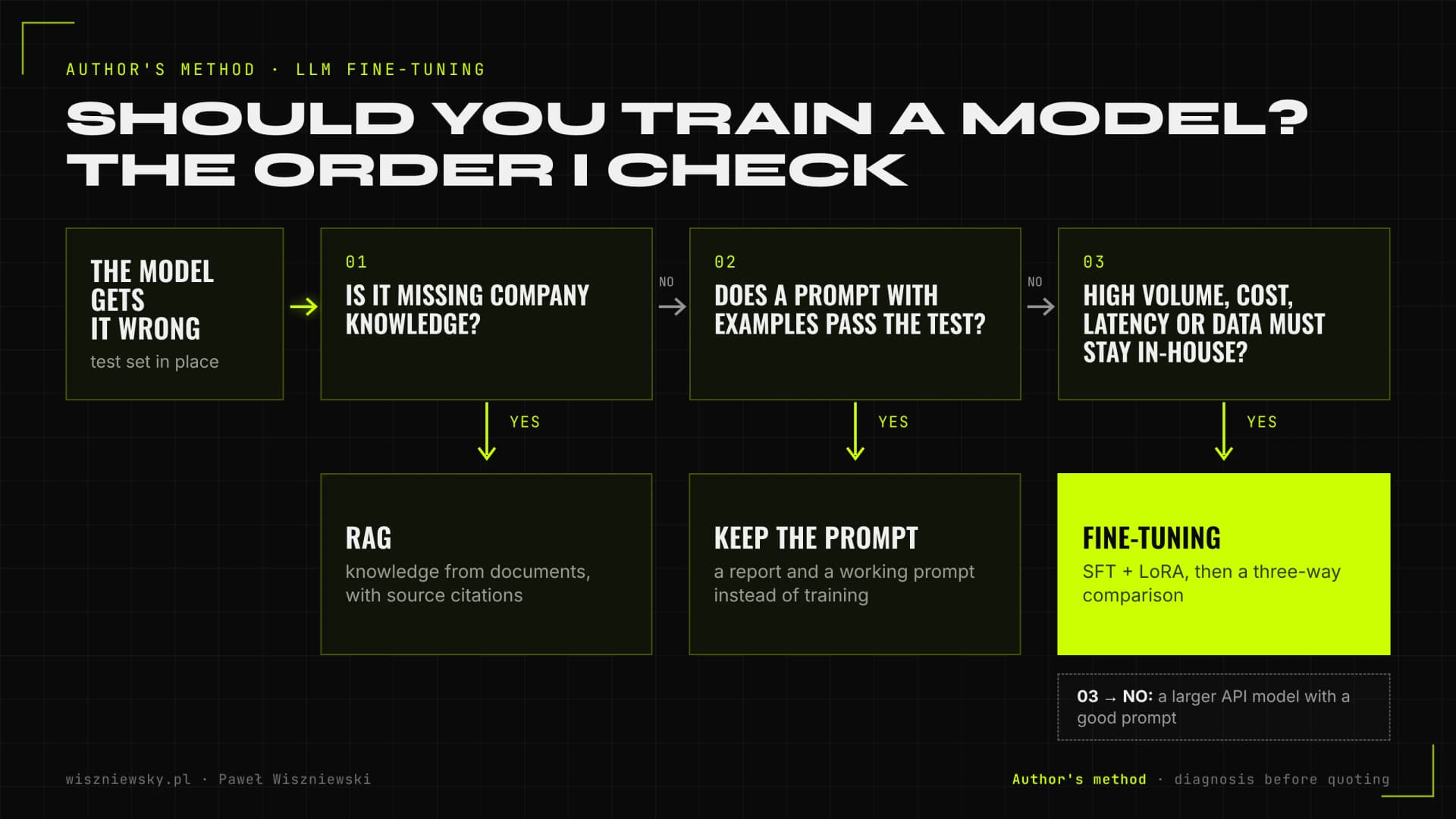
Fine-tune when you need the model to follow a specific output format, write in a specific style, or perform a task type the base model struggles with. Use RAG when you need accurate retrieval of specific facts from a knowledge base. Many production systems use both together.

How much cheaper is a fine-tuned local model vs GPT-4?

At scale, dramatically cheaper. A self-hosted 7B model on a single A100 handles 1,000+ tokens/second. At 1M tokens/day, the cost is ~€0.50/day in cloud GPU vs ~€30/day with GPT-4 API—a 60x cost reduction.

Got a project?

Terminate
Silence

Initiate protocol. Establish connection. Let's build something loud.

> WAITING_FOR_INPUT...