How to Write Content AI Cites - Retrieval Structure: Chunks, Direct Answers, Tables

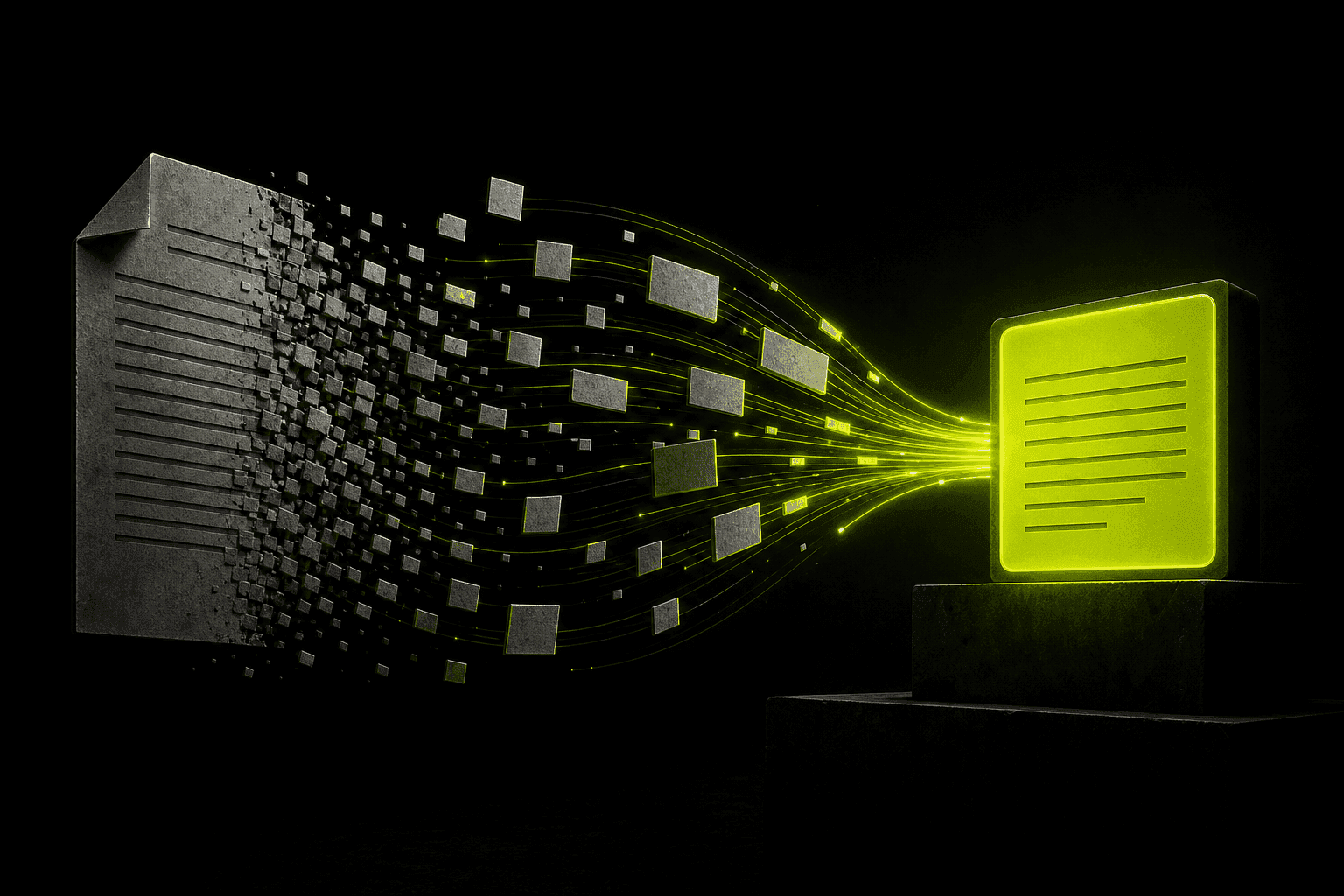
Most "writing for AI" guides stop at the slogan "create valuable content". True, but useless - because it skips the mechanism that decides citation. And the mechanism is concrete: AI models don't cite whole pages. They cite individual passages. Before ChatGPT or AI Overviews compose an answer, the retrieval system splits your content into fragments (chunks), turns each into a vector and picks the ones that semantically best match the question. What lands in the answer isn't "your article", but one or two paragraphs that won that match.
AI models don't cite pages - they cite individual passages. The retrieval system splits content into fragments (chunks), turns them into vectors and picks the ones that best answer the question. The takeaway for the writer: every paragraph must be a self-contained answer, ready to be quoted out of context. The complete editorial workshop: 5 rules, the anatomy of a paragraph, the formats AI loves, and a pre-publish checklist.
This changes the craft of writing more than any keyword advice. If the unit of citation is the paragraph, then every paragraph must be a self-contained answer, ready to be pulled out of context. Not "part of a larger whole that makes sense once you've read everything above" - but a closed unit the machine can quote in isolation from the rest. In this post I break that down into five editorial rules, show the anatomy of a paragraph that wins retrieval, and give a checklist to tick off before publishing.
How AI decides what to cite - retrieval in one paragraph
Before we get to writing, you have to understand the machine you're writing for. Retrieval works like this: the user's question is turned into a vector, indexed content is also vectors (cut into chunks), and the system picks the fragments whose vector is closest to the question's vector. The same mechanism I describe in the post on advanced RAG sits behind citations in AI search - except here your content is the corpus.
/// RETRIEVAL — THE UNIT OF CITATION IS THE CHUNK, NOT THE PAGE
That is why every paragraph must stand on its own
The practical takeaway is single and fundamental: you write for two readers at once - a human who reads the whole thing, and a machine that sees a single chunk without context. Good content for retrieval satisfies both: it reads smoothly top to bottom, and every fragment also stands on its own. Everything else in this post is techniques that make that possible.
One caveat so you don't overdo it: in January 2026 Google's Danny Sullivan said plainly on the Search Off the Record podcast that Google doesn't want content cut into "bite-sized chunks for LLMs" - it's a tactic aimed at systems rather than people, and in his view it won't survive as the algorithms improve. The principles in this post aren't about artificially chopping text up; they're about clear editing: the answer up front, one idea per paragraph, no dangling references. That kind of text helps a human as much as a machine - which is why it stays safe however the systems change.
Rule 1 - a direct answer in the first two sentences
Start every section with a direct answer, then develop it. That's the inverted pyramid: thesis first, context and nuance later. A model scanning a chunk for the answer finds it immediately - instead of digging through three sentences of intro before reaching the point.
In practice: if the heading reads "How much does implementing X cost", the first sentence should contain a price range, not "it depends on many factors". Add the nuance ("it depends on…") in the second or third sentence. This ordering is the simplest single change that raises citability - and it lowers bounce rate for humans too, because nobody likes waiting for the answer.
Rule 2 - the self-contained paragraph (chunk = quote)
Write paragraphs that make sense pulled out of context. This is the hardest and most important rule, because it breaks the habit of smooth narration. Phrases like "as I mentioned above", "it follows that", "let's return to our example" make a chunk useless to the machine - because they point to content the model doesn't see in that fragment.
[Thesis] One sentence with a direct answer, ideally with a number.[Support] 2-3 sentences explaining "why", with a specific.[Attribution] Source / date / boundary condition.--> Understandable without the previous and next paragraph.
The test is simple: copy any paragraph, paste it alone and check whether it still answers a question. If yes - it's a ready quote. If it needs "reading the rest" - rewrite it so it carries its own context (a subject instead of a pronoun, a specific instead of a reference).
Rule 3 - H2 headings phrased as questions
Phrase headings like a user's question or an unambiguous thesis. Retrieval matches a question to content, and the heading is the strongest signal of a chunk's topic. "How to measure AI traffic" beats "Analytics" every time, because it mirrors exactly what the user asks - and what the model looks for an answer to. It's also the natural output of question research and query fan-out: questions gathered in research become headings directly.
Rule 4 - the formats AI cites most readily
Not every format cites equally well. Models prefer content that's easy to extract as a closed unit: definitions, step lists, comparison tables, short TL;DRs. A wall of text can be factually correct but hard to "pull out" - so it loses to a fragment that is itself a ready structure.
/// THE FORMATS AI CITES MOST READILY
Closed units beat a wall of text
- Definition - a single "X is…" sentence. The most-cited format for "what is" questions.
- Step list - for procedural intent ("how to do X"). Numbered, each step self-standing.
- Comparison table - for "X vs Y". The model pulls a row as a ready answer.
- TL;DR / summary - a few sentences summarizing the section; a convenient chunk to quote.
- Stat with attribution - number + source + date. More on that in rule 5.
This doesn't mean writing only in bullets. It's about deliberately interleaving prose with structures - where a question has a natural format (list, table, definition), use it instead of a rambling paragraph.
Rule 5 - hard data with attribution
Back claims with numbers and sources - it's both a quality signal for humans and a "handle" for the machine. A model more readily cites a passage with a concrete figure ("conversion ~4.4× higher", "TTFB under 200 ms") than a generality ("much better"). Attribution (who, when, in which study) adds credibility and plugs into E-E-A-T, which models treat as a trust signal for a source.
Boundary rule: don't invent numbers for effect. False precision is worse than none - for the reader and for the reputation of the domain, which models build on factual consistency. Give data you can defend with a link.
The anatomy of a paragraph that wins retrieval
Let's put it in one comparison. The same fact, two ways of writing it - one loses retrieval, the other wins:
/// SAME FACT — LOSES VS WINS RETRIEVAL
As we mentioned earlier, the topic is complex. Many factors affect the result and all are worth considering, which we cover more below.
Server response time (TTFB) should be under 200 ms — Perplexity and AI Overviews favor fast pages when picking sources to cite.
The difference isn't "better style". The "after" version is self-contained (points to nothing), opens with a thesis, contains a number and a boundary condition, and is understandable pulled out of the text. That's exactly what retrieval selects for citation - and, incidentally, what a human understands faster.
What to avoid - patterns that break citability
- Walls of text without headings or paragraphs - there's nothing to extract as a chunk.
- Pronouns and references without context ("it", "he", "as above") - they kill self-containment.
- A clickbait heading with no answer in the body - the model won't find a fact that isn't there.
- Keyword stuffing - cramming a phrase doesn't help retrieval, which works on meaning (vectors), not word matching.
- A buried answer - the point in the section's last paragraph instead of the first.
- Purely generic content - without your own data, examples and experience there's nothing to stand out with; it's also a risk against Google's policy on AI content.
How it ties into E-E-A-T and topical authority
The chunk craft works only on a foundation of trust. The model first decides which sources it trusts (E-E-A-T signals, domain authority, factual consistency), and only among those picks the best chunk. That's why a single brilliantly written paragraph on a weak domain loses to an average one on an authority domain.
Hence the order of investment: topical authority and E-E-A-T build the right of entry into the citation pool, and the techniques in this post decide which of your paragraphs from that pool gets picked. One without the other isn't enough - which is why channel strategy (citations in ChatGPT, AI Overviews) has to go hand in hand with editorial craft.
Editorial work is completed by the machine-readable layer: Schema.org structured data (FAQPage, Article) gives models an explicit description of what your content already says. It's a complement, not a replacement - a well-written chunk gets cited even without markup, but markup makes it easier for the machine to understand the structure.
The editorial checklist before publishing
Tick off before every publish:
- 1.Every section opens with a direct answer in the first two sentences.
- 2.H2 headings are questions or unambiguous theses (not a single word).
- 3.The pull test: a random paragraph copied alone still answers a question.
- 4.Zero dangling references ("as above", "it", "he") without context in the paragraph.
- 5.Format matches intent: comparison → table, procedure → list, definition → one sentence.
- 6.Hard data with attribution on key claims - number, source, date.
- 7.A TL;DR or summary in longer sections as a ready chunk.
- 8.The heading keeps its promise - the answer is actually in the body.
- 9.E-E-A-T signals: author, update date, external sources.
---
I teach writing content for AI citations - from chunk anatomy to an editorial checklist - as part of AI optimization (GEO) and SEO content marketing. We go through this whole workshop in the SEO & GEO course. Get in touch - I'll rewrite your key pages so every paragraph wins retrieval.
Worth reading next:
- Image SEO in the AI era - Google Lens and graphics models cite
- AI translation and content localization
- How to get cited in ChatGPT - an LLM visibility strategy
- Google AI Overviews and AI Mode - how to optimize your page so AI cites you
- Advanced RAG - chunking, hybrid search and reranking
- Keyword research in the AI era - query fan-out
/// RELATED_SERVICES
Need these concepts implemented? Explore the services related to this topic.
GEO – AI Search Optimization
Generative Engine Optimization (GEO) gets your brand into AI answers — ChatGPT, Google AI Overviews and AI Mode, Gemini, Perplexity and Copilot. I make AI know your company, cite your site and recommend you.
View serviceServiceContent Marketing & SEO
Content marketing for SEO and GEO: content strategy, expert articles and blog management. Content that ranks in Google, gets cited in AI answers and turns readers into customers.
View service/// SOURCES
- 01Google - AI features and your website (AI Overviews, AI Mode)
- 02Google Search Central - Creating helpful, reliable, people-first content
- 03Anthropic - Introducing Contextual Retrieval (chunks, embeddings, retrieval)
- 04OpenAI - Introducing ChatGPT search
- 05Perplexity - crawler and citation documentation
/// RELATED_RECORDS
Ecommerce Faceted Navigation and SEO - Which Filters to Index and Which to Block (noindex, canonical, robots.txt)
Which ecommerce filters to index and which to block: a rule with thresholds, noindex vs canonical vs robots.txt vs nofollow in one table, a check of filters in 11 Polish stores, Shopify, WooCommerce, PrestaShop and IdoSell defaults, URL counts at two scales, robots.txt rules, a script and two pitfalls.
Ecommerce Keyword Research - How to Map Queries to Categories, Filters and Products
How to do ecommerce keyword research and map queries to categories, filters, product pages and guides: a mapping rule with thresholds, a keyword map from 1,109 Google suggestions and real store product counts, Search Console, Keyword Planner, Senuto and Ahrefs with prices, a sheet template and a cannibalisation script.
Ecommerce SEO Strategy - a 3, 6 and 12-Month Roadmap
How to build an ecommerce SEO strategy ranked by revenue: a one-day diagnosis from Search Console, a priority matrix, a 3, 6 and 12-month roadmap with KPIs, SEO vs Google Ads cost at two scales, an audit of product data in 26 Polish online stores and a quick-wins script.

Signal received?
Terminate
Silence
Initiate protocol. Establish connection. Let's build something loud.